
The Lord of the Rings

Five Reasons to Read J.R.R. Tolkien's The Lord of the Rings
This multi-volume work begins with a loosely connected prelude work called The Hobbit, followed by a tight trilogy consisting of: The Fellowship of the Ring, The Two Towers, and The Return of the King. The trilogy concerns the mission of Frodo Baggins who must destroy a magic ring whose powers are great and attractive, but whose tendency (the ring's tendency) is ultimately obedient to evil. His companions, his travails, and his decisions make a profound tale. I will give away no more of the plot, but only tell you that this is a great read if you like poetry, fantasy, theology, philosophy, or walking.
1. First of all, Tolkien is truly a master of the English language. His sense of the music of English is deftly put to use in a series of characters whose language spans everything from the simple stateliness of Tom Bombadil, (who always speaks in iambic pentameter, not only when the verses are written out so), to the uneducated and plain-spoken Gaffer, Frodo's gardener. In between are all sorts of characters who speak different kinds of prose and poetry, and out on the rim are those with nothing but harshness of heart and language. Tolkien's words are so musical and well-chosen, they are a joy to read and hear.
2. But music is not enough. One wants an author of fiction, even of fantasy, to have a thorough imagination so that his world comes to life. One dislikes any reminder that this world is just a box of paper; one wants the sub-creation to work. And in making the fantasy work, one thing above all cannot change from this world to the fantasy -- the effect of goodness and evil within and among the hearts of persons. Water may flow uphill, and animals may talk, but character development must be true to life. The author must understand human nature, even if he chooses to give it to animals or dwarfs or elves -- or to hobbits! And he must love his characters so that they may live, even as God loves us and gives us life. Tolkien has a thorough imagination and a loving fullness of human wisdom.
3. What of theology? Shortly after reading the Lord of the Rings, I was directed to read Watership Down, a story about a prophetic rabbit who was always falling into a trance before giving his greatest prophecies. But St. Paul tells us that prophets have control over the spirit of prophecy. True prophecy is never in a trance. Tolkien would not have made such a theological error. His good characters always act on their own free will, tempered and developed over time and suffering. They may have unusual gifts, but goodness is always the fruit of generous effort and long patience. In a most astonishing way, Catholic theology comes to life in Tolkien, not in a self-conscious manner, as if he were writing an allegory, but simply and deeply. Catholic readers will not fail to feel the presence of Mary in these volumes (I will not say how, but you will see it). And students of moral theology must marvel at the combination of weakness, wisdom, and mercy-responsive mercy which resolves the plot.
4. Not only a theologian, Tolkien is a master philosopher. In the persons of Gandalf, Strider, and Galadriel especially, but in many other ways, he reflects on the path of wisdom in confronting evil with humility and a sense of service. The folly of attempting to fight evil with evil -- or even with mere magic, a tool ultimately shaped in darkness -- is clearly portrayed.
As long as we are talking about confronting evil, there is a side issue that must be considered. Some have suggested that Tolkien's work is a metaphor on the issues of the Second World War. It needs to be clearly understood that any work of serious value may be read on several levels -- simply as a good story or beyond that, as an allegory of one kind or another. But a truly creative work is not self-consciously allegorical; its allegorical or metaphoric power flows from its creative origin in a heart that lives on many levels -- in the author's own created world and also in the real world of the author. Tolkien clearly stated that his work was not about the War; it is just a story. Still, if you can't see the metaphor for various world events, you must not have studied history. Nor can you have studied the human heart if you cannot see a metaphor for the service of God. But these truths are inside the fullness of the story, which is just a plain good story. No metaphor may be permitted as an intruder in its landscape.
5. So, finally, what's this about Tolkien and walking? Tolkien walked. He walked for hours and hours, in all sorts of weather. And when you read this travel story, you will understand that he really did walk, and knew what it felt like to be tired, exhilarated, more or less lost, tangled, wet, and glad at last for food and song, -- and beer. Not only that, but if you know enough about the stars to keep track of them and let them give you directions, you will quickly learn that so did Tolkien. His constellations are the very constellations that burn in the English sky, season by season, no mere stick-ons in an obligatory, painted sky. They are thoroughly consistent. A walker will recognize this book as written by one from his fellowship.
In The Tolkien Reader, there is a little essay "On Fairy Stories" in which Tolkien explains the theology of creativity as he understands it. No discussion of Christian fiction is complete without this little gem, a flawless discussion of creativity among the sons of the Creator. Tolkien is one of the towering literary figures of the 20th century. We have read his volumes three times, as a family, since our first children were six and seven, and once before that in the first year of our marriage. The story is richer every time. Like a mirror of scripture, it has become a mine of wisdom and imagery for what we do, whom we meet, and how we conduct our lives. Wonderful, wonderful, wonderful, and twice more wonderful.

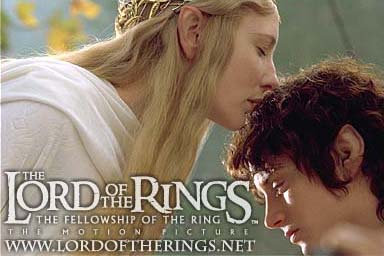 Although I think that watching the movie will lead many people to pick up the book, I think it best to read the book before seeing the movie so that one's first impressions in the imagination come directly from the book rather than another's re-creation of it. Parents, in particular, might do well to read the book before seeing the movie because, particularly if they aren't regular movie-goers, I think the violence and intensity wouldn't make much sense without being familiar with the plot and themes.
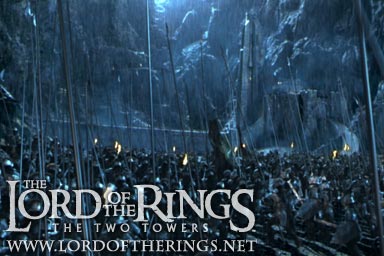 There are several general things that I think remarkable about this phenomenal task of creating movies from Tolkien's beloved stories. (For those who really like movies, as my husband and I do, the Fellowship of the Ring DVD is interesting partly because of the extensive commentaries, interviews, photo galleries, etc. which provide details on both how the movies were made and what the movie-makers were trying to do.) Many of the people most intimately involved in the movie production have read the story countless times. Faithfulness to Tolkien was a major priority for them. They have referred to the books over and over again, not just in writing the screenplay, but in how the actors portray their parts. A great deal of attention and thought has gone into many, many details of the story. For example, recordings exist of Tolkien himself reading parts of his stories. Ian McKellan, who plays Gandalf, based his portrayal of Gandalf, in voice tone and expression, on these recordings. Christopher Lee, who plays Saruman, has read the books every year for decades. In addition to his excellent portrayal of the villain, he discussed parts of the book with the other actors to be sure that certain details weren't left out. The two artists most famous for illustrating editions of the Lord of the Rings, Alan Lee and John Howe, worked as art consultants on the sets and miniatures. Peter Jackson, the director, collaborated with hundreds of cast members, production members and Tolkien fans to fine tune the script and the ideas. We had a local news story here in Wisconsin about a man who was, as a hobby, an expert in Tolkien's fictional languages. He offered his services to Peter Jackson and was invited to play a part in the production. I've never heard of any project done in this kind of fashion and the final result is truly reflective of the incredible effort and labor of love that went into making these movies.