Math Elementary

Why mental math?

The authors state that "two common problems found in all levels of math classes are the inconsistencies of math terminology and the lack of self confidence in students when answering simple math questions." This series of books was written to address these problems and to provide practice in solving math problems both mentally and quickly. The use of terminology from standardized tests is also beneficial; my children have been confused by different terms even when they understood the concepts well. To a first-grader, "add" doesn't always mean the same thing as "plus".

This series of math supplements is available for grades 1 to 5, and is designed to be used each day of the school year for the first 10 minutes of math class. These courses provide practice and review, but no direct instruction; this is not a complete math program. In addition, these courses require the active participation of the teacher; Mental Math cannot be considered an independent program. From my perspective, this is a particular strength for homeschoolers. Many students work on their math independently, and these courses give the homeschool teacher an opportunity to casually and regularly assess the progress of their student. First graders begin in the second semester of the school year while the other grades start at the beginning of the school year. With the exception of the first grade book, each book begins by reviewing material from the previous grade level.

The instructions for each book clearly state that the teacher is to read the questions to the student twice and then to go on to the next question. The student is not permitted to ask questions, to talk, or to request that the problem be repeated. The student is also not permitted to use scratch paper. Because these courses were designed for the classroom, the student is instructed to write the answer. In a homeschool setting, the answers could be given orally as well.

The only confusing part of the program to me was the numbering system used on the daily worksheets. Each sheet is coded with the grade level and the types of problems being practiced. A key is provided to explain it, and the system makes sense, but I floundered a bit until I developed some experience. This is done to provide flexibility; the program does not have to be used in a specific order. My children have enjoyed these books, and they look forward to showing me just how much they have learned. Sometimes they are quicker to find a solution than I am.

Reviewed by S.K.

Cuisenaire Rods

Subject(s): 
Grade / Age level: 
Resource Type: 
Review: 

When I first researched homeschooling products and resources, I spent quite some time looking at different math manipulatives. For one thing, there are so many, and for another, I love math. I remember wondering whether these colored rods would really be worth purchasing, as they are on the expensive side. And my math education, as far as I could remember, had been accomplished without a single manipulative.

Then I found Miquon Math, and immediately liked the concept. Miquon uses Cuisenaire rods as their primary manipulative, so with some trepidation, I acquired a starter set.

I needn't have worried. The rods made math so much easier for my very concrete, hands-on son to grasp. That was almost a decade ago, and now my youngest enjoys doing his math with the rods.

The concept behind the rods is simple. Each rod color is a specific length, representing a particular number of units. White rods are "units" 1cm long, reds are twice as long and represent the number 2, and so forth. A starter set comes with several of each rod from 1-10, with more of the smaller rods.

The child then uses the rods in combination to visualize basic math concepts. Perhaps it is obvious that addition can be modeled using such rods, simply by putting them end to end in a "train." However, they can also be used for subtraction, multiplication, and division, and even fractions, areas, and more. Using the Cuisenaire rods, quite young children can understand what multiplication means and can work out simple problems.

We actually own a lot of math manipulatives, including both store-bought and homemade ones, but these are the ones I use the most.

Publisher: 
ETA/Cuisenaire
Review Date: 
5-5-2009
Reviewed by: 
TitleSort: 
Cuisenaire Rods

Great Estimations

Author(s): 
Bruce Goldstone
Subject(s): 
Grade / Age level: 
Resource Type: 
Copyright: 
2006
Review: 

Great Estimations is an eye-popping introduction to the art of, or perhaps the science of, mathematical estimation. Bold colors and clear photographs are used to demonstrate simple, concrete approaches to an abstract mathematical concept. Penguins and pennies. Jelly beans and elbow macaroni. Plastic shoes and paper clips. Practice the techniques for eye training and the methods for clump counting and box counting. Then you can estimate how many of them there are - maybe before your young student does! If you get stuck, use the hint box at the bottom of the page for suggested methods, answers, and applications. This is a winning addition to your living math bookshelf!

Publisher: 
Henry Holt and Company
Binding: 
Sewn Hardcover
Number of pages: 
32 pages
Review Date: 
3-17-2007
Reviewed by: 
TitleSort: 
Great Estimations

Math Talk

mathematical ideas in poems for two voices
Book cover: 'Math Talk: mathematical ideas in poems for two voices'
Author(s): 
Theoni Pappas
Subject(s): 
ISBN: 
933 174 748
Resource Type: 
Copyright: 
1999
Review: 

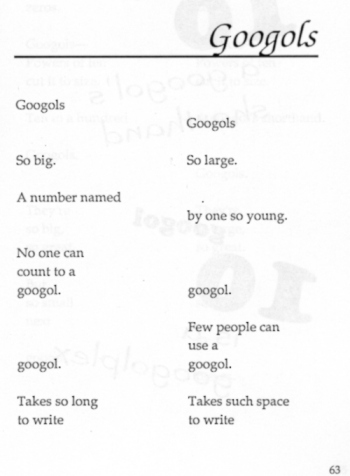
I have long been a fan of the poems for two voices books by Paul Fleischman. This book puts a twist on the idea by covering math topics in poems. It's a really unique and engaging way to memorize a math concept, reciting it as a poem. A poem for two voices is a poem recited by two people where sometimes the same words are said in tandem, sometimes alternately, and sometimes, the speakers speak at the same time saying different things.

Here is a sample of part of a poem from the book: (The first column is the first speaker and the second column, the second - shown smaller than actual size)

Some of the math concepts in the poems are fairly simple ideas that would pertain to a grammar school student, however most of the ideas are for middle schoolers or high schoolers. There were a few math concepts I had never heard of, such as fractals, (the geometry of nature), Fibonacci numbers (adding the last two numbers in a series to give the next number), and Mobius strips (circular strip with a twist in it).

While you don't learn everything you need to know about the math concepts in the poems, you get an introduction to the idea and the basic or interesting facts. For tessellations, the reader learns that not all figures tessellate; for triangles, the reader learns that the angles in the figure must equal 180 degrees. Some of the accompanying illustrations are also instructive. I could not have visualized the Mobius strip without the drawing of it.

This is a fun way to talk about these concepts. Trying to say the poems as a team takes a lot of concentration and brings a lot of laughs along the way. The book would make a great addition to a living math program or be a nice break from a formal textbook program.

Recommended for grades 4-12

Publisher: 
Wide World Publishing/Tetra
Binding: 
Softcover
Number of pages: 
71 pages
Review Date: 
6-21-05
Reviewed by: 
TitleSort: 
Math Talk

Math-U-See

Book cover: 'Math-U-See'
Author(s): 
Steve Demme
Subject(s): 
Grade / Age level: 
Resource Type: 
Copyright: 
1998
Review: 

Math-U-See is a fairly new Math program, designed especially for homeschoolers, which runs from Kindergarten all the way through high school. The author is a former high school Math teacher who has attempted to balance a solid conceptual understanding of math with enough practice to let it "sink in." The program consists of a student text (workbook format), a teacher's manual, and optional practice sheets, special Math-U-See blocks and a teacher training DVD. I am very impressed with this program. The author does a fine job of allowing the students to become well aquainted with using numbers. I found math concepts very easy to explain to my daughter with the use of the very clever manipulatives (which might be thought of as a cross between "Base-ten Blocks" and Cuisinaire Rods). I was particularly impressed with how clearly place value is taught and how thoughtfully the child is prepared for future lessons (e.g. early on in addition, the child starts doing simple "solve for the unknown" problems in preparation for subtraction). Other skills learned include telling time, measurement and a heavy emphasis on skip counting (in preparation for future multiplication and factoring). My only complaint is that some of the material is contained only in the teacher's manual (I can imagine that this might have been done intentionally to force the parent to follow along in the teacher's manual rather than letting the child work entirely on their own. The author demonstrates how each concept works on the DVD so that the parent may more confidently teach the concept to the child.

Over the years we haven't always used Math-U-See as our primary Math text, but we have always found the DVDs and blocks useful no matter what we were using.

Publisher: 
Math-U-See Foundation
Review Date: 
7-7-05
Reviewed by: 
TitleSort: 
Math-U-See

Miquon Math

Author(s): 
Lore Rasmussen
Subject(s): 
Grade / Age level: 
Resource Type: 
Review: 

Miquon Math is a series of 6 math workbooks designed to be used in 1st through 3rd grade. They are named by color and not by grade level, so that an older child can use them without feeling they are "remedial". The workbooks are designed to be used with Cuisenaire Rods. I have had the books for a couple of years but have only started using them this year as a supplement for my 3rd and 4th graders. I hesitated using them before because they have an unusual format -- the pages don't necessarily have to be done in order, and are grouped by topic rather than in sequential chapters. Multiplication is introduced along with addition in first grade, and advanced concepts such as squared numbers and pre-algebra are introduced through use of concrete manipulatives. However, my 3rd grader now says she "loves this kind of math" and both the children have shown a better grasp of what numbers mean since they have started using the books. We've discovered that when the manipulatives come out and are used to illustrate concepts, the "littlies" want to join in. My 5yo was watching carefully as my 8yo tried to figure out the square of 4, and suddenly announced "It's 16!" He was so proud of himself!
I have ordered the Orange Book (the first one in the series) to start with my almost 6 year old. After completing the Miquon Series, a child can go straight into Saxon Math 54 or 65.

Publisher: 
Key Curriculum Press
Review Date: 
1999
Reviewed by: 
TitleSort: 
Miquon Math

My First Number Book

Book cover: 'My First Number Book'
Author(s): 
Marie Heinst
Subject(s): 
Grade / Age level: 
Copyright: 
1999
Review: 

This delightful picture book introduces many math concepts to preschoolers. We have enjoyed working through concepts such as counting, matching, sorting, sets, and sequencing. The illustrated pages make it fun for my son to discover more, less, and equal, addition and subtraction, geometric solids, and more. For example, matching begins with familiar matching pairs such as handprints, shoes, and earrings. Ideas of more or less begin to take shape as the child ponders such questions as, "Are there enough collars for the puppies?"

Sometimes your child may surprise you with an unexpected answer; for example, on a page showing five puppies and three doghouses, my son confidently assured me that "each puppy can have its own house." When I asked him how, he said, "The puppies that are brothers share a house." To him, sharing was not incompatible with the idea of being its "own" house.

The book also includes a few games. My son's favorite is a simple game involving counting backward or forward according to the roll of the die and directions on specific spaces.

Numbers are incorporated into the book in other clever ways; for example, each page number is illustrated by a string of the appropriate number of items. See if your child notices. Near the end is a section of BIG numbers, which all my children have enjoyed.

This book does an unusually good job of combining attractive photographs with questions designed to lead the child to discover math concepts.

Publisher: 
DK Publishing
Binding: 
Sewn Hardcover
Number of pages: 
48 pages
Review Date: 
5-5-2009
Reviewed by: 
TitleSort: 
My First Number Book

Saxon 2

Author(s): 
Nancy Larson
Subject(s): 
Grade / Age level: 
Resource Type: 
Copyright: 
1994
Review: 

Saxon 2 covers the arithmetic topics of addition and subtraction of one and two digit numbers and simple multiplication and division as well as the related topics of patterns, graphing, time, measurement, money, geometry and estimating. Although it uses manipulatives it is not a "manipulatives-based" program.

Each day's lesson begins with oral exercises called "The Meeting" during which use of a calendar, counting, time, money, and patterns are practiced. The actual lessons follow and are completely scripted in the teachers edition. They are designed for four days of new material and one day of review. Math facts are practiced every day as well, using flash cards provided with the kit and fact sheet drills in the workbook.

The beauty of Saxon is repetition. Concepts are introduced and then reinforced over and over again. In Saxon 2 there are games, art projects and physical activites as part of the lessons which provide a break from strict pencil and paper work. My children had been doing a strictly manipulative based math program previously so I thought they wouldn't like Saxon, but they love it. I believe it is because of the variety of activities.

One drawback to Saxon is the price which is close to $100.00 for the homestudy kit. The kit includes a teacher's manual, workbook, meeting book and cardboard manipulatives and flash cards. It can be found in discount catalogs or used from fellow homeschoolers. It requires a set of manipulatives which can be purchased separately at teacher supply stores or as a kit from the source given by Saxon and various homeschool catalogs.

Publisher: 
Saxon Publishing
Review Date: 
1999
Reviewed by: 
TitleSort: 
Saxon 2

Saxon Math

Author(s): 
John Saxon
Subject(s): 
Grade / Age level: 
Resource Type: 
Review: 

I have friends who have used Saxon for years and are very, very happy with it. Saxon's circular pattern and constant review is exactly what they love about it. However, it was this circular pattern that caused problems for us. The way Saxon works (someone please correct me if I'm off base here) is that it introduces a new concept in increments, the child works a set of problems that teach a new concept, then spends the rest of the lesson reviewing previously learned concepts. The next day, another new concept may be introduced with a few problems and then review of previous concepts including a problem or two from yesterday. Then further on in the book the first concept learned will be expanded upon and the review continues from there.

The reason Saxon didn't work for us was that it didn't spend enough time on a concept for her to fully grasp it and once she had mastered a concept the constant daily review irritated her. So, we had many days with either a totally frustrated child that thought she was dumb because she "didn't get it" or grumpy because she already knew how to do it and didn't see the value of doing it again and again. As you can see it could very well be a personality thing. We discovered that Torie learns better in "chunks", i.e.. learn a concept, work on it until it is mastered, then move on.

Additional notes: 

All the basic problem solving material and techniques are there - this is the whole rationale for the series. What it lacks is the founding principle that math is knowledge which is worthy of possessing for its own sake. Thus, it will fall short in depth. Practically speaking, it WILL prepare them for standardized tests - best at the lower grades.
(Michael Van Hecke - headmaster of St. Augustine Academy in Ventura, California, and homeschool father

Review Date: 
1999
TitleSort: 
Saxon Math

Schiller Math

Kit 1 for 4-8 year olds
Schiller Math Kit
Author(s): 
Larry Schiller
Subject(s): 
Grade / Age level: 
Review: 

This is an impressive, complete, scripted, Montessori-based Math program. Though it's not 100% purist Montessori (for example, some of the manipulatives will provide changes in color and shape at the same time, where Montessori was very fussy about only working with one attribute at a time), I think it does a really nice job of incorporating her most critical ideas. I think it's a perfect fit for those who want to start with something really well-organized (such as those who appreciate Saxon's completeness), but wish to aim for a more holistic approach or are working with a child that might be struggling with learning challenges or unconventional learning styles. I was particularly impressed with how the materials helps the parent determine how much the child will need to work in each area. Note: The scripted lines are included in the workbooks.

The books are workbook in format, but carefully make use of (and include explanations of) the Montessori philosophy throughout.

The kit includes workbooks, answer guides and manipulatives for grades K-4. The manipulatives are quite nice for "inexpensive" products (in comparison with those you can purchase for starting up a Montessori school). The bulk of the expense of the kit is for the books. Some of the manipulatives are inexpensive and readily available at teacher supply stores, where others are custom made for Schiller, like the "numbers bank", a lovely set of numbers in a wooden box (with sliding lid) that helps teach place value (my kids have really enjoyed using this!).

Scripted programs are not for everyone. They tell you exactly what to say at each point, which are helpful for some parents and annoying to others.

The best way to more thoroughly understand the program offered here is to visit their website where you can view pdfs of all the materials included, sample pages and more: SchillerMath.com

While this particular kit is intended for grades K-3, Schiller also has Math materials available for grades 4-7.

The K-3 kit is quite expensive (about $500), but includes a large box of books and materials (including a CD of math songs to accompany the program), plus 5 years of free downloads of consumables - to cover younger siblings. Keep an eye on their website for discounts and sales which seem to come up frequently.

Binding: 
Spiralbound
Perspective: 
Catholic
Review Date: 
10-29-2011
Reviewed by: 
TitleSort: 
Schiller Math