Literature

Frost on the Windowpane

Author(s): 
Christine Coley
Margot Davidson
Subject(s): 
Resource Type: 
Copyright: 
2002
Review: 

"Art and Composition Activities for Little House in the Big Woods by Laura Ingalls Wilder"

This deceptively-simple supplement to Little House in the Big Woods packs a wallop of meaningful content into easy and fun art and writing assignments. Not only will it will help children understand the book better, but it provides full-fledged lessons in art appreciation and composition.

The bulk of this resource consists of "chapter activities" which generally include three segments:

1. "Discussion" - Simple discussion questions are intended to start conversations about the book and invite the child to compare their own life with Laura's life. Discussions such as these are excellent for reading comprehension, thinking skills, etc.

2. "Writing" - Assignments are simple and related to the story, suc as writing about a special gift you have received for Christmas. The unique thing about these assignments is that they each have a corresponding worksheet in the back of the booklet that help the child to collect his thoughts, organize ideas, and in the process learn to become a better writer.

3. "Art" - The simple art projects employ a process called "discipline based art education". Rather than simply assign a drawing based on the story, the child is presented with a famous work of art (such as Van Gogh's Bedroom by Vincent Van Gogh) which provides a good example of an artistic feature that they will use in their assignment. In the case of Van Gogh's Bedroom, the child sees how the artist made the picture three dimensional (simple instructions are included) and replicates that aspect of the painting into their own artwork (in this case a drawing of the attic). What a great way to apply art appreciation to the child's work (reminiscent of the Suzuki method in music). All of the artwork can be viewed online (websites are included) or purchased in postcard form from the publisher.

Rounding out the booklet are...

Activities before Reading, which includes projects about the four seasons and about the geography of Wisconsin

Activities after Reading, which includes instructions for making little books relating to the story, a three-dimensional diorama of a scene from the story, planning an evening "Little House Style", comparing the child's life to Laura's and some simple recipes.

I"m very pleased to recommend this very well-thought-out booklet as a worthwhile, family-friendly resource. Suitable for a wide age range, especially grades one thru five.

Publisher: 
Hillside Education
Series: 
Little House on the Prairie
Binding: 
Loose-leaf (binder-ready)
Number of pages: 
50 pages
Review Date: 
10-08-02
Reviewed by: 
TitleSort: 
Frost on the Windowpane

Little House Country, A Photo Guide to the Home Sites of Laura Ingalls Wilder

Book cover: 'Little House Country, A Photo Guide to the Home Sites of Laura Ingalls Wilder'
Author(s): 
William T. Anderson
Subject(s): 
Illustrator(s): 
Leslie A. Kelly (photography)
ISBN: 
961 008 881
Resource Type: 
Copyright: 
1989
Review: 

My family and I may never be able to visit the "Little House" country in person, but this photo-filled book makes us feel as if we were there. This is a picture book in the most literal sense of the word! Each of the full-color, professional photographs has a caption of several sentences describing the photograph and some interesting details about the scenes in them.

The photographer traveled through Wisconsin, Kansas, Minnesota, Iowa, South Dakota, Missouri, and New York to take these pictures. We can see the footbridge over Plum Creek in the summer time and the sun rising over a wintry Silver Lake. We are taken inside Laura's prairie schoolhouse and into the writing study she used as an adult. We are shown a picture of the Ingalls' family Bible with Ma's beautiful handwriting and another of Pa's fiddle. These photographs truly reinforce the idea that the "Little House" books are telling the story of a real family. This book is a "Must Read" for any fan of the series!

Publisher: 
Terrell Publishing
Series: 
Little House on the Prairie
Binding: 
Softcover
Number of pages: 
48 pages
Review Date: 
9-3-02
Reviewed by: 
TitleSort: 
Little House Country, A Photo Guide to the Home Sites of Laura Ingalls Wilder

The Little House Cookbook

Book cover: 'The Little House Cookbook'
Author(s): 
Barbara M. Walker
Subject(s): 
Resource Type: 
Copyright: 
1979
Review: 

For all those of you whose mouths were watering at all the descriptions of food in the Little House Books (particularly Farmer Boy!), Barbara Walker (inspired by the requests of her own children) has done a great deal of research in compiling lots of recipes (over 100) and other background information on the meals from these books.

Publisher: 
HarperCollins Publishers
Series: 
Little House on the Prairie
Binding: 
Softcover
Number of pages: 
240 pages
Review Date: 
3-15-01
Reviewed by: 
TitleSort: 
Little House Cookbook

Mother of Divine Grace School British Literature Syllabus

Author(s): 
Margaret A. Hayden
Grade / Age level: 
Copyright: 
2003
Review: 

NOTE: A more recent edition of this syllabus was published in 2007 - this review is based on the 2003 edition.

This syllabus outlines a complete year of study in British Literature intended for 12th graders.

Books used in this course:

Required:
The Harp and Laurel Wreath by Laura Berquist
Beowulf
Sir Gawain and the Green Knight

Primary Works of Literature:

Ivanhoe by Sir Walter Scott
Henry V by William Shakespeare
Midsummer-Night's Dream by William Shakespeare
Vicar of Wakefield by Oliver Goldsmith
David Copperfield by Charles Dickens
Emma by Jane Austen
Out of the Silent Planet by C.S. Lewis
Perelandra by C.S. Lewis
That Hideous Strength by C.S. Lewis

Alternate Works of Literature (for substitution of any titles in the above list that the student has already read):

Kenilworth by Sir Walter Scott
Macbeth by William Shakespeare
Othello by William Shakespeare
Gulliver's Travels by Jonathan Swift
The Warden by Anthony Trollope
The Woman in White by Wilkie Collins
The Everlasting Man by G.K. Chesterton
Brideshead Revisited by Evelyn Waugh

This is the author's explanation for the goals of this study:

The goal for this year is for the student to exhibit more subtlety in understanding, more discrimination in interpretation of text, and more attention to language in his papers. The syllabus is designed to help the student in these areas. British Poetry will be studied throughout the year, and great works of literature will also be read and discussed. There will also be 4 required papers.

There are paper topics included at the end of this syllabus. However, students are encouraged to create their own topics for their papers, using the 'General Questions for Works of Literature'. The reason students should be encouraged to create their own paper topics is that the thought that will go into creating a paper topic will help the student organize his thoughts about the work of literature which he has just read. A student in the rhetorical stage should be able to assemble and organize his thoughts, and then should be able to present those thoughts in a well written, well organized paper.

She goes on to explain the "how" and "why" of discussing works of literature with your children

The syllabus contains eight pages of detailed instruction for parents on learning objectives, pointers for improving and grading student papers, and a basic style sheet for student writing.

A detailed lesson plan (11 pages long) provides a year-long schedule of readings, including time allocated for discussions, writing papers and studying works of poetry.

Detailed discussion questions (and answers) are included for Beowulf, Sir Gawain and the Green Knight and the "Prologue" to the Canterbury Tales (the text of this Prologue is also included in this syllabus). A detailed "General Questions for Works of Literature" is provided as a help in discussing the other works studied.

Finally, a paper topic is provided for each of the primary and alternate works of literature covered in the syllabus. Some are fairly detailed such as this one for Henry V: "Henry V undergoes a great change in his life. This change is referred to in the opening scene by the Archbishop. Do you think such a change is realistic, and do you think that Henry V is really a good man?" Others are quite simple, such as this one for The Everlasting Man: "Summarize and explain what the author is teaching us through this book."

I've personally read about half the books recommended in this syllabus and they seem quite well-suited to the reading level and area of study. The one thing that surprised me was having G.K. Chesterton's The Everlasting Man recommended as an alternate to a portion of C.S. Lewis' Space Trilogy, to be read over the course of three weeks. It's a fantastic book (one of my very favorites!) - but really more of a non-fiction selection (and overview of history), rich in language and symbolism, that I believe would frustrate many students if read through too quickly. G.K. Chesterton's The Man Who Was Thursday might be a better option and would certainly provide wonderful material for writing and discussion.

Publisher: 
Mother of Divine Grace School
Series: 
MODG Lesson Plan
Perspective: 
Catholic
Number of pages: 
41 pages
Review Date: 
4-11-2007
Reviewed by: 
TitleSort: 
Mother of Divine Grace School British Literature Syllabus

Mossflower

Subject(s): 
Grade / Age level: 
Copyright: 
1988
Review: 

Mossflower, the second book in the Redwall series, tells the story of the founding of Redwall Abbey and of Martin the Warrior's part in it. The peaceful woodland creatures of Mossflower woods are invaded and conquered by a wild cat and his army of weasel, stoats and ferrets. After mounting an unsuccessful attempt at rebellion, the woodlanders slowly retreat further and further into the woods and out of the grasp of the cat. He dies leaving his evil daughter, Tsarmina to rule. Evil as she is, no matter what plan she hatches, she can't seem to subdue the woodlanders and enslave them as she desires. The woodlanders have pinned their hopes on the return of the onetime ruler of Mossflower, the great badger, Boar the Fighter. He had long since left the woods on a quest to the volcano, Salamandastron, and never returned. His daughter, Bella, feels sure that he is alive and must return to vanquish the evil Tsarmina.

Martin the Warrior, a bard-like mouse named Gonff and Dinny the mole leave to find and bring back Boar the fighter. They encounter many adventures along the way, meeting friends and foes, leaving the woodlanders to fend off the increasingly maddened Tsarmina. They do find Boar but his destiny lies in the defeat of an evil sea rat, not in his return to Mossflower. He forges a sword for Martin, however, from the fires of Salamandastron (which is really not a volcano but a huge forge in the mountain) and charges Martin with the duty of the defeat of Tsarmina in his place.

Martin and his friends return to Mossflower just as a plan to flood the evil cat's castle is underway. With Martin's battle plan, the cat's castle is destroyed and the army subdued. Martin himself battles the cat and defeats her. In the end, the mice plan to build an abbey there in the woods dedicated to peace and designed for the protection of the woodlanders. Martin becomes a legend and his saga told to all successive ages of Mossflower inhabitants.

There are many similarities to the original Redwall story, such as a thoroughly evil antagonist, the hero away on a quest during most of the story, the quest ending in finding a sword and a battle between so-called peaceful creatures and trained armies. In this story, however, the hero Martin is portrayed as a noble warrior from the beginning. He has great courage and chivalry and is proven time after time. Another pleasant part of this story is the bard mouse Gonff. He is a delightful character, making up songs and poetry at every turn in the story. The woodlanders are quite ingenious in their resistance to the wild cats (squirrel archers, otter commanders and tunneling moles). I kept thinking that they were doing pretty well without Boar the Fighter. I still found the dialogue trite at times and the plot pretty obvious. When Tsarmina starts to have nightmares about water, we know she's going to die in water.

Mossflower was a good prequel to Redwall in that references made in the first book were explained and the stage set for other stories. Other books in the series suggested by this story include the titles Salamandastron, Martin the Warrior, Luke (father of Martin), Mattimeo (son of Matthias) and more. They all have similar themes in the defeat of evil rats or other vermin by the peaceful, good woodlanders.

Publisher: 
Philomel Books
Series: 
Redwall
Review Date: 
4-25-01
Reviewed by: 
TitleSort: 
Mossflower

Redwall

Book cover: 'Redwall'
Subject(s): 
Grade / Age level: 
ISBN: 
441 005 489
Copyright: 
1945
Review: 

This is a novel about a mouse among mice. There is a community of mice that lives in Redwall Abbey. The newest novice, Matthias, cuts a willing but uninspiring figure. He has an inordinate passion for Martin the warrior mouse whose legend is like that of Arthur - except that it lacks everything but the ability to swing a sword for the right side. There isn't much depth to Martin. But thanks to his efforts the abbey is become a place of peace and goodness to the surrounding forest community of animals. The abbey is an impressive structure and a formidable fortress despite it's peaceful look. But it is not 'deep' either -beyond the fact that it is an abbey and that the inhabitants wear robes God, religion and eternal truth is absent to the players in this story. Cluny the Scourge is a rat. He is a big, ugly, evil rat with only one eye left due to his warlike ways. Cluny has a legion of rats, ferrets and other unsavory characters in his company. And Cluny is on the move. He has been wandering down from the north spreading despair and ruin - killing, destroying and pillaging wherever he felt like stopping. Cluny feels like stopping at Redwall abbey. But, he finds the abbey of the 'peaceloving' little mouse community much more impenetrable than he expected - due in large part to Matthais and company. Matthias turns out to be a genius, a rabbit-tail of good luck, and a guy who everybody seems to love and trust. The book goes on and on with battle, skirmish and raids. Matthias is searching and searching for the sword of the legendary Martin. He has a sixth sense about it's ultimate importance (there is way too much sixth sense and forshadowing in this story for my taste). In fact the Abbey is often without his incredible leadership skills and sixth sense intuition because he keeps taking unnecessary sorties. But by extrordinary good luck (and because he's the hero of the book) he survives them all. I still wonder what the sense of this is in the book. It is poor philosopy and worse morals. Cluny, on the other hand, is conducting war as a leader of a rough hewn horde of this type would. In fact the author gets inside his head on a number of occasions regarding strategy, psycholgy and primitive politics. And from what I can tell he is probably quite accurate! This is an interesting study since the gallic wars and other writings of succesful generals usually view the other kind of army - the good guys. I kept wondering where the people were. There is no explanation. Though I did learn late in the book that the abbey was actually built by the mice in ages past (it is not the mouse occupation of a man made church which one would find so believable!) And more importantly I kept wondering why I should be sympathetic to Matthias. He didn't ever quite earn the right to my sympathy even though I knew he was the good guy. And his novice's habit failed to stir me as it seemed to be little beyond just the type of clothes he happened to wear. This is an OK story. I don't get the fanfare though. There are MUCH better war tales out there.

Publisher: 
Ace Books / Penguin Putnam Inc. NY
Series: 
Redwall
Binding: 
Softcover
Number of pages: 
333 pages
Review Date: 
1999
Reviewed by: 
TitleSort: 
Redwall

Redwall (additional review)

Subject(s): 
Grade / Age level: 
ISBN: 
441 005 489
Copyright: 
1945
Review: 

Redwall Abbey, inhabited by peaceful monk-like mice, is set in the heart of Mossflower Woods and is the center of life for all the peaceful creatures who inhabit the woods. In this story the abbey is besieged by evil sea rats with an infamously merciless huge rat, Cluny the Scourge, as their leader. The rats are unable to conquer the abbey at first fight and thus infuriated, Cluny is all the more determined to have Redwall Abbey as his own. The rats attack the abbey with various battle plans and finally enter the abbey through the betrayal of a field mouse.

One of the abbey mice, Matthias becomes an unlikely hero, rescuing captive field mice, solving mysterious riddles of prophecy, fighting warlike sparrows, killing a huge adder and finally facing and defeating Cluny in one last show-down. Most of this action does not take place in defense of the abbey but on Matthias' quest for the famous sword of an ancient defender of Mossflower: Martin the Warrior. Through one of the prophecies Matthias discovers that Martin had foreseen the days of the rats' attack and Matthias' heroic part of it. He had hidden the sword for Matthias to find and Matthias feels the safety of the abbey rests on this sword alone. Of course it isn't where Martin left it so Matthias must go questing to find it.

When I first read this book several years ago, I was greatly disappointed. It received rave reviews in book catalogs and from 4th and 5th grade teachers everywhere. But, I found the story much too obvious and the writing weak. The dialogue was a distasteful modern sarcastic banter. The plot was full of too many coincidences and no real surprises. The hero showed no signs of heroic virtue, or any other virtue, before he took a central role in the defense of the abbey.

Recently, through the urging of some friends of my children, my husband and I read Redwall aloud to our children. To my surprise, the story, brought to life by my husband reading the voices, was not as stale as I had first thought. The children loved it. Yes, Matthias had no great obvious character from which to draw his heroism but that made him more loveable to my children. He was an ordinary, awkward nobody who rose to greatness and defeated the greatest of evils. He was like them, and yet found the ability to wield a sword. This afforded a great opportunity for discussion about the source of our strength for battling evil.

Fortunately, while they play Matthias and company, they haven't forgotten Jim Hawkins or Peter, Susan, Edmund and Lucy. While I thought the book a somewhat inferior literary effort, it has continued to increase their excitement about reading and storytelling and has not ruined their taste for finer pieces.

Publisher: 
Ace Books / Penguin Putnam Inc. NY
Series: 
Redwall
Binding: 
Softcover
Number of pages: 
333 pages
Review Date: 
1999
Reviewed by: 
TitleSort: 
Redwall (additional review)

The Lord of the Rings

Book Cover: 'Lord of the Rings'
Author(s): 
J.R.R. Tolkien
Grade / Age level: 
Review: 

Five Reasons to Read J.R.R. Tolkien's The Lord of the Rings

This multi-volume work begins with a loosely connected prelude work called The Hobbit, followed by a tight trilogy consisting of: The Fellowship of the Ring, The Two Towers, and The Return of the King. The trilogy concerns the mission of Frodo Baggins who must destroy a magic ring whose powers are great and attractive, but whose tendency (the ring's tendency) is ultimately obedient to evil. His companions, his travails, and his decisions make a profound tale. I will give away no more of the plot, but only tell you that this is a great read if you like poetry, fantasy, theology, philosophy, or walking.

1. First of all, Tolkien is truly a master of the English language. His sense of the music of English is deftly put to use in a series of characters whose language spans everything from the simple stateliness of Tom Bombadil, (who always speaks in iambic pentameter, not only when the verses are written out so), to the uneducated and plain-spoken Gaffer, Frodo's gardener. In between are all sorts of characters who speak different kinds of prose and poetry, and out on the rim are those with nothing but harshness of heart and language. Tolkien's words are so musical and well-chosen, they are a joy to read and hear.

2. But music is not enough. One wants an author of fiction, even of fantasy, to have a thorough imagination so that his world comes to life. One dislikes any reminder that this world is just a box of paper; one wants the sub-creation to work. And in making the fantasy work, one thing above all cannot change from this world to the fantasy -- the effect of goodness and evil within and among the hearts of persons. Water may flow uphill, and animals may talk, but character development must be true to life. The author must understand human nature, even if he chooses to give it to animals or dwarfs or elves -- or to hobbits! And he must love his characters so that they may live, even as God loves us and gives us life. Tolkien has a thorough imagination and a loving fullness of human wisdom.

3. What of theology? Shortly after reading the Lord of the Rings, I was directed to read Watership Down, a story about a prophetic rabbit who was always falling into a trance before giving his greatest prophecies. But St. Paul tells us that prophets have control over the spirit of prophecy. True prophecy is never in a trance. Tolkien would not have made such a theological error. His good characters always act on their own free will, tempered and developed over time and suffering. They may have unusual gifts, but goodness is always the fruit of generous effort and long patience. In a most astonishing way, Catholic theology comes to life in Tolkien, not in a self-conscious manner, as if he were writing an allegory, but simply and deeply. Catholic readers will not fail to feel the presence of Mary in these volumes (I will not say how, but you will see it). And students of moral theology must marvel at the combination of weakness, wisdom, and mercy-responsive mercy which resolves the plot.

4. Not only a theologian, Tolkien is a master philosopher. In the persons of Gandalf, Strider, and Galadriel especially, but in many other ways, he reflects on the path of wisdom in confronting evil with humility and a sense of service. The folly of attempting to fight evil with evil -- or even with mere magic, a tool ultimately shaped in darkness -- is clearly portrayed.

As long as we are talking about confronting evil, there is a side issue that must be considered. Some have suggested that Tolkien's work is a metaphor on the issues of the Second World War. It needs to be clearly understood that any work of serious value may be read on several levels -- simply as a good story or beyond that, as an allegory of one kind or another. But a truly creative work is not self-consciously allegorical; its allegorical or metaphoric power flows from its creative origin in a heart that lives on many levels -- in the author's own created world and also in the real world of the author. Tolkien clearly stated that his work was not about the War; it is just a story. Still, if you can't see the metaphor for various world events, you must not have studied history. Nor can you have studied the human heart if you cannot see a metaphor for the service of God. But these truths are inside the fullness of the story, which is just a plain good story. No metaphor may be permitted as an intruder in its landscape.

5. So, finally, what's this about Tolkien and walking? Tolkien walked. He walked for hours and hours, in all sorts of weather. And when you read this travel story, you will understand that he really did walk, and knew what it felt like to be tired, exhilarated, more or less lost, tangled, wet, and glad at last for food and song, -- and beer. Not only that, but if you know enough about the stars to keep track of them and let them give you directions, you will quickly learn that so did Tolkien. His constellations are the very constellations that burn in the English sky, season by season, no mere stick-ons in an obligatory, painted sky. They are thoroughly consistent. A walker will recognize this book as written by one from his fellowship.

In The Tolkien Reader, there is a little essay "On Fairy Stories" in which Tolkien explains the theology of creativity as he understands it. No discussion of Christian fiction is complete without this little gem, a flawless discussion of creativity among the sons of the Creator. Tolkien is one of the towering literary figures of the 20th century. We have read his volumes three times, as a family, since our first children were six and seven, and once before that in the first year of our marriage. The story is richer every time. Like a mirror of scripture, it has become a mine of wisdom and imagery for what we do, whom we meet, and how we conduct our lives. Wonderful, wonderful, wonderful, and twice more wonderful.

Publisher: 
Del Rey
Series: 
The Lord of the Rings
Review Date: 
11-17-2007
Reviewed by: 
TitleSort: 
Lord of the Rings

The Lord of the Rings: The Fellowship of the Ring (Movie)

Shot from 'Fellowship of the Ring' movie
Subject(s): 
Resource Type: 
Copyright: 
2001
Review: 

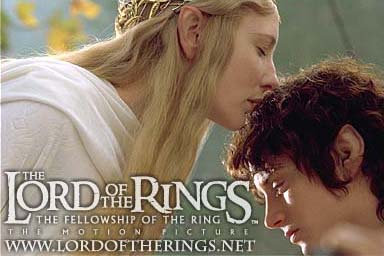
What a happy thing, especially after all the Harry Potter fuss, to have such a revival in interest in the great Lord of the Rings trilogy because of this new movie (if Harry Potter leads people to Tolkien, I couldn't say much against him). I really believe (and I have noticed this with children of neighbors and friends) that in the end Lord of the Rings tends to be more beloved than Harry Potter. Although Harry Potter can be a little more accessible to younger and/or less experienced readers, the Lord of the Rings is a real adventure story, whereas Harry Potter is more of a fantasy/mystery with a much smaller scope. The Lord of the Rings movies are also making the books more accessible to a new generation of fans.

Overall, Tolkien fans (who are considered rather "fussy") seem to be rather pleased with the movie, and with good reason. Although it's very difficult to turn such a complex and imaginative story into a movie, and the movie will certainly never replace the book, overall I think the movie-makers did a fantastic job. First, and most importantly, I think they captured the overall themes (the temptation of power, the reality of evil, etc.) very well. The characters are very well-cast and quite believable. As might be expected in a movie version, the plot is simplified, several characters are compressed into one, etc. The neat thing is that significant portions of dialogue are taken directly from the book and the essentials of the plot are really quite faithful to the original story. My husband and I (who have both read the books) enjoyed the movie very much. Since we were expecting the birth of a child at the time and she decided to arrive significantly past her due date, we were able to see the movie twice in the theater, which is a real rarity for us.

For those unfamiliar with the books, this first part of three books introduces us to the main characters in the story - Hobbits - and the other races of Middle Earth - dwarves, elves, men and wizards. We see the beauty of the hobbits' homeland - the Shire - and their simplicity and love of nature. We are introduced to Bilbo who discovered "the Ring" and prepares to leave it to his nephew Frodo. When Gandalf discovers the true identity of the ring - the One Ring that was forged by the evil Lord Sauron to control all living things - Frodo sets out to bring the ring to a safer place and thus begins his quest.

This movie is not intended for young children. The story is very complex and focuses on major conflicts between good and evil. Turning it into a movie without making it silly and laughable creates rather intense cinema. Happily the moviemakers sought a PG-13 rather than an R rating and thus there is almost no blood and gore and no bad language or other objectionable content. The movie does, of course, portray battle and action scenes and a number of rather frightening creatures that some young children find too scary even when reading the book. It is sometimes easier to allow younger children to watch this sort of movie when it is released to video/DVD where the entire effect is less intense and scenes may be edited at will.

Although I think that watching the movie will lead many people to pick up the book, I think it best to read the book before seeing the movie so that one's first impressions in the imagination come directly from the book rather than another's re-creation of it. Parents, in particular, might do well to read the book before seeing the movie because, particularly if they aren't regular movie-goers, I think the violence and intensity wouldn't make much sense without being familiar with the plot and themes.
The extended version of the movie, which was released to video and DVD in November 2002, is really worth seeing. It incorporates 30 minutes of additional footage into the movie which helps make the story more understandable and enjoyable, but made the movie too long for the theatrical release.

Publisher: 
New Line Films
Series: 
The Lord of the Rings
Additional notes: 

Rated PG-13 (Violence)

Review Date: 
1-2-03
Reviewed by: 
TitleSort: 
Lord of the Rings: The Fellowship of the Ring (Movie)

The Lord of the Rings: The Two Towers (Movie)

Still shot from 'The Two Towers' movie
Subject(s): 
Resource Type: 
Copyright: 
2002
Review: 

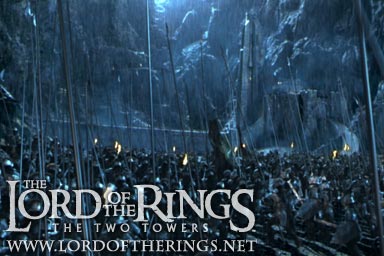
After much anticipation, my seven year old son and I saw the Two Towers on the Saturday before Christmas. My nine year old daughter watched it with my husband the night before in order to switch off with the little ones at home. A year ago I wouldn't have expected to be taking any of my children to see the movie (because of their age), but a lot has changed since then for us. John read the entire Lord of the Rings aloud to the children over the past year. Jacinta read it, again, on her own. She and Matthew have also listened to the 13 disc BBC audio drama numerous times. They also very much enjoyed the Fellowship of the Ring movie on the "small screen". The point is that they have really attained a decent grasp of the story. In addition, my son, who doesn't like loud noises much, wore earplugs (which diminishes the intensity quite a bit) and my husband and I both did a bit of editing by simply covering their eyes with our hands. This was necessary during the previews and commercials before the movie more than for the movie itself.

Two of the toughest characters to portray - Gollum and Treebeard - were absolutely amazing. Gollum is a complex character - tortured by his desire for the ring, whom you don't know whether to hate or pity. A computer graphics generated character, he was entirely believable and pathetic in the way, I think, Tolkien intended him to be imagined. Treebeard could so easily have been a silly cartoonish character. While not without humor, he's also magnificent and ...respectable in the way that one would appreciate and admire an older gentleman who's a bit eccentric.

There are several general things that I think remarkable about this phenomenal task of creating movies from Tolkien's beloved stories. (For those who really like movies, as my husband and I do, the Fellowship of the Ring DVD is interesting partly because of the extensive commentaries, interviews, photo galleries, etc. which provide details on both how the movies were made and what the movie-makers were trying to do.) Many of the people most intimately involved in the movie production have read the story countless times. Faithfulness to Tolkien was a major priority for them. They have referred to the books over and over again, not just in writing the screenplay, but in how the actors portray their parts. A great deal of attention and thought has gone into many, many details of the story. For example, recordings exist of Tolkien himself reading parts of his stories. Ian McKellan, who plays Gandalf, based his portrayal of Gandalf, in voice tone and expression, on these recordings. Christopher Lee, who plays Saruman, has read the books every year for decades. In addition to his excellent portrayal of the villain, he discussed parts of the book with the other actors to be sure that certain details weren't left out. The two artists most famous for illustrating editions of the Lord of the Rings, Alan Lee and John Howe, worked as art consultants on the sets and miniatures. Peter Jackson, the director, collaborated with hundreds of cast members, production members and Tolkien fans to fine tune the script and the ideas. We had a local news story here in Wisconsin about a man who was, as a hobby, an expert in Tolkien's fictional languages. He offered his services to Peter Jackson and was invited to play a part in the production. I've never heard of any project done in this kind of fashion and the final result is truly reflective of the incredible effort and labor of love that went into making these movies.

Jackson and crew did a great job of balancing this rather dark, middle part of the story with some enjoyable comic relief (especially found in the character of Gimli the dwarf) which flowed quite well. I thought there were a few more unnecessary plot-deviations than in the first movie (particularly a significant thread involving Aragorn), but this annoyance was rather minor. We enjoyed the movie very much and look forward to its conclusion, The Lord of the Rings: Return of the King, coming out in December 2003.

Publisher: 
New Line Films
Series: 
The Lord of the Rings
Additional notes: 

Rated PG-13 (Violence)

Review Date: 
1-2-03
Reviewed by: 
TitleSort: 
Lord of the Rings: The Two Towers (Movie)