Sample Pages from [em]Book Title[/em] by Author
Excerpted from Book Title by Author
Used with permission.

Excerpted from Book Title by Author
Used with permission.


Excerpted from Brightest and Best: Stories of Hymns by Fr. George Rutler
Copyright 1998, Ignatius Press, Used with permission.


Excerpted from Brother Joseph: The Painter of Icons by Fr. Augustine DeNoble, O.S.B.
Copyright 2000, Bethlehem Books, Used with permission.
ONE
Moving
PETER and Patsy Mitchell stood on the front lawn of their home in Washington, D.C. They watched the furniture being carried out of the house into a big moving van, a much larger one than the neighbors had used when they had moved. But then the neighbors had only one child and the Mitchells had six, not counting pets. At present only Peter and Patsy could really enjoy the move; Joan was rocking Baby Catherine to sleep and Angela and Timmy had been foisted onto neighbors, for fear they'd manage to get themselves packed up with the furniture.
Peter and Patsy, nine and eleven respectively, could be trusted to take care of themselves, yet they just escaped being old enough to be always pressed into service, like poor Joan. Of course Joan didn't really mind, she liked to help and she adored Baby Catherine.
The moving men were straining and puffing. They had ropes and small carts to help them carry the heavy furniture. Now they were lifting the piano down the steps. Sweat streamed down their faces as they cried out to one another in French. They spoke French because they came from Montreal. They spoke it so quickly it was hard to understand them even when you knew French. One of the men had said something to Grannie but Grannie had kept shaking her head.
"Plus lentement," she'd begged, which means "slower."
So the man had talked very, very slowly and Grannie had understood but it hadn't been worth the trouble. He had only been saying that it was hot, as if everyone didn't know that.
The men were packing the furniture into the van. They put sacks over it for protection. They fitted everything in like a jigsaw puzzle. There went Timmy's tricycle and Angela's doll carriage, but not her dolls, Surshy and Traincrack. Mother had wanted to pack them in a trunk but Angela had forbidden it.
"You don't pack us in a trunk, do you?" she had said indignantly. "My children want to go in the train and look out of the window too." So Surshy and Traincrack were waiting somewhere on a window sill, all dressed up to go. There went Grannie's radio.
"I hope it doesn't break," said Peter. "What will Grannie do if she can't hear the 'Mayor of the Town'?"
"Or 'Information Please,' " agreed Patsy.
There went Catherine's crib and high chair. They used to be Timmy's, the marks of his teeth were still on them. Catherine didn't bite things; she was very dainty.
Peter wiped his forehead on his sleeve. "It sure is hot," he said. "Maybe it will be cooler in Canada."
"Of course, because it's farther north there," Patsy instructed him.
"Yes, but that's what I don't understand," said Peter, frowning. "North is only nearer to the North Pole and if you go all the way up, right slap bang into the middle of the North Pole, then where is north? There isn't any."
Patsy hadn't thought of that. "There must be," she said.
"No, there isn't," crowed Peter. "Up in the middle of the North Pole there's only south. I must go there some day."
"Let's go inside and look at the house now," proposed Patsy.
They wandered through the dusty, empty rooms. Neither of them could remember ever having lived anywhere else. This house was as much a part of them as their teeth or noses. It disturbed them to see it so bare and friendless now.
"Do you like going away?" asked Patsy softly.
Peter ruffied his hair with one hand. He remembered how he had looked forward to Canada. When Daddy came home from the war his position in Washington was still available, but prices had gone up so much that Daddy preferred to look around for abetter one. Through a Canadian soldier friend of his he finally got a very good offer, a permanent job as hydraulic supervisor in Montreal. He jumped at it, but when the contract was signed he discovered that there wasn't a house for rent in the whole of Montreal. For a year he had hunted without results, and all that time his family had to stay in Washington. Even the children at school had finally ceased to admire the Mitchells for going to Canada.
But just when the summer holidays started Daddy wrote to say he had found a house. "It's only for the summer, though. After that we'll have to find something else."
"And what if we don't?" Grannie ventured to murmur, but the children thought it quite safe. ..what all couldn't happen in three months!
And now it was true for sure. The moving men had come and would put the Mitchells' furniture in Storage for them in Montreal until they found a permanent house. It was all very adventurous and delightful. Yet, when Patsy asked, "Do you like going away?" Peter felt a queer tightening of his throat. He suddenly realized that he loved this house, old and shabby though it might be.
"Let's go through all the rooms once more," he suggested.
They walked on tiptoes because their steps sounded so hollow. They knew every spot and crack and creak in the house; everything had its history. Peter had shot that hole in the hall window with his arrow. Mother had given him the bow and arrows at Christmas and she had been so proud that they shot well until that hole. After that she wasn't so proud any more.
And that spot of ink on the hall floor was left from the day when Angela had poured the ink bottIe over Snow White in the hope of changing the poor kitten's color. And the tear in the screen wire of the porch had been the work of Blinkie, the pet squirrel. And the hole right through the wall of the lit tIe front bedroom dated from the time that Patsy had been quarantined there for scarlet fever. Peter and she had worked at it from both ends until they could talk together, but it had been a secret; a picture had covered it. Now it stood bare and naked, for everyone to see.
"Do you remember how you used to buy me popsicles with your pocket money and stick them through that hole, and one was so big it wouldn't go through?" said Patsy dreamily. "I don't think I'll ever get over this house."
She sat down on the hall steps and Peter sat down beside her. "Do you remember the Christmas with Mr. Spencer and Eunice?"
"I was only six then," said Peter. "But I do remember when they went back to England and we waved good-by to them. It was a very big boat, wasn't it? And they took Snow White with them, and Bertha the bunny. I wonder how they like England."
"So many Christmases," Patsy went on. "So many Easters, so many birthdays. Do you think they have Christmas and Easter in Canada?"
"Well, anyway, they can't take away our birthdays," Peter consoled her.
Suddenly the stillness of the house was broken by a scream from Joan, and a few seconds later she flung open the door of what used to be Mother's bedroom and ran into the passage, clutching a surprised but placid Catherine.
Joan had grown very tall the last year or so and was developing what Mother called a "pretty figure." People nowadays remarked on Joan's improved looks. She was taller and thinner than she used to be, her eyes seemed larger, with long, coal-black lashes and quirky eyebrows, and her hair had begun to curl around her forehead. But people admired her expression most.
"She must be a sweet girl," they said. "A real help to her mother. "
And she was. She had taken over the care of Catherine from the day she was born. Catherine was born at home because there was no place in the hospital. It had been difficult to get help; Gwendolyn dared not touch a newborn baby, so Mother had kept Joan at home and taught her to wash and dress Catherine. Joan said it was much more fun than taking care of a dog. Joan was only two years older than Patsy but Patsy was beginning to feel as if there were six years between them, at least. Joan could look so sedate and understanding, listening to Mother's and Daddy's talk and voicing a calm opinion which no one snubbed. Patsy felt downright ashamed of her at those moments and would mutter fiercely to herself: "She acts like a grownup!" But at present Joan was her own age and very excited.
"Do you know what happened?" she cried. "Catherine was almost electrocuted!"
"How? How?" cried Peter and Patsy, jumping up. Grannie opened the door of her room. "What's the matter?" she asked.
Joan turned to her. "The baby. .." she gasped. "She had waked up and I was minding her and you know that big electric cord in Mother's room! It plugs in and then it has a gadget at the end for two extension cords. The moving men took away the lamp and the clock but they didn't unplug the cord and left the gadget on the floor and I just caught Catherine as she was trying to put it into her mouth!"
"My goodness, that was terribly dangerous," cried Grannie, startled. "What a clever girl you are, Joan, to think of that. It wouldn't look dangerous at all!"
"Would she have died?" asked Peter, awed.
"Not necessarily," said Grannie. "I know of a little toddler who did just that, but she didn't die. She was knocked unconscious and her lower lip was burned away. Her parents had a terrible time taking her to skin specialists who more or less fixed her up again. You are a clever girl, Joan. ..that poor baby. .." and Grannie held her arms out to Catherine, but Catherine only clung more tightly to Joan.
At that moment the moving men came up the stairs to fetch Grannie's bed. Grannie had with many French words persuaded them to leave her bed till the last. For some reason the beds were the first things they had wanted to pack when they had started the day before. So the other Mitchells had been sleeping on the floor, but Grannie was too old for that and they left her her bed. Now they came to fetch it. Grannie might look as pathetic as she pleased, the bed was carried downstairs.
"Where'll I sit? " cried Grannie helplessly.
There wasn't anywhere for her to sit except on the stairs and everyone knew that Grannie couldn't sit long on anything hard.
So Peter went down to where the telephone still wobbled on the top of the radiator and dialed a number. He was worried about Grannie. It was now about twelve o'clock and the train didn't go till four. She couldn't be without a chair all that time! Mother didn't matter so much, she was rushing around anyway, supervising the moving men, because she said if she didn't they were sure to pack all the empty bottles and garbage cans with holes and seatless chairs and maybe leave behind the icebox. It was quite a spectacle to see them pack; they just snatched any object they could reach, without looking at it, rolled it in newspapers, and dropped it in a barrel. Gwendolyn, the maid, had rescued her coat and hat and hung them in the garage or they would have packed those, too.
But Grannie could not help and now she wandered around miserably, hesitating between the fatigue of standing and the agony of sitting. So Peter dialed the number of Mrs. Duquesne, Grannie's best friend, and said:
"Hello, is this Mrs. Duquesne? This is Peter. You know we are leaving today, the moving men are here and they took all our chairs and Grannie has nowhere to sit and the train only goes at four. ...Oh yes, that would be lovely, thank you." Peter quickly dropped the receiver.
"Grannie, Grannie," he shouted. "Mrs. Duquesne is coming with her car to fetch you! You're going to have lunch there and a nap. But be sure now that you are at the station at four. Please don't miss the train, that would be dreadful!"
Grannie was delighted. Her cheeks grew pink with pleasure as she put on her hat, hoping it looked right, for there were no mirrors. Soon Mrs. Duquesne arrived. It was time, too. Grannie was already stiff with sitting on the stairs.
"Be sure to bring her to the station before four," said Peter anxiously as he helped Grannie into the car. "Yes, yes, we'll take good care of her," promised Mrs. Duquesne, smiling.
When the car left, Peter inspected the moving van. It was quite full, yet there were still heaps of things in the house. The two men seemed worried. They kept shaking their heads and saying French words. They went to Mother and made motions with their hands. Mother looked scared. She said something and the men shrugged their shoulders.
"Goodness," cried Mother. "I must phone my husband - mon mari. "
The men spat gloomily into the yard. Mother rang long distance. "I want to speak to John Mitchell, Elwood 3771, Montreal, Canada." It was some time before she got him.
"Listen, John, they can't get all our furniture in, they say. Into the van, of course. Oh, lots and lots. In the basement. ..trunks and the baby carriage and that nice sofa. ..they say they'll have to leave them. But all our clothes, John. ..and the new people won't come in until Monday. ..and you know you can't really lock up this house. ...Yes, they say there is another van going day after tomorrow. I put red labels on all the things we'd need in the country and I did tell them to keep them apart but I don't think they understood. Oh dear, I'm so worried. ...No, I know you can't help it. ...Phone the police to keep an eye on the house? All right. ..all right, dear, I won't keep you." Mother put down the phone.
"What is it, Mommy?" asked Joan, but Mother brushed her off like a fly.
"Be quiet," she snapped. "C'est bien," she told the moving men. " Mon mari ...agrees, il consent. Oui, you can leave the stuff in the basement. ..what is basement in French? Where is Grannie? Grannie, what is basement? Gone? To Mrs. Duquesne's? Why? Oui, oui, descendez bas. ..laissez lo-bas, oui. "
Mother looked around for something to sink onto. She felt weak in the legs. But the radiator was too high and the floor too low so she leaned against the wall instead.
"All our trunks. .." she murmured. "And I asked them to pack those first but they didn't listen. And anyone can break into this house. ..."
"Oh, I'll ask Dickie and Butch to keep watch," offered Peter. "They're training to be detectives and they'll love it."
He flew off to enlist the help of his friends. Mother held her throbbing forehead with both hands and tried not to cry. She had been on her feet since five that morning, as the moving men had daylight saving time and preferred to work while it was still cool. She had planned so carefully and worked so hard and now all threatened to go wrong because the van was too small. It wasn't fair. Who would have thought that all the shabby little odds and ends that made up their furniture would take up so much space? If only the trunks could have gone. ..it takes a lot to dress six children. ...
"Mother, do you know that Baby was almost killed?" asked Joan.
"What?" With a shock Mother stood upright. "Killed? How?"
Joan told her what had happened and Mother grabbed Catherine and buried her nose in the baby's wispy hair, feeling a passionate gratitude. What did it matter about the trunks as long as her children were alive and well and didn't have to be left in a basement? They were her treasures and they were going with her. So with a singing heart she rushed off to supervise the final cramming of the van. When it left at last it had furniture tied outside with ropes. It looked as if one more chair would make everything collapse, but the men said it would be all right. The van slowly groaned into motion, watched after by most of the children in the street.
"When are we going to eat, Mother?" asked Peter when he returned from his mission.
Gwendolyn had been sweeping the empty rooms and now sat on the sink in the kitchen looking helpless. It is hard to prepare a meal when there is only a stove and a sink and even the can opener has been taken away. Besides, Gwendolyn was melancholy. She had been with the Mitchells since just before Catherine's birth and she loved them all. She couldn't get over the fact that they were leaving, and added to the general confusion by loudly weeping into her apron from time to time. It was no use expecting a meal from her.
Luckily Timmy trudged up the steps presently and announced that the lady who was taking care of him and Angela now invited Patsy and Peter to lunch, too. Mother then decided that she and Joan would have a snack at the drugstore and leave Catherine to be fed by Gwendolyn. There were still some cans of baby foods and a beer-can opener.
But just at that moment several of Mother's dearest friends came to say good-by, and then the phone rang, another friend wanting to know how everything was get- ting along, and another phone call to ask about the maid: "Was she free to work somewhere else now?"
Finally Mother had to feed Catherine while Gwendolyn made arrangements for another position. At last Joan said she'd go to the drugstore alone and fetch Mother a sandwich, and as she left, another batch of friends were mounting the front steps to say good-by.
Then Angela and Timmy had to be fetched back and dressed in clean clothes, which had been painstakingly kept out of the clutches of the moving men. But Angela wasn't satisfied with Traincrack's appearance and had to wash her at the last minute, wetting her own dress. Then Timmy was lost, and everyone looked allover the house until he was found in the cellar, inside the baby buggy, fast asleep.
Trusty, the dog, and Mr. Jenkins, the parrot, had to be packed into baskets, to their disgust. Especially Mr. Jenkins, who cried loudly: "What a shame, what a shame!" The fishes had been donated to neighbors; their habits were too moist for a train journey.
At last all was ready and Mother telephoned for a taxi, only to find to her dismay that there was none to be got there was a taxi strike on. She had been too busy moving to know about it, as she hadn't read a paper or listened to the radio. So there she was, at three-thirty, hot and weary, with six children, a dog, a parrot, and two dolls, with no way of getting to the station. Luckily a friend saved the situation by offering to drive them over in his car.
And so they cast a last look at their house, so dreary and bereaved without its curtains, gave a last handshake to the group of mournful friends, and off they went in Mr. Dowling's large car.
A feeling of peace settled over the family. It was done now, the cables were cut, they were launched. Before them spread the Unknown.
Mother had bought tickets and reserved compartments a month beforehand, so they were in plenty of time and even had to wait for the gates to open. It was hard to keep the little ones from running around. Luckily the dog and the parrot were going in the baggage car, so they were off Mother's hands. They had food and drink with them, and it was probable that they would survive the trip. Both were dear to the Mitchells, Trusty because he had helped to save Daddy when he was shipwrecked and Mr. Jenkins because he had been a present from dear, darling Uncle Jim who had never returned from the war.
The large hands of the station clock moved forward, but Grannie hadn't arrived yet. Peter worried. Grannie was his special friend; he felt responsible for her. Besides, it had been his idea to send her to Mrs. Duquesne's. "Don't you think Grannie ought to be here?" he asked of Mother.
Mother glanced at the clock.
"Goodness, yes, it's ten to four," she cried. "Where is Grannie? I have her ticket, too!"
The gates were opening now and a porter was urging Mother to go on. Angela was already back from doing gymnastics on the railing, and Timmy had fallen asleep again, half on and half off a suitcase.
"We'd better get them settled first, Mother," advised Peter. "Then we can always go back to find Grannie." So Mother explained to the man at the gate about the ticket and the missing Grannie and then they all trooped behind the porter, Joan carrying Catherine, Peter half dragging Timmy, and Patsy helping Angela to carry her dolls.
Mother had engaged three compartments, little private rooms in the train. Two, connecting ones, were for herself, the girls, and Timmy; Grannie and Peter had a smaller one in another car. The children were wildly excited, and all seemed to want to sit in the same place. Mother had a hard time settling them, and so she didn't notice how Peter slipped away.
At last peace returned. Catherine sat in her auto seat, nibbling a biscuit, Timmy and Angela took out their coloring books and crayons, and Joan and Patsy hung up their coats and hats like thoughtful young ladies. But where was Petet?
Joan and Mother ran from one compartment to another, trying to locate him and merely bumping into a lot of passengers intent on getting to their seats and not a bit interested in Peter. It was two minutes to four and Mother became frantic. It was bad enough having Grannie late, but now Peter, too!
Patsy thought she had an idea what Peter had been up to, so she leaned out of the platform door, very much in everybody's way, and scanned the clock and the passen- gers in turn.
One minute to four. ..half a minute. ..fifteen seconds. ...And then Patsy let out a shout of joy, for she had caught sight of Peter, who was running like mad and dragging Grannie after him. Poor Grannie had lost her hat and looked completely exhausted, but what with Patsy pulling and Peter pushing they managed to get her into the train just as the whistle blew and the wheels started to move.
"Oh, dears," panted Grannie, when Peter deposited her beside Catherine in one of Mother's compartments, "I made it, thanks to Peter I made it!"
"What happened?" asked Mother, who felt so relieved that she had all her chickens together that it was as if there had been no trouble at all that day.
"Wait till I get my breath and I'll tell you," gasped Grannie.
So they all waited in suspense while Grannie examined her bag, snapped it shut, wiped her nose, and straightened her hair.
"The Duquesnes' car got a flat tire," she explained at last. " And there was no taxi. And putting on a new wheel would take too long, I thought, so I took a trolley, but it went in the wrong direction. And then I had to run and I lost my hat, but I hadn't time to go back, and as I entered the station and saw it was four o'clock I thought I was too late and would have gone back if Peter hadn't come like a whirlwind and pulled me into the train!"
"Well, thank goodness," said Mother, leaning back on the soft seat. "We're all here and now I don't have to do a thing until tomorrow morning." And closing her eyes she gave herself up to the train's rhythm, while the children, relieved of their fears about Grannie, settled down to enjoy their first overnight trip in a train.
Excerpted from Canadian Summer by Hilda Van Stockum
Copyright 1948, Used with permission from Bethlehem Books


Excerpted from Catholic Math Activities by Mary Ann Grobbel
1999, Catholic Heritage Curricula, Used with permission.


Excerpted from Catholic National Readers: Book Two
1890s, Neumann Press, Used with permission.


Excerpted from Catholic Stories for Boys and Girls (Neumann Press)
Used with permission.
Contents
Falling Stars 3
Lightning! 5
Feeding Baby Plants 7
Freezing and Solids 11
Nerves and Your Sense of Touch 14
Eyes to See 18
How to Dress a Duck 21
Our Hearts and Theirs 25
Spit! 29
God's Building Blocks 33
Invisible Marks 37
The Salt of the Earth 41
He Will Dry Every Tear 45
Light from Light 49
Before You Were Bom 53
Baby Food 57
Dominion Over the Earth 61
Power in Weakness 65
Traveling Seeds 69
Ears to Hear 73
Coloring Adam and Eve 77
Run for Your Life! 81
Precious Blood 85
Answer Key 89
Key to Pronunciations 92
Sources 94
Baby Food
Do you have special birthday customs at your house? At our house, the 'Birthday Child' gets to pick whatever she' d like for dinner. Sometimes our menus look like this: hot corn on the cob, fluffy mashed potatoes and gravy, crispy chicken and chocolate ice cream. Does that sound good to you? If it is a good 'birth-day' meal, would it be a good meal for a baby which had just been born? No, a little baby could not eat that meal, because its tiny body needs only one thing--milk!
God's perfect food for babies is milk from their mothers! When a mother nurses, or feeds her baby from her breast, she is giving it the best food possible. Mother's milk not only makes her child grow big and strong, but helps keep the baby healthy, too. That is because there is a special ingredient in the milk called antibodies. Antibodies are disease-fighters which give the baby extra protection against germs.
Most people think that, when a mother nurses her baby, it is just good for the baby. But Our Lord, in His always perfect plans, made nursing benefit the mother, too. Women who nurse their babies have more protection against some types of cancer. A nursing mother also recovers more quickly from childbirth. Isn't God good to think of everything?
Most babies spend a full nine months in the womb before they are 'finished growing' and ready to be born. Sometimes, however, babies can be born too early, at eight or seven or six months of pregnancy. You already know a little bit about how a baby lives before it is born. Long before it is born, it is practicing breathing, and sucking and all of its little body is working at growing. However, not every part of the baby is mature, or ready to work on its own. Even a healthy newborn is not mature enough to take care of all its own needs; it has to have a Mom and Dad to feed it and care for it.
A baby born prematurely [before it is mature] is called a premature infant, or 'preemie'. These babies did not have time to finish maturing before they were born. Their tummies were not quite ready for food, and their lungs weren't quite ready to do the work of breathing. What would happen if you could not eat or breathe properly? You would be very sick, wouldn't you? That is the worry with preemies; if they cannot eat or breathe well, they can become very sick. But guess what--God has a special plan for preemies. In the past, doctors had a hard time making preemies well. But in the last several years, scientists have made many discoveries of God's special providence for His tiniest children. One of these discoveries is that, when a woman gives birth to a premature baby, her milk is different than it would be if the baby had been 'full-term " or in the womb for the full nine months!
Let's see if you can figure out how the mother's milk might be different. If a baby has trouble digesting its food and difficulty breathing, it would be pretty important to work at fixing those problems, wouldn't it? Well, that's just what Our Lord did. Scientists have discovered that women who give birth prematurely have milk that is even richer in 'growth factors', that speed up the maturing of the baby's lungs and digestive system.
The premature infant also needs a 'boost' to grow the strong bones and muscles that he would have developed within the womb. So God gave this specially designed mother's milk extra protein for muscles, calcium for bones and antibodies to fight germs! Finally, scientists have found that this special milk continues to be made in the mother's body for several weeks after the baby is born, to give the baby the extra help that it needs. How well Our Lord provides for us! For all His wondrous works, may Jesus Christ be forever praised!
"She of the King of Stars beloved,
stainless, undefiled,
Christ chose as His Mother-nurse,
to Him, the stainless Child;
Within her breast, as in a nest,
the Paraclete reposes,
Lily among fairest flowers,
Rose amid red roses."
from Hymn To the Virgin Mary, by Conal O'Riordan
I. What are the disease-fighters which give protection against genus called?
2. Look up calcium in the encyclopedia. Why do we need calcium in our diet? Which foods are rich in calcium ?
3. Look up protein in the encyclopedia. Why do we need protein in our diet? Which foods are rich in protein?
Excerpted from Catholic Stories from Science for Little Folks by Nancy Nicholson
1997, Catholic Heritage Curricula, Used with permission.


Excerpted from Catholic World History Timeline by Marcia Neill
1999, Marcia Neill, Used with permission.
Contents
Acknowledgments. xi
Foreword xiii
I. The New World Meets the Old. I
The Devil Gods 2; The Incas of Peru 5; Visitors from the East 7; Christopher Columbus 8; Catholic Spain Leads the Way 13; Catholic Portugal Follows 14; Spaniards Explore the New World 17
2. Two Heroes: Cortes and Magellan. 20
Toward the Home of the Devil Gods 21; In the Home of the Devil Gods 23; The Night of Sorrows 24; Never Surrender 25; Victory 27; The Captain General 28; Across the Pacific 30; Death 31
3. Missionaries and Conquistadors. 34
The Bishop and the Audiencia 35; The Indian and the Queen of Heaven 36; The Great Plains 38; The Great River 41; Conquest of the Incas 42; Argentina 44; The Mighty Amazon 45; Cortes 47
4. Bringing Christ to the New World. 50
The Apostle of Brazil 50; Land of Saints 52; Apostle Over the Andes 53; St. Peter Claver 54; North to New Mexico 55; The Jesuits in Paraguay 57; The Jesuits Expelled 58; The Evangelization of California 60; The Black Legend 62; The Spanish Achievement 63
5.France in the New World 66
The Father of New France 67; The Blackrobes 69; The Heroines of New France 72; New France's Saintly Bishop 74; Frenchmen on the Great River 74
6.From England to America 79
Saints and Strangers 81; The City on a Hill 83; The Dutch in the New World 86; The Maryland Experiment 87; The Remaining Colonies 89; The Colonial Wars 91
7. The Eve of the American War for Independence. 95
John Adams of Braintree 97; The First Continental Congress 99; The Shot on Lexington Common 100; Thomas Jefferson of Monticello 102; Charles Carroll of Carrollton 104; The Declaration of Independence 105; A Note on Liberalism 106
8. The United States' War for Independence. 109
When in Doubt, Attack 1ll; The Shifting Fortunes of War 114; Victory with the Help of France 117; Why America Won 119; Revolution or War for Independence? 120
9. The Birth of the American Government. 122
Madison and the Convention 124; Ratification 126; The Constitution 128; First in Peace 129 10. Catholics in the New Nation. 132 The First Bishop's Background 132; The First Bishop in Office 135; Was John Carroll a Liberal? 138; Elizabeth Ann Seton 138; Other Early Catholic Leaders 142
11. The French Revolution and the New World. 145
Revolution in Haiti 145; President Adams 148; The Election of 1800, 150; Marbury v. Madison 151; President Jefferson 152; The War of l 1812,153
12. Spain Is Driven From Latin America. 160
Uruguay and Paraguay 161; The Rebellion in Chile 162; New Granada f162; Bolivar and Peru 164; Mexico's Agony 165; John Quincy Adams and American Foreign Policy 167; The Experience of Brazil 168; The Legacy of Independence 169
13. Manifest Destiny 171
Old Hickory in the White House 171; The Birth of the Texas Republic 173; The U.S. Looks West 175; California and New Mexico 177; To the Halls of Montezuma 179; Zion in the Desert 181; The Donner Tragedy 183; 1848, 185
14. No Irish Need Apply 187
Maria Monk and Friends 187; Dagger John 189; Nativist Political Action 191; "I Know Nothing" 192; St. John Neumann 193
15. The Coming of the Civil War. 197
The Compromises 198; The Compromises Collapse 200; Bleeding Kansas 203; Lincoln v. Douglas 206; Secession 207; Robert E. Lee 210; War 211
16.The Civil War 214
The War During 1862, 215; The Absolute Masterpiece 218; Gettysburg 220; Vicksburg 224; The North Takes Charge 225; The Road to Appo- mattox 226
17. Traditionalists in Latin America. 234
Maximilian and Carlota 234; Glory and Disaster 237; From Juarez to Diaz 241; Garcia Moreno in Ecuador 242
18.The U.S.in the Gilded Age 248
Reconstruction 248; U.S. Politics 1877-1896,253; Business and Labor 255; Bishop Lamy and the Southwest 257; The Indians, the U.S. and the Church 260; At the End of the Santa Fe Trail 263
19. The Age of Theodore Roosevelt 266
Roosevelt as President 269; The Progressive Movement 270; The Supreme Court 272; Foreign Policy Under Roosevelt 273; President Taft and the Bull Moose 274; Italian Immigration and Mother Cabrini 275; The Church Reaches Out 278
20. Woodrow Wilson and the First World War 282
Wilson as President 284; The Election of 1916, 286; America Goes to War 289; The President and the Emperor 291; Winning the War 293; Losing the Peace 294; After the Treaty 297
21. Viva Cristo Rey! 300
Mexico: The Revolution Begins 300; Wilson Gets Involved 302; The Constitution of the Revolution 303; The Cristero Rebellion Begins 305; Blessed Miguel Pro 308; The Rebellion Ends 310
22. Boom, Depression and the New Deal. 313
Politics of the 1920's 317; The Great Inflation 318; The Depression Strikes 320; The Election of Roosevelt 323; The New Deal 324; The Second New Deal 329; Roosevelt v. the Supreme Court 332; The New Deal in Retrospect 335
23. The United States in World War II 337
Day of Infamy 338; War in the Pacific 340; The War in Europe 345; Unconditional Surrender and Terror Bombing 347; 1944 in Europe 349; 1944 in the Pacific 353; Yalta 354; Dresden 356; Operation Keelhaul 357; The Atomic Bomb 358
24. The Birth and Death of Anti-Communism. 363
The Truman Administration 363; The Loss of China 367; Witness 368; The Atomic Bomb and the Soviet Union 372; Korea 376; Joseph McCarthy 383; Eisenhower's Foreign Policy 387; Summary 387 25. Communists vs. Christians in Latin America. 390 Cuba 390; Argentina 394; Chile 396
26. The Moral Decline of America. 400
The Warren Revolution 401; The Kennedy Era 402; The Vietnam Nightmare 405; Lyndon Johnson in the White House 408; America and the Second Vatican Council 410; 1968: Year of Revolution 411; Richard Nixon in the White House 415; Roe v. Wade 417; The Fall of Vietnam 420; President Carter and the Hostage Crisis 421; Reagan, Bush, Clinton 423; America and the Future 425
Afterword. 427
Bibliography. 429
Index. 433
Chapter 1
The New World Meets The Old
WHEN HUMAN BEINGS first arrived in the New World, the Western Hemisphere, they probably came from Asia, crossing from Siberia to Alaska over what was then a land bridge across the Bering Sea. The land bridge would have been exposed because water was locked up in the huge glaciers of the Ice Age. We do not know exactly when men first set foot in the New World, but we do know that they gradually spread throughout the Hemisphere, living for hundreds of years as wandering hunters, showing little advancement or progress. Then, around 2500 B.C., the Neolithic Revolution occurred in the New World: Men began growing crops and raising animals, instead of relying for food on hunting and gathering. The New World was far behind the Old, which, according to some calculations, had achieved the Neolithic or Agricultural Revolution around 9000 B.C.
The oldest village sites in the New World date from around 2000 B.C. and appear in Central America. For some reason the vast plains of North America did not encourage human settlement and progress, but the jungles of Central America and the high plateaus of Mexico did. The staple crop was corn-unknown in the Old World-on which everything else depended. The early farmers of Mexico tattooed their bodies, turned the earth with digging sticks, and ground the corn to make a dough which was patted into cakes and baked over the fires. Their life was primitive and uncivilized, at a time when in the Old World the Egyptians were ruling a mighty empire and the Hebrews were learning and maintaining their belief in the one true God, whose name is "I Am. "
Around 1000 B.C., the Olmecs, a warlike people from the eastern coastal jungle plain of Mexico, invaded the highlands to the west, establishing themselves in power. The Olmec magicians claimed special powers over nature, performing strange superstitious rituals to persuade the gods to do the will of man. If at times they appeared to be successful-after all, it takes very little magic to learn that crops sprout in the spring and die in the winter-they also knew failure, for nature is never wholly predictable. Their desire for power led the Olmecs to think of ever greater sacrifices to the gods of nature, until they began offering the greatest they could imagine: human beings. In the ancient Olmec village sites, archaeologists find decapitated skeletons, smashed skulls, bodies without arms and legs, and murdered children. What they deemed the necessity of human sacrifice was fully accepted by the people of Mexico, remaining an indispensable part of their culture, even after the Olmecs were no longer dominant.
The Devil Gods
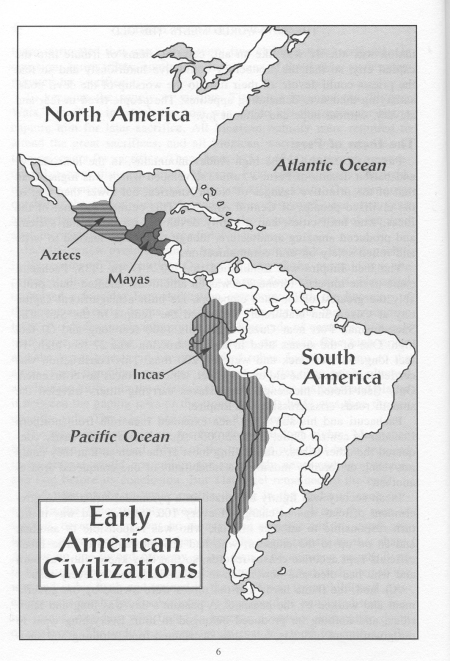
Some time after 650 B.C., the first civilization appeared in the New World. A civilization is distinguished from barbarism by the presence of cities and of writing, and the first people in the New World to achieve settled communities and written records were the Mayas of Central America and southern Mexico, whose civilization grew out of the Olmec culture. The first Mayan settlements grew up around the sacrificial altars, which gradually became marketplaces as well.
Mayan writing has not been fully deciphered to this day. It is composed of weird pictures called Maya glyphs, some of which have been given such descriptive names as the toothache glyph and the upended frog glyph. We are able to read Mayan numbers, however, and know that their society was mathematically advanced. They developed a calendar based on an 18-month year which is slightly more accurate than our own calendar. They were excellent astronomers; a Mayan inscription gives day and month positions for astronomical objects calculated back hypothetically for more than 400 million years.
Around the time of Christ, the Mayans had their greatest cultural achievements. Though they still had stone-age tools and never did invent the wheel, they built huge temple-pyramids and also built beautiful cities. They developed irrigation, and their mathematics and astronomy reached a peak. But like the powerful ancient civilizations of the Old World, the Mayas eventually began to decline. By the 800's A.D., new tribes gained power, and in the mid-900's the Toltec people became dominant under the great leader Quetzalcoatl.
Quetzalcoatl adopted the name of the god he worshiped, a feathered serpent. He was a powerful, popular leader, who established his capital in the city of Chichen Itza on the Yucatan peninsula. Quetzalcoatl's greatness is best illustrated by his hatred of human sacrifice. He did everything he could to stop this bloody practice, and for a brief time his civilization-freed from this brutality-flourished. But the habits of centuries could not be eliminated by one man. He was eventually overthrown, and his religious reformation died out. Human sacrifice returned. Society became collectivized: the individual person was regarded as unimportant. So little value was placed on individuals that singular pronouns-I, my, mine, me-scarcely existed. Life centered on the corn fields, the battle fields and the temple-pyramids. But there remained a prophecy which was never quite forgotten: Someday in the year "One Reed" (which occurred every 52 years), Quetzalcoatl would return, coming from the east.
Around 1450, still another tribe gained power: the Mexica-now more commonly known as the Aztecs. They came from a small island in the middle of a large lake in central Mexico and were particularly warlike and bloodthirsty. They established their capital city on their home island, which was named Tenochtitlan ("Cactus Rock"), and built there a magnificent city. The city became wealthy and powerful and remained the most important city in Mexico, which it has continued to be down to the present day, being renamed Mexico City.
The most powerful man in the Aztec Empire was not in fact the Emperor Montezuma I, but a successful warrior named Tlacaellel, who dominated Montezuma land then picked the next three emperors. He was the effective ruler of the Aztecs for 67 years, living to be 98 (1398- 1496). The one dominant policy of his rule was human sacrifice. The two chief gods to whom the sacrifices were offered were Huitzilopochtli, the Hummingbird Wizard, also known as Lover of Hearts and Drinker of Blood, and Tezcatlipoca, the Smoking Mirror and Lord of the Dark. The universal religious symbol in the Aztec religion was the serpent.
To worship the devil gods, Tlacaellel's laws required a thousand sacrifices to Huitzilopochtli in every town with a temple, every year; there were 371 towns in the Aztec Empire, though not all had full-scale temples. There were other sacrifices as well. It is estimated that at least 50,000 were sacrificed a year, probably more. One early Mexican historian estimated that one out of every five children was sacrificed. On occasion, entire tribes, numbering in the tens of thousands, were exterminated by sacrifice.
To keep up the supply of victims, Tlacaellel invented the "Flower Wars," conflicts in which the goal was not to kill the opponent but to capture him for later sacrifice. All Mexican nobility were required to attend the great sacrifices, and all Mexican warriors were required to take prisoners for sacrifice. Then, from 1451-1454, a series of unprecedented natural disasters struck Mexico. First came a serious drought, then four consecutive years of snows and killing frosts. The corn crop, on which the whole society depended, was destroyed year after year, and the people starved. To appease the devil gods, Tlacaellel required ever increasing numbers of sacrificial victims.
In 1487 a new pyramid-temple had been dedicated to Huitzilopochtli in the center of Tenochtitlan. On the flat top of the pyramid was the principal altar, with 600 smaller altars up and down the sides. Tlacaellel organized a four-day-long dedication ceremony. With the booming of the great snakeskin drums echoing over the city and the surrounding lakes, the dedication ceremony began. Thousands of captives, in a column three miles long, were herded across the plaza. The high priest and the lesser priests, in blood-drenched robes, led the victims to the altars. Each trembling man was stretched out flat. The priest plunged an obsidian knife into the victim's chest, pulled out his heart and placed it between the gaping jaws of the stone god. His body was then thrown over the side. The whole process took 15 seconds.
The mass murder went on for four days and four nights. More than 80,000 men were killed. Most of the nobility, who had been required to be present, could not endure the seemingly never-ending spectacle and fled before its conclusion. But Tlacaellel remained to the end. And what of the ordinary people, living in the midst of such horrors? In the Aztec society, wealth consisted of land and the men to work it, because there was no money. The emperor and his court collected a share of all the crops harvested, the pagan priests another share. Almost no one owned property of his own. The common people lived in tightly organized communities. Every man-child was dedicated to the war god at his birth and trained in the art of war from childhood. Discipline was harsh; for disobedience, a boy could be punctured with cactus spines. Any boy who failed to become a warrior was put to death or enslaved. The individual was taught that he stood for nothing: the nation was all. He was like an ant, carrying items of tribute into the capital city, so that the aristocracy could live luxuriously and so that the priests could devote all their time to the worship of the devil gods, satisfying their ever-demanding appetites. The people lived in fear and slavery, without hope and without joy.
The Incas of Peru
Far to the south, in the high Andes mountains, in the lush valleys and barren deserts of Peru, a culture developed which was higher than that of the primitive savages of North America, but lower than that of the civilized peoples of Central America. This culture was that of the Incas, who built cities, had a highly developed governmental system, and produced amazing architecture, though they never learned to write and relied solely on oral communication.
The Inca Empire was established in 1200 A.D. In 1438, Pachacuti came to the imperial throne. He was an ambitious, talented man, probably the greatest of the Inca emperors. He built a magnificent capital city at Cuzco and elaborately decorated the Temple of the Sun. The Sacsahuaman Fort near Cuzco had walls 1800 feet long and 60 feet high. One of the stones used in the construction was 27 feet high, 14 feet long, 12 feet thick and weighed 200 tons. This construction was carried out without the aid of the wheel, which the Incas never invented. Only fleet-footed messengers and slaves carrying litters traveled the smooth roads criss-crossing the Empire.
Pachacuti and his son Topa Inca extended Inca rule from northern Ecuador to central Chile, over 350,000 square miles. They easily conquered the other tribes, often killing most of the men so that they could not rebel, or forcibly moving the inhabitants of one conquered area to another.
Incan society was tightly organized in a pyramidal structure. A government official was in charge of every 100 families and was in his turn responsible to another official, who was responsible to another, and so on up to the emperor, who had absolute authority. The Incan officials kept accurate census records, so that they knew who was born and who had died and how much in taxes was owed by every man.
All land, the llama herds and the mines were owned by the government and worked by the peasants. A peasant's day was long and laborious, and nothing he produced belonged to him. Everything went to the government officials, who then distributed food, clothing and shelter to the people. As in Mexican society, the individual counted for nothing. He existed solely to serve the government. All offenses against the government were punishable by death.
The wealthy noblemen and the pagan priests lived in luxury in Cuzco, supported by the labors of the peasants. The emperor was worshiped as a god, and no one could enter his presence without removing his sandals and placing a burden on his back to indicate his humble position. When an emperor died, his body was mummified, and his favorite wives and servants usually voluntarily accompanied him in death. Though on a much smaller scale than the Aztecs, the Incas also had human sacrifice. On solemn occasions the most physically perfect of the young boys and girls would be sacrificed to the sun god. Those chosen as victims regarded their death as an honor.
At the time of the discovery of the Americas, therefore, two advanced cultures flourished amidst the primitive Indian tribes of North and South America. In Peru, society focused on the emperor, who had the right to dispose of any man's life as he chose. In Mexico, society focused on the hungry gods and revolved around the necessity of satisfying their appetites. Thus the New World awaited the Old, and the stage was set for a clash of cultures unlike any the world had ever seen.
Visitors from the East
Many different European countries had legends of lands to the west. In our own day, scholars have claimed to find evidence that Irishmen, Phoenicians, Jews and any number of others reached the New World long before Columbus. Except in one case, these exploits remain legends. There now is compelling evidence that St. Brendan the Voyager, an Irish Saint of the sixth century, reached Newfoundland in a leather boat. The account of his voyage, The Navigation, long thought to be fantasy, has been confirmed in all essential respects by Brendan's fellow Irishman, Tim Severin, who duplicated the voyage in the 1970's in a leather boat made of the same materials and by the same techniques as Brendan's. Irish settlements are known to have been made on Greenland, but none are known in Newfoundland; therefore, although Brendan reached the New World, he made no lasting mark on it.
The first known New World European colonies were established by the Vikings, the fierce Norsemen who pillaged and burned throughout Europe in the ninth, tenth and eleventh centuries, destroying much of the culture that had been slowly and painstakingly created after the decline of the Roman civilization in Western Europe and the influx of original barbarians.
In the late 10th century, a hot-tempered Viking named Eric the Red was exiled from Iceland for killing two men in vengeance. He sailed on to Greenland, where he established a colony on the site of an abandoned Irish colony. In 985 he brought 14 colonists. One of them had asked his son, Bjarni Herolffson, to follow him. On his way to Greenland, Bjarni was blown off course and ended up on the east coast of I Newfoundland, becoming the first Viking to reach a continental landfall, even though by accident. Later, Eric's son Leif bought Bjarni's ship and returned to Newfoundland, which he named Vinland. He wanted the timber that was there, but made no attempt to found a colony. Leif became a Christian in Norway a few years later, and soon thereafter missionaries came to Iceland and Greenland.
The next Viking New World visitor was Thorfinn Karlsefni, who organized a colonizing venture to Leif's Vinland. He could not find it, though, and ended up in a less hospitable location on the northern tip of Newfoundland. At this spot, called Vinland II, the first white child was born in the New World, the son of Thorfinn and his wife Gudrid. They named him Snorri. The colonists had trouble with the natives, much of it their own fault because they always assumed the worst of the natives. Finally, Thorfinn gave up on the colony and returned home with many of his followers.
The Viking colony lasted only a few more months, then was abandoned. The Vikings left nothing enduring; their discoveries did not change the course of history. And when the Viking power was broken, the memory of their exploits died with them, becoming only a fading and misty legend.
Christopher Columbus
In 1451, a son named Cristobal was born to the Colombo family in Genoa, Italy. He grew tall and red-haired and at the age of 22 went to sea. He took part in many expeditions, including some to the East Indies, and in his mind a strange notion began to take shape. The route to the Indies was long and difficult, involving both a sea voyage and an overland journey, along which local rulers exacted heavy taxes for the privilege of crossing their land. The Portuguese were venturing around Africa to avoid these difficulties, but Christopher had another idea. Why not sail west, coming into the Spice Islands, India and China by the back door? He was sure that it would be an easier, faster route. He calculated the distance as 2,400 miles from the Canary Islands, the last European outpost in the Atlantic, to Japan. The actual distance was 10,000 miles, and two continents stood in the way, but Columbus knew nothing about the continents and was sure his calculations were accurate. Many people told him that his figures were in error: Among them were the advisers to the King of Portugal, whom he approached in 1484; and the advisers to the Queen of Spain, who received him in May 1486. But Columbus refused to abandon his dream. He was motivated by far more than a belief that he was right and the scientists were wrong about the size of the earth. (They did not disagree about the shape; all educated men of the time knew the earth was round.) He felt that God had called him to bring Christianity to lands where Christ was unknown. By finding an easier route to these lands, he could bring glory to God. Just as Columbus refused to abandon his dream, so Queen Isabel of Spain could not forget him. She too had a vision of the glory of God. Columbus was ready to leave Spain, but made a last appeal to Isabel. Having just driven the Moslems from Spain, she agreed to his plan in 1492. She found financial backing for his voyage, gave him a royal commission as Admiral of the Ocean Sea, and sent with him official documents claiming the lands he discovered for Spain (along with a letter to the King of China, which she wrote in Latin though she had no idea whether this king, who she was not even sure existed, could read a word of the language).
On September 6, 1492, Columbus' three ships-the Nina, the Pinta and the Santa Maria-weighed anchor in the Old World for the last time at the little Spanish port of Palos near Seville. His course was "West, nothing to the north, nothing to the south." Columbus had great confidence in his judgment, but he knew that his men would not always be so confident, especially as they sailed farther from familiar lands. Therefore, he kept two records of the distance covered: what he called the true reckoning for his own use and a false reckoning for the eyes of the crew, so that they would not be discouraged. As it happened, Columbus overestimated his speed, so the false reckoning was more accurate.
By October, the crew was grumbling and upset. They had never been out of sight of land so long before; they were afraid they would never see land again. Finally, on October 9, Columbus promised Alonso Pinzon, his second in command, that he would turn back if they sighted no land within three days. The Admiral was not taking a grave risk with this promise. From his past experience at sea, he could recognize the signs that told him land was near. Then, at 2:00 a.m. on October 12, the lookout on the Pinta cried "Tierra! Tierra!"-"Land! Land!" "Thanks be to God!" the men prayed, as the tiny speck on the horizon grew steadily bigger. They landed on the beach around noon. Columbus went ashore, knelt in the damp sand and thanked God for the safe arrival. Thinking he was in the East Indies, not knowing he was actually in the Western Hemisphere (most probably on an island now known as Samana Cay in the Bahamas), he claimed the land for Spain and christened the island San Salvado1; "Holy Saviour."
Throughout October, November and December, Columbus and his men sailed from island to island, searching for spices and for identifying landmarks. Instead of a flourishing and wealthy Eastern civilization, they found primitive, impoverished natives; instead of spices, they found tobacco. Still Columbus was convinced that around the next island he would finally find what he had sailed halfway around the world in search of: the East Indies.
Christmas Eve came to the men far from the Navidad celebrations in Spain. Yet in spite of their strange surroundings, they held a Christmas Eve feast. The officer on duty during the night had too much feasting, and thinking no one would know the difference, turned the tiller of the Santa Maria over to a young boy. The boy had no one to whom he could turn it over, so he stood sleepily at the helm until around midnight a grinding, crunching sound awakened his shipmates to the awful realization that the ship had run aground on a coral reef. The men were unable to free her and so had to abandon the Santa Maria. She was the biggest ship, and there was no room for her crew on board the smaller Nina and Pinta. Columbus had to leave the extra men on the island to establish a colony. Then, on January 4, 1493, he set sail for home.
The homeward voyage was extremely rough, in contrast to the smooth outward journey. In February Columbus ran into some of the worst storms in recorded history. Between February 13 and 14 he and Pinzon lost sight of each other as their ships were blown apart in the gale.
They did not see each other again until Spain. The storm continued to rage on the 14th, and the crew had no hope left, except in God. They prayed desperately, promising to go on a pilgrimage if they were spared. Columbus himself had one of his rare moments of despair; he wrote an account of his discoveries and dropped it overboard in a barrel, hop- ing that if his ship were lost the barrel might eventually find its way to shore.
But the crew's prayers were heard, and on February 15 they arrived safely in the Azores. Still, their troubles were not over because, on the final leg of the voyage home, they ran into more storms. On March 2, a storm blew away all but one of the Nina's sails. On the night of March 3, the ship was being blown by near hurricane-force wind toward the cliffs off the coast of Portugal. In the greatest display yet of Columbus' seamanship, the Admiral managed to turn his vessel at the last moment and save his ship, his crew and the knowledge of his discoveries.
Isabel was delighted with Columbus' news, believing with him that he had achieved his goal. He could have retired then and there a wealthy man, but he was not the retiring type. He wanted to ensure that the Faith was carried to the Indies and the area properly administered. So he set sail again in 1493 with a much larger fleet.
Columbus made new discoveries throughout the Caribbean, visiting the Lesser Antilles, Virgin Islands, Puerto Rico, the south coast of Cuba and Jamaica. He found to his sorrow that the colony left behind had been wiped out by Indians, but he established anew colony named "Isabel" on Hispaniola Island. Again he did not find what he wanted, but only a little gold, some rather poor spices and a few tropical birds. He sent these things back to Spain with one of his ships and kept looking.
When he finally returned to Spain on March 10, 1496, almost every- one but Columbus himself knew that he had not found the East Indies. But he was able to get backing for a third voyage, in 1498, during which he made the first continental landfall in the New World at what is now Venezuela.
Columbus had found anew world, thus dramatically changing the course of history, but though he is perhaps the greatest mariner of all time, he did not have the temperament or talent to administer his discoveries. His administration of the colonies was unwise; he permitted enslavement of the Indians, against Isabel's express policy. When Isabel sent a royal commissioner to investigate, Columbus was arrested and sent home in chains. The man whose vision, courage and determination had given the New World to Spain left it disgraced and humiliated.
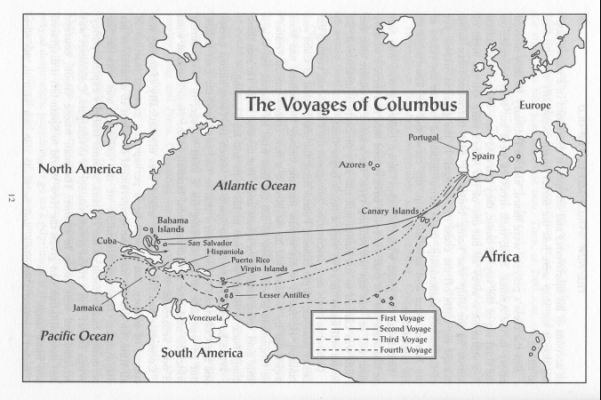
Isabel released Columbus, and he made one last visit to the New World, his fourth voyage, from 1502-1504. Now he knew that he had not found the Indies, and he spent most of the voyage looking for a way through Central America so that he could reach the East. But he did not find the way, because it did not exist. He returned to Spain, where he died two years later.
Before Columbus, men rarely sailed out of sight of land, hugging the shore, scarcely daring to sail down unfamiliar coastlines. Everyone looked east. Columbus looked west and dared to leave familiar sights and shores behind him. In so doing, he turned the continent of Europe around. The New World was drawn into the orbit of Europe and European civilization. The world-old and new-would never again be the same.
Catholic Spain Leads the Way
The knowledge that a whole new world had been discovered set fire to Spain. Before long, ships were sailing frequently from Spain to the Western Hemisphere and back again, and Spaniards were leading expeditions of discovery and colonization, slowly mapping out the shape of the New World. Some men came for gold, some for glory, some for the thrill of discovery, some for the chance to start anew life, some to spread the Gospel of Christ; most came for a combination of rea- sons. They were filled with enthusiasm, courage and a faith in God which let them brave any risk. Most were heroic and admirable; some were greedy and cruel. But both the good and the evil could have come only from Spain, which at this time was different from any other coun- try in Europe.
Though all of Europe was Catholic, Spain's Catholicism was stronger and healthier. At the time of Columbus, Spain was ruled by Ferdinand and Isabel, known in Spain as los Reyes Catolicos-"the Catholic Kings." Isabel especially lived for her Faith; her primary mission in life was to make Spain unshakably Catholic. She succeeded in her mission. Isabel was followed on the throne by her grandson Charles I, whose primary mission in life was to defend the Catholic Church against the Protestant revolutionaries who sought to destroy it from within and the Moslem Turks who sought to destroy it from without. Some of the Spaniards who came to the New World were good Catholics, some were bad Catholics, but all were Catholics. They built a Catholic society which endures to this day throughout most of South America, Central America, and Mexico, and which has left its mark even in the United States, as we can see in so simple a thing as the Catholic names which dot the map: San Francisco, San Antonio, Trinidad, Santa Fe and hundreds more.
The Spaniards, in the very year of Columbus' discovery of America, had just won a 770-year war with the Moslems, driving them at last out of Spain with their conquest of Granada, the last Moslem stronghold in Spain, and uniting their country under one flag. They were optimistic and courageous and felt there was nothing they could not do. They were good fighters, used to winning even when the odds were against them. They could also at times be cruel and bloodthirsty, as men who have fought long and hard can be.
These were the Spaniards who left their footprints across South America, Central America, Mexico and the southern part of what is now the United States, footprints which time has not been able to erase.
Catholic Portugal Follows
Though Spain launched the discovery and exploration of the New World, another, similar nation was close behind. Though smaller than Spain, Portugal also had optimism, a deep religious faith and unshakable courage. Portuguese explorations were sparked by a prince of the royal family, known as Prince Henry the Navigator, because of his interest in voyaging.
Prince Henry's telescope looked east, toward the Indies. He, like Columbus a few years later, wanted to find a new route to the Indies to avoid the costly overland route. He also wanted to outflank the Moslem-held lands and advance the cause of Christianity. So he financed and encouraged voyages down the African coast. No one knew how far Africa extended, nor what men might find if they sailed far enough south, and most men~did not care. But Henry gave his sailors and captains a share of his courage. They began sailing down the coast of Africa, going a little farther each time. Eventually, Vasco da Gama rounded the Cape of Good Hope, Africa's southern tip, and reached India in 1498, the first man to do so by an a1l-water route. Prince Henry had already died by this time, but the voyage would never have been made except for his vision and encouragement.
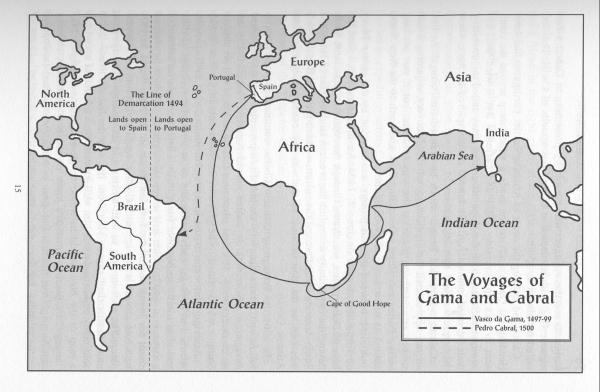
The year after Da Gama returned, King Manuel (who was married to Isabel's daughter Maria), authorized Pedro Cabral to follow up Da Gama's discoveries. Cabral outfitted 13 or 14 ships, painting the red cross of Christ on their sails. King Manuel himself came down to the harbor to see the voyagers off, personally presenting to Cabral a Portuguese flag, with its depiction of the five wounds of Christ. The fleet sailed on March 8, 1500. Cabral did not hug the coast of Africa as earlier Portuguese had done. Heeding Da Gama's advice, he made a wide sweep around the continent to pick up favorable winds and currents. But a wind shift and stronger currents drove the ships off course. They sailed more westerly than intended, and on April 21 landed on unexplored territory, where they were watched by timid natives.
Cabral had reached Brazil, which he claimed for Portugal. At first no one appreciated the significance of the discovery, regarding Brazil simply as a stopping place on the way to India, but it was not long before Portuguese ships were sailing back and forth to the New World almost as often as the ships of Spain.
A clash between the two powers was avoided by the earlier Treaty of Tordesillas, signed on June 7, 1494. An imaginary line, called the the Line of Demarcation, was drawn through the Atlantic Ocean, with Spain having the opportunity to explore the western lands - most of North and South America - and Portugal the eastern - which included Brazil, which was east of the line because of the way the country bulges into the Atlantic Ocean.
In 1501 the Portuguese Gonliclo Coelho commanded three ships to follow up Cabral's discovery. On board as a passenger and self-appointed navigation officer was an Italian named Amerigo Vespucci. His last name meant wasp. His first name was that of an uncle and an obscure Saint; it was destined to be given to the continents of the New World. Amerigo first went to sea in 1499. He jumped ship in Hispaniola, returned to Portugal early and wrote an account of the voyage as if he had been totally responsible for it. A little later he wrote an account of a voyage in 1497, which had never taken place, in which he claimed credit for being one of the first Europeans in the New World. In 1504 he wrote about his voyage with Coelho, again giving himself a central place. The account was so well-written and interesting-Amerigo gave more details than anyone else about the way the Indians lived-that it sold many copies and made him well-known. Then a friend of his printed a map of the New World in which he gave credit to Amerigo's 1497 "voyage" by placing Amerigo's name on the new continents, claiming that Amerigo was the first European to reach the mainland (as opposed to the islands). By the time Europe realized that Amerigo was not all he claimed to be, the use of the term "America" was so widespread that it could not be changed. Thus did a faker with a gift for words and a friend in the right place at the right time give his name to the two continents of the New World.
Spaniards Explore the New World
Other achievements were more genuine. Vasco Nutiez de Balboa went on a voyage to the New World, then settled in Hispaniola as a planter. Unfortunately, he soon ran out of money and was being annoyed by his creditors. So he stowed away on a ship by hiding in a provision cask that was lowered into the storage hold with the rest of the cargo. When he was discovered, the captain was first angry, but then came to appreciate Balboa's ingenuity and courage. On September 1, 1513, Balboa led an expedition across Central America. No one knew at that time just how wide it was, but everyone hoped that an easy way across could be found. Balboa and his men hacked their way through the thick growth of the tropical rain forest and waded through the swamps. Finally, on September 25, Balboa climbed a small hill and looked upon the Pacific Ocean-the first European ever to do so. He reached the shore on September 29, taking possession of this Southern Sea, as he called it, in the name of the Emperor Charles V.
Juan Ponce de Leon was red-haired, strong, aggressive and active. As a boy he had fought against the Moors for Ferdinand and Isabel. At the age of 19, he volunteered to accompany Columbus on his second voyage. He made many other voyages to the New World, becoming ever more intrigued and excited by it. In 1513, he launched a voyage under his own command, with the stated purpose of finding a "Fountain of Youth." A persistent myth had spread through the New World that somewhere there existed a spring which would restore to old men the powers of youth. Since the New World seemed strange and exotic, it is not surprising that the myth was believed. Juan found no such fountain, but he did find Florida, sailing up and down the coast of this peninsula and becoming the first white man to explore the continental United States. He also discovered the Gulf Stream, that swift current originating in the Gulf of Mexico. He was eventually wounded in a fight with Indians, dying of the wounds in Cuba.
In the meantime, the islands of the Caribbean were being colonized. Cuba, the largest, was conquered and colonized in 1511 by Diego Velazquez. From Cuba, two expeditions were sent out which reached Mexico in 1517 and 1518. On the second expedition, Spaniards for the first time crossed into the territory ruled by Montezuma II, Emperor of the Aztecs, and also for the first time realized that this empire practiced human sacrifice. The leader of that expedition, Juan Grijalba, was not quite up to facing the magnitude of the Aztec evil, so he decided to return to Cuba.
Montezuma and his priests also had to make a decision. They knew that fair-skinned men from the "Eastern Ocean" had arrived in their domains. They also knew of an ancient legend that Quetzalcoatl would one day return from the Eastern Sea and rule again over his people. The prophecy had been very specific that he would return in the year l-Reed in the Aztec calendar, which recurred once every 52 years. As it happened, 1519 would be a l-Reed year.
If one of these strangers was indeed Quetzalcoatl, then Montezuma and his priests had better not antagonize them. What should be done? Montezuma, never a man of action, decided to wait and see. Wait until the next year, l-Reed.
Another man was waiting, rather more impatiently. He was preparing to lead Spain's third expedition to Mexico. His name was Hernan Cortes, and though he did not yet know it, he would challenge the devil gods directly and write his name forever in history.
REVIEW QUESTIONS
I. How did men first come to the Western Hemisphere? When did the Neolithic Revolution take place there?
2. Who were the Olmecs? What did they bring to American culture?
3. What was the first civilization in the New World? What was its form of writing? What were some of its accomplishments?
4. What was the significance of Quetzalcoatl ?
5. How did human sacrifice come to be vastly increased? What was the significance of Tlacaellel ?
6. Describe Aztec society.
7. What were the characteristics of Incan culture?
8. Why did Columbus want to find a new route to the Indies? What was his plan? Why was it rejected by most? Why did Isabel accept it?
9. When did Columbus sight land? Where did he land?
10. What happened to the Santa Maria? What were the conditions on the return voyage?
11. What happened on Columbus' second voyage? How did his third voyage end?
12. What was the main significance of Columbus?
13. Describe Spain at the time of the explorations.
14. What were the achievements of Portugal during the Age of Explorations?
15. Give the significance of Vespucci, Balboa, and Ponce de Leon.
PROJECTS
1. Do additional research on any of the explorers mentioned in this chapter and prepare a report.
2. Do additional research on Brendan the Voyager and/or Tim Severin's voyage and prepare a report.
3. Do additional research on the Viking explorations in the New World and prepare a report.
Excerpted from Christ and the Americas by Anne Carroll
1997, TAN Books, Used with permission.