Sample Pages from [em]My Catholic Speller[/em] (Level D) by Nancy Nicholson


Excerpted from My Catholic Speller (Level D) by Nancy Nicholson
Copyright 2000/2003/2005, Catholic Heritage Curricula, Used with permission.

Excerpted from My Catholic Speller (Level D) by Nancy Nicholson
Copyright 2000/2003/2005, Catholic Heritage Curricula, Used with permission.


Excerpted from My Catholic Speller (Level E) by Nancy Nicholson
Copyright 2001,2005 Catholic Heritage Curricula, Used with permission.


Excerpted from My Temple of the Holy Spirit by Katherine Rode, R.N.
Copyright 1998, Catholic Heritage Curricula, Used with permission.


Excerpted from My Very First Catholic Speller by Nancy Nicholson
Copyright 2001, Catholic Heritage Curricula, Used with permission.
CHAPTER 3
Natural Structure
"For we let our young men and women go out unarmed in a day when armor was never so necessary. By teaching them to read we have left them at the mercy of the printed word. ..They do not know what the words mean. ..they are a prey to words in their emotions instead of being the masters of them in their intellects. " -Sayers
"When a child utters his first word there is no need to prepare anything special for him, since his prattling is heard as a sound of joy within the home. But the work of tiny hands which are the first stammerings of a man at work require 'incentives to activity' in the form of objects which correspond to his desire to work. " -Montessori
The difficulties caused by the 'lost tools of learning' having been lost are perhaps most apparent in the fields of mathematics, science, engineering and technology. Having both experienced the difficult process of rediscovering those tools by ourselves in order to earn degrees in these areas, we had no doubt that Dorothy Sayers' essay contained excellent educational insight. As homeschoolers, we set out to devise a P-12 curriculum for our children that would spare them from encountering the same difficulty. As we progressed we began to use various manipulatives, and in observing our children, realized the value of hands-on learning. We began to tailor the curriculum to include a number of these beneficial materials.
In the due course of time and research we encountered the writings of Dr. Maria Montessori. We were excited to find that her method confirmed much of what we were doing, and delighted to discover that there was a Catholic educator from whose work we could proceed. The method she described fit perfectly observations of our own children. We had already noticed that our children would concentrate intently on certain activities, asked to work on "days off" and showed a definite preference for simple and realistic items over children's stylized or exaggerated materials. Dr. Montessori's writings told us why. The activities and materials they preferred were similar in nature to some of those she described in her method. For example, in her first year of preschool, Lizzie loved to trace over letters we had written for her. She loved this work so much that we had to make copies of master worksheets in order to keep up with her demands for "more letters".
She did not, however, care for bought workbooks with lots of pictures and activities that really were not "to the point" of forming letters. Although we did not know it at the time, she was essentially performing the same task accomplished in tracing Sandpaper Letters over and over with the fingers. We knew we had found what we were seeking.
In implementing several more elements of the Montessori method in our homeschool, we began almost immediately to see results resembling Dr. Montessori's description. The concentration, repetition, calm and preference for work over play were apparent in a matter of days, and the speed with which the children "took to" the work was amazing. When Eddie was beginning his sensorial work, we ordered a hooked mass set that came fitted in a wooden block as an inexpensive substitute for the cylinders. When they arrived, the smallest weight was missing and we called the company to explain. By the time the problem had been explained, we had to tell them we would keep it anyway and arrange for a new set to be sent. Eddie had discovered the "cylinders" and begun using them, exactly as he should, without any demonstration. He would not let go of them!"
We knew Dorothy Sayers was right, as was Dr. Montessori. We were faced with a dilemma. How could these apparently incompatible works be combined? Dorothy Sayers' curriculum is often interpreted as very structured and regimented. Dr. Montessori's method relies on flexibility, free choice of work with subtle guidance and limits, and proceeding at the child's pace. They seemed on the surface to be almost diametrically opposed.
Convinced that there was a solution to this problem, and looking carefully below the surface of both, we began to realize that some critical elements were shared. Both rely heavily, classical education in the division of the Trivium and Dr. Montessori in the sequence of work, on the natural development and interests of the child. Both also claim as one result the ability to learn on one's own. Looking at them from this perspective we realized that they could indeed be combined, and in fact complemented each other perfectly. Dorothy Sayers' outline provided the overall framework, while Dr. Montessori's method provided the day-to-day detail. In reality this is simply an extension of the Montessori method which, when closely examined, reveals a pattern of free choice within limits. Dorothy Sayers provided us with the content and Dr. Montessori with the method of our curriculum.
This brings us to the final requirement for what ,we now call Natural Structure. In the late 1980's we were introduced to homeschooling by an doctoral dissertation advisor and professor when we were living in Worcester, Massachusetts. He and his wife were homeschooling their children and we were impressed by both homeschooling and the children themselves. We decided then that homeschooling is an excellent educational option.
Ten years later we were homeschooling and became convinced, for religious reasons as well, that it is the best option for our children. Natural Structure had to work in the homeschool. In the next chapter we will explain how and why it does. For the moment we will consider the 'what' and 'what not'.
Dr. Montessori showed in her work that a rigidly structured educational environment which forces the child physically and mentally into unnaturally controlled behavior is counterproductive. It can cause a number of behavioral deviations which "normalized" children do not display, some of which are so common that they are considered to be normal behavior in our culture. It must be noted that, perhaps in response to this discovery, an error of the opposite extreme has appeared. There is a school of thought which claims the child should be allowed freedom without limits. According to this theory no action or behavior of a child is to be considered wrong. His behavior should not be checked nor his choices limited for any reason save physical safety. This completely contradicts Dr. Montessori's teaching, which emphasized free choice within limits.
"Let us leave the life free to develop within the limits of the good, and let us observe this inner life developing. This is the whole of our mission. Perhaps as we watch we shall be reminded of the words of Him who was absolutely good, 'Suffer the little children to come unto Me.' That is to say, 'Do not hinder them from coming, since, if they are left free and unhampered, they will come." (emphasis added)
Dr. Montessori encountered this problem personally. In one rather amusing incident while visiting a Montessori school, she corrected a child who was behaving in a disruptive manner. The child's mother immediately informed the doctor that she must not correct him, as it was not the Montessori way!
This brings us to an interesting point which we will consider in depth, as it is critical to Montessori and Natural Structure. An attempt has been made to generalize or secularize Dr. Montessori's method ". ..especially in the United States. For here a number of schools use Montessori only as a teaching method. Here also, many people maintain that this is what Dr. Montessori meant. They disregard what she most valued: the contribution the child can give humanity." Dr. Montessori believed that understanding the nature of the child as God created him, and encouraging the development of the child as God planned for him, would result in men who matured and lived as He intended. The religious beliefs of the family must be at the heart of the curriculum. We now see an agnostic or new age 'spiritual component' substituted and an intentional blurring of world religions in the name of 'culture' or 'multi-culturalism'. A New Age, or pantheistic, element is alien to the Montessori method.
The Montessori method, especially in its original form, is unfamiliar to most Americans. Substituting a New Age spirituality for Catholicism may not appear to be all that important to many people. As a society we have long ago unwittingly accepted a theory of education that has its roots in pantheism, the Kindergarten system of a German educational reformer named Friedrich Froebel.
Froebel's theories emphasize play and imagination. The concept of play and imagination according to Froebel versus according to Montessori is also worth looking at in depth. His system greatly influences the education commonly found in our schools, both public and private, as well as most individual's concept of the needs of children. It contains several elements incompatible with the Montessori method. The most important is their diametrically opposed roots, pantheism versus Catholicism.
"Froebel's religious philosophy was very largely pantheistic and Nordic; whereas Montessori's is Catholic and Latin...The German defenders of Froebel against the Montessori system, support their statements by appealing to a pantheistic philosophy. .. It is the breaking down of all distinctions and forms, the flowing together in the universe -soul, body, matter, spirit, you and I, God and man -in one great whole. As opposed to this view, historical Christianity presents a universe with definite and abiding forms, eternally distinct, and distinct from its Creator. The dogmatic teaching of traditional Christianity, with its doctrine of the Incarnation, of the visible Church with its sacramental system, of Heaven and Hell, of spirit and matter, and many others - all combine to form an objective body of truth, external to the individual, hard as adamant, to be taken for what it is, or not at all. The Gospel is essentially the 'Good News,' and news is something which comes from the outside, to be accepted and believed -or rejected. "
Dr. Montessori emphasizes the comprehension of a pre-existing real world, a material reality by which the child is formed and which the child masters. Froebel emphasized a shifting reality in which the child, through pretending and imagination, ignores the material reality and creates his own world. In our culture this fantasy world in which children often live is considered normal and is even encouraged. It is actually behavioral deviation called a fugue which disappears with normalization. Dr. Montessori directly addressed this herself.
"Adults, even though they punish or patiently tolerate the errant and unruly actions of these disordered children, actually favor and encourage their fantasies, interpreting them as the creative tendencies of a child's mind. Froebel invented many of his games to encourage the development of a child's imagination along these lines. ..Toys furnish a child with an environment that has no particular goal and, as a consequence, they cannot provide it with any real mental concentration but only illusions. ..'divided' children of this sort are regarded, particularly in school, as being highly intelligent, even if they lack order, neatness, and discipline."
6 It can be considerably more difficult to distinguish toys from educational materials now than in the past. The advent of educational toys has made a gray area where each product must be evaluated based upon its own features. For example, a recently advertised game claimed to be educational because it helped a child learn to count, despite the fact that the highest number a player would be required to count to was two. It looked like fun and a good way to practice motor skills, but not helpful to learn to count. A toy in this context can be distinguished from an education material by determining whether or not it has a particular developmental goal. If it is used as it was intended, will a goal be achieved, such as color recognition, or improved memory skills? Only if the answer is yes, can it be considered educational.
Dr. Montessori refers to children who have a great abundance of toys as 'pampered children.' These children were first encountered in Europe and America. They did not immediately respond to the materials as the poor children had, and they had very little ability to concentrate. They would fight over the materials then abandon them almost immediately. In each child, normalization began with one particular material which captured his attention and allowed him to calm himself and proceed to other materials. In our very affluent society this difficulty in beginning can appear in children that are not considered, by American standards, to be wealthy. If sparking an interest is difficult, do not give up. Sooner or later one of the materials will capture your child's interest. "There are spiritual difficulties connected with prosperity which explain why the words of Christ strike home in every heart: 'Blessed are the poor in spirit!... Blessed are they who mourn!'".
This aspect of play and imagination takes some consideration for the homeschool. In the Montessori classrooms where normalization began, usually after a few days of chaos, the child's toys were at home and unavailable. Even when a small selection of toys was made available until no longer chosen, the large number of toys belonging to the child was still unavailable. We found our best solution to the immediate availability of too many toys was to allow one to be chosen to take into the classroom and the others made unavailable until later in the day. We soon saw that the toys were quickly forgotten as work began. Another solution might be to have a small basket of toys as one of your displays. This is a very difficult limitation to impose since we haev all been led to believe that a child needs an abundance of toys. Dr. Montessori found that too many possessions can become a spiritual obstacle, even and especially for a child. St. Teresa of Avila and St. Francis of Assisi would heartily agree.
Dr. Montessori's method was deeply rooted in her religion. She wrote several books over the years regarding religious education. It seems obvious from all of her writings that this was most important to her, not just as a subject area, but as something which must permeate education as it permeated her writings and her life. Specific books on the teaching of religion include The Child in the Church, Life in Christ, The Mass Explained to Children, and The Opened Book. E.M. Standing, her long-term friend and collaborator, who two years after meeting her converted to Catholicism from the Quaker religion, described her as a combination of scientist and mystic.
We can glimpse the fruit of her faith in his descriptions of her as a doctor and lecturer. He tells us of a time when she was called to a very poor home where twin infants lay dying. Sizing up the situation immediately, she lit a fire in the fireplace, sent the mother to bed to rest and began feeding and caring for all of them herself until all were well. Mr. Standing makes it clear that this was her normal manner of treating indigent patients. As a lecturer, her students would comment that she inspired them to be good; they found spiritual stimulation in her lectures.
Religious education, especially the Mass, was an integral part of her schools. She specifically stated that Raphael's 'Madonna of the Chair' should be prominently displayed in all classrooms where her method was used, and the wheat grown by the children in their small gardens was used to make altar breads. Mass was celebrated for the children in a child-size chapel. Her last public statement was a message to be read at the inaugural meeting of the Catholic Montessori Guild in England. She died the next day.
Perhaps one of the surest signs that something is of God is opposition by evil. So abhorrent was Dr. Montessori's work to the Nazis that they ordered all of her schools closed and had her burned in effigy, over a bonfire of her books, in Berlin and Vienna. At the time of the Spanish Civil War, her life was in danger because of her Roman Catholic Faith and her writings on religion. With the help of the British government she barely escaped to Holland.
Is it any wonder that in our country, where God has been expelled from school, that the essence of Montessori would become corrupted? Dr. Montessori believed good would come of her work if the original principles remained firm. Even in her lifetime, she was concerned about the directions in which those who misinterpreted her work in this country were taking her method. She responded to the possibility of corruption of her method by retiring into study and meditation. We must do the same in order to implement her method well.
Having clearly seen the need for the primacy of the spiritual aspect in this method, we now move on to some specifics. We will begin with the daily work in Natural Structure, which is work accomplished by the Montessori method.
It will be helpful at this point to study one surprising, from the traditional educational point of view, aspect of her method. This particular aspect clearly demonstrates the fact that the child's natural, or spontaneous, development does not always progress as we have commonly been led to believe. In Montessori education phonetic writing (spelling by sounding out, e.g., 'snac' or 'snak' for snack, or 'sox', for socks) , not simply of letters but of whole words, not copied or traced, precedes reading. We will begin at the level of the use of Sandpaper Letters (see Figure 20), which the child uses to lightly trace a textured letter cut from sandpaper while hearing or pronouncing its sound. The following excerpts from Dr. Montessori's works clearly explain why and how this came to be.
"A child who looks at, recognizes, and touches the letters as if he were writing is prepared at one and the same time for reading and writing. ..The muscular sense is the most highly developed in childhood. Writing is therefore very easy for children. ..The process involves motion, which is always present and easy for him. Writing develops easily and spontaneously in a little child in the same way as speech, which is also a motor translation of sounds that have been heard."
"This was the greatest event to take place in the first Children's Home. The child who first made the discovery was so astonished that he shouted out loud: 'I've written, I've written!'. ..It was only after some six months that they began to understand what it is to read, and they did this only by associating reading with writing. They watched my hand as I traced letters on a piece of white paper and came to realize that I was communicating my thoughts as if I were speaking. As soon as this was clear to them, they began to take the pieces of paper on which I had written something and carry them off to a corner and try to read them."
We have chosen to detail this particular aspect of the method to emphasize the importance of proceeding with work in the order natural and spontaneous to the child. This natural progression is no less important in high school than preschool. The material becomes more complicated, but the method does not change. Please realize that the child's natural method of working is not always without some unexpected difficulties. For example, when the children began to try to read books, they tore out pages to take to a corner to try to read as they had the slips of paper on which Dr. Montessori wrote. Reading material needed to be provided for them in this form.
Another important aspect of this way of teaching is free choice of work. Of course, this does not mean that you must let your child do as he pleases, free to decide that he doesn't care to learn his multiplication tables or his catechism.
It does mean that your child is free to choose from whatever work you decide to make available at any given time. If he is not progressing in an important area over a period of time you may have to make his choice for him, but this should be very rare. At some time you may find yourself facing a situation where your child has to complete a specific amount of work in a given time, but you decide you really do not want to force. A good balanced solution can be to insist work be done daily, but allow as much freedom in when and where and how it is done as possible.
So what do you do? How do you teach in a Natural Structure homeschool?
"'Wait while observing.' That is the motto for the educator. Let us wait, and be always ready to share in both the joys and the difficulties which the child experiences. He himself invites our sympathy, and we should respond fully and gladly. Let us have endless patience with his slow progress, and show enthusiasm and gladness at his successes. If we could say: 'We are respectful and courteous in our dealings with children, we treat them as we should like to be treated ourselves,' we should certainly have mastered a great educational principle and undoubtedly be setting an example of good education. "
"By his passive attitude he [the teacher] removes from the children the obstacle that is created by his own activity and authority. The children can thus become active themselves. The teacher is satisfied when he sees them acting by themselves and making progress. Without attributing anything of this to himself he can be inspired with the thoughts of John the Baptist: 'He must increase, but I must decrease."'
It can be hard to believe this is all that is needed, but in essence it is. You have already been doing this for your child since he was born. You observed him, and when you saw that he was ready you helped him to take his next developmental step. He learned. He walks and talks and feeds himself. You didn't do it for him, but you helped him to do it himself and you prepared an environment that invited him to grow. Natural Structure is the next natural step in the journey you began together long ago. You will simply need to demonstrate how to do the work, make the work available for him to use at will and be there to guide and to encourage.
The classical part of Natural Structure is the framework supplied by Dorothy Sayers. Through the second grade basic skills are mastered. Beginning with the third grade, the Trivium of classical education begins.
It provides the material to be contained in the work you make available to your child. Each part of the Trivium has its own emphasis and nature.
In Part II (Grammar, grades 3-5) emphasis is placed on narrative and lyric works, recitation, memorization and observation. Both prose and verse can be memorized as well as historical lists of dates and events. Geography can include maps, ethnic customs, plants and animals, capitals and major topographic features. Collecting and identifying all types of scientific specimens should be encouraged. It is very important at this level that you remember that these areas of study are not to be seen as 'subjects' in themselves, but as a source of material that will be used when your child begins Part III (Dialectic).
In Part III (Dialectic, grades 6-8) emphasis is placed on essays, argument, criticism, discursive reason and the development of the capacity for abstract thought. Material for essays, logical argument and debate can and should be found in all subject areas.
In Part IV (Rhetoric, grades 9-10) emphasis is placed on appreciation of literature, self-expression in writing, and the ability to speak and write, i.e. express yourself, clearly and well. "The doors of the storehouse of knowledge should now be thrown open for them to browse about as they will."
Grades 11 and 12 begin the study of subjects as subjects, i.e. for their own sake, and constitute the Beginning of the Quadrivium, or work at the level of the medieval university.
As you have seen, Natural Structure combines the classical curriculum and the Montessori method. Natural Structure is not a specific curriculum, although we hope that the one included in this book will be helpful. Curriculum materials were selected according to the following educational criteria and were screened for anti-Catholic content.
1. Format facilitates ability to prepare lessons in Montessori style of free choice and independent work.
2. Content in accordance with classical education.
3. Ability to tailor material/work to needs and interests of an individual child.
4. Easily available or made.
Natural Structure is the education that results when you teach the subjects and content of a medieval curriculum using Montessori's approach to learning.
Figure 8. [shown above]
Religion Table
The religion table (display) includes such items as a crucifix, plastic statues, pictures that can be handled easily, items used in the liturgy, sacramentals and devotional items. A separate 'holy box' (bottom shelf) , Picture Bible and catechism are available for each child. A box of rosaries, scapulars, etc., is also displayed.

Excerpted from Natural Structure by Edward and Nancy Walsh
1998/2000, Catholic Heritage Curricula, Used with permission.
 he daughter of a Fairy and a King, the Princess Niamh was glorious fair, so that just as once her father could not see for his christening curse, so others could not look upon Niamh for her beauty. And when the ten remaining Fairies came for the newborn Princess’s christening, even they were blinded and shielded their eyes.
Niamh grew in size, age and wisdom, the constant delight to her parents, and to those who learnt to turn their eyes just so and at least converse with her. As she grew, so did her beauty, until even to sit near the Princess seemed like passing through a fire. Her parents alone could touch her when she came to age sixteen, for King Gavron himself was saintly, and Queen Rhianna doubly so.
But as the days wore on, the counsellors grew fearful, for although they dearly loved their Sovereign and his Lady, and as much as they cherished Niamh--who could be brought to marry her? There were no nobles' sons good enough to withstand her radiance, nor were there any other princes--for this was before the kingdoms split, and Gavron had no male heir. Even among the honest burghers, the mayors' sons or the chandlers', none were found to even withstand an hour in Niamh's company. And it was not long before all the land trembled in fear.
"What a quandary is this!" one Duke, Llewellyn by name and most senior of all the nobles, said to his fellows. "We thought it bad when King Gavron could not see, but he set forth and was cured in ways miraculous to tell. But the Princess needs no remedy. This time it is we who lack. "And who shall rule after her?" he pressed, when the room grew silent with sullen rebuke. "For if none of us and none of our get are worthy of her beauty, then we are neither worthy of the crown."
"It is easy for you to speak," a Count called forth, "for you are old and married and have often said that you prefer your country home to any palace. But there are those of us with sons a-bed, raving sick for a year and more now from having touched her hand; and those who have killed themselves for want of her. For there is no denying that she is a terror, no matter if you bespeak her through a veil betwixt--she burns, and we have suffered for it."
"You would have her defiled because your son left her side in holy raptures and renounced his right for a heavenly crown?" the Duke exclaimed.
"I would send her to a convent, where she will harm no man further."
"And set yourself as King, no doubt?"
"I should not hide within my country home, smug, surrounded by my married sons!"
"There is one," a lowly squire, Ewan, cried when it looked as though the Duke and Count might come to blows, "who might marry her."
His Knight, Lord Mackelwy, who had raised his hand to box the squire's ears, stopped and permitted the youth to speak on.
"I am from the far countries," said the youth, "north and west of this land. And there lives a man, a Hermit, who is well respected by all his neighbours, far flung though they be. I myself have made pilgrimage to where he lives, and through his instruction came I to my lord's service. I have never seen this man, but it is said that he has the head and tail of a lion, and the arms and wings of an eagle, those double marks of valour and of savagery, and is terrible to look upon. I know not how he came to that unhappy state--whether through birth, curse or sin--but it is this which has sent him to the life of a Hermit. Although I have never laid eyes on him, I know he has a soul equal to the King's own, and it has been rumoured that he has performed miracles, and thus may be a fitting bridegroom for the Princess."
Upon hearing this, the counsellors all agreed that they could do no better nor worse than to beseech the King to parlay with the Hermit. To King Gavron they went, where Ewan again recited his tale. So simple was his telling that it moved the hearts of many with hope for Niamh--and more, with curiosity to see such a wonder as this Hermit.
"Hath he a name?" King Gavron asked, when the squire paused for breath.
"If he has a name," Ewan answered, "I do not know it. But we all call him Duncan, for his hiding in shadows."
"And can any substantiate thy claim that such a man existeth?"
"You have only to ask any man who has travelled to the north and west, Majesty, below the Ice Giants, beside Loch Corraigh."
With that the King dismissed his court, and leading his lady to their chambers, he asked her if she had ever heard of such a man.
"I have not," Rhianna said, shaking her sunglory hair. "Although those of my kin may. I shall ask Maelgwenn, who guardeth those lands--although I must admit myself disposed to believe the squire's tale without my cousin's word. For I have lived now five full centuries, and attended christenings of every sort, and have seen much stranger things than this!"
"Aye," Gavron said. "How well we know, beloved, the wonders and terrors of the Dark Wood, from thy sad banishment there and from my many sallies upon its border. A battle with a manticore wouldst convince many a stonier heart than mine what wonders are in this world.
"But what concerns me, beloved, is from whence these abnormalities spring. If from a source outside himself, then I can well forgive him. Shouldst he prove himself a good man and true, gladly shall I give him crown and daughter. If, however, he brought his misfortune upon himself...."
"These things," his wife urged, "may not be divined by speculation. Let us amongst ourselves agree to send for this Duncan, and see what manner of man he truly is. We can do no more this even."
The King acquiesced to his wise wife's words, and soon messages were sent to the Hermit, and also to Maelgwenn: the first a summons, the second an inquiry. From both returned missives. From the Hermit came a request to know for what cause he was summoned, for he had not left his solitude for fifteen years. The letter, written in an elegant hand and intelligent, although not overly proud, greatly impressed the King and Queen--an impression only deepened by Maelgwenn's own correspondence.
"My dearest cousin," wrote he, "how glad am I to receive word from thee, since last we spoke was too long ago. I lament, even now, the misfortunes thou suffered at our fallen cousin's hand--although how well I wont thy present happiness. It is a selfish lament, I concede. When once thou wert full one of us, I mean, with thy wings, how much more quickly such matters as these might be resolved! For thou mightest have flown to me, then, and so inquired over nectar and ambrosia, but thou hast chosen a mortal path, and so I fumble with mortal pen and mortal parchment, and spill the ink like footprints.
"In the question put to me, I reply in fashion suitable to a Fae. Yea, I know the man after whom thou seekest. But on his past, I shall not speak. It is as dark as it is mysterious, and shalt come to light in given time, God willing. (Sure! And I must be out of practice to mangle my prophecies so!) As to his character, for that I will doubly vouch and more. But hear me now: as thou lovest thy daughter, do not delay in sending for the Hermit. Nor delay their marriage by courtship, or even by an hour, lest they never marry, and thy proud line dieth with thee. "Alas that I cannot think to end this note on hilarity, as I am wont to do. Thy concern, Rhianna, is the concern of us all. But be thou assured, that shouldst thou or any who calleth on thy name approach me for aid, I shall readily give it, though it cost me all I am."
So the heart of Rhianna and the heart of Gavron were appeased and worried all at once, for if Maelgwenn, the trickster of all the Fairies, thought the matter weighty, how much more dire must the matter be! So promptly they sent once more for the Hermit, with full and lengthy entreaties, calling upon every manner of persuasion and appeals to duty at their command. Long, then, must they wait for answer--for even by swiftest messenger and fastest horse, their hope could not arrive until the first heavy Harvest Moon at the earliest, and this was just recent Lent.
Of Niamh's would-be suitor, Gavron and Rhianna agreed to acquaint their daughter with all that could be told, for the half-year of waiting must suffice for a courtship. The Queen found her daughter coming from the chapel, fully veiled beneath a white mantilla and clasping her cherished gold-leafed prayer book. Behind her trailed two of her Handmaids, Gwendolyn and Magdwa, golden haired both, whispering between each other like two senseless butterflies wafting in the breeze. When they caught sight of the Queen, they gasped, swept low curtsies, and drew away respectfully. Thank God they did, for Niamh smiled joyfully beneath her veil, and her glorious eyes lit with an inner dancing flame, causing all around her to turn their heads and cross themselves. How dearly Niamh longed to embrace her mother, but how well she knew that to reveal her face would blind the only retainers willing to follow her. So the Princess allowed herself to be drawn away to her rooms.
There the Queen revealed all that had closeted her and the King within their council chambers. But Rhianna's heart sunk when first she told Niamh of the Hermit's demeanour, for the Princess, always the best of daughters before, grew agitated and paced about the room, wringing her hands.
"What can this mean," she cried at last. "That I am so strange that none can bear me but a monster? I am not so good as to be ignorant of my effect upon the others who have courted me. And, although I weep for joy that some leave my side to take up Holy Order, still, it is hard when I hear other tales of those who have slain themselves or gone mad when they but approach the castle!"
"So it is hard," her mother said. "But thou must not take the blame upon thyself, or that which Heaven endowed. Those who come here have had their mettle tested, and some have been found wanting. Weep then for them, and for their souls, but not for thine own beauty."
Excerpted from Niamh and the Hermit: A Fairy Tale by Emily C. A. Snyder
Copyright 2003, Used with permission from Arx Publishing
FOR PARENTS, GRAND PARENTS, GODPARENTS, SISTERS, BROTHERS, UNCLES, OR AUNTS WHO FOR SOME REASON FIND THIS BOOK IN YOUR HANDS
These stories were written to disarm rather than alarm. They are meant to show that the saints were not marshmallows - pale, sticky- sweet glops of goo that could be interesting only when toasted. They are meant to show human and lovable (most of the time) people whose passion for God led them into preposterous escapades.
Their lives are as unbelievable, as fantastic, as fairy tales of princesses with golden hair, princes on white stallions, blacker-than-hell witches, elves, pookahs, black ravens, white rabbits and smoke-belching dragons.
Fairy tales clear the way for sanctity. They are the child's first morality play, clear-cut, no-nonsense black and white, good and evil, life and death - with a bit of fun thrown in to alleviate the pain. The lives of the saints, so filled with derring-do, gaiety, charm and courage, are all the more fantastic because the persons were real, even though they might seem right out of the pages of Hans Christian Andersen.
You will not find dates and statistics here, except where they seem necessary to explain how or why a saint got to his particular spot.. And I have used the embroidery of legend because I feel that under its eye-catching trivia, there is the good homespun of fact. Sometimes it has been hard to discover which facts are the real facts. In reading six books about one saint, you may have as many versions of his or her death - he may have died on the battlefield, in the arms of a wife or son, pinned to a tree with seven arrows. ..or a combination of all three.
I have chosen lesser-known saints because these are the ones to whom I am drawn, coaxing these hideaway saints out of the dusty pages of old reference books for one brief, if fanciful, moment in the sun.
When you see a statue of a saint in church or a painting in a museum looking very long-faced and sour, please don't think saints were that way when they lived on earth. Most of them were very much like us. They laughed and cried and enjoyed picnics and ice cream and hopscotch, told jokes and had quick tempers. They probably pinched their baby brothers and were spanked for it when they were little. They might even have stolen apples from the store and lied about it. Certainly they hid their liver under their plates at suppertime.
But then something happened. God spoke to them, and they stopped what they were doing and listened, and every thing was different from then on. They took their ordinary lives and made them into extraordinary adventures.
No matter who they were (farmers or soldiers or queens or jugglers), they knew where they were going. They made butter, washed lepers, sailed to Nova Scotia, taught children the alphabet, or whatever God gave them to do, as perfectly as possible. They knew that God was always with them so nothing could frighten them - not even thunderstorms, spiders or death.
They loved this world as well as Heaven. The birds and beasts and everything God had made were their friends. They tried to see Christ in all people, even those who were a pain, a bore, or just plain nasty. It wasn't easy, but they knew God loved them, so they tried.
The saints teach us one important thing-that we don't have to follow anyone else's way to holiness. All we have to do is want to be saints, in our own way and using our special gifts, and God will send that gift of grace with each sunrise. That grace will help you master the bumps in the day ahead.
If you want to be a saint badly (or goodly) enough, then you will, and someone a few hundred years from now may be writing a story about you!
Alice
Once upon a time in the country of Burgundy, there lived a princess named Alice. When she was two years old, her father, King Rudolf, said to King Hugh of Italy, "Hugh, I think your son, Lothair, is a handsome, smart fellow. He should be just right for my daughter in about fourteen years. What do you say to an engagement?"
Hugh thought that was a fine idea, so the two kings signed a paper saying that Alice and Lothair were to be wed. Everyone celebrated at a great feast, with Sparkling Burgundy for the grown-ups and raspberry ice cream for the children.
When Alice was sixteen; she became queen of Italy. She would have been very happy except for Lothair's brother, Berengarius. He was as dark and evil as Lothair was bright and good. He was very jealous of his brother and his bride, for he wanted the throne for himself.
The young couple ruled Italy justly and kindly for three years, and then Lothair died. (Some say his brother poisoned him.) Berengarius tried to persuade Alice to marry his son. When she refused (she didn't even like his son), the angry brother imprisoned her in his castle on Lake Garda.
Alice felt as if the world had come to an end. After years of being 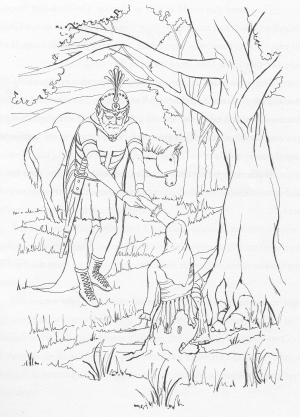 loved and treated royally, here she was in a bleak castle dungeon, in a rough itchy dress that didn't fit, and her beautiful hair no longer hung with ribbons and jewels but cut blunt and uneven. She was glad she had no mirror to see it. "This is no way for a queen to be treated," she sniffled. She was alone, abandoned, friendless. It even hurt to cry, because her nose was already red and sore from a cold brought on by the dampness.
Then God spoke to her, quietly so as not to startle her. "Be of good heart, Alice. Don't you know I will rescue you at just the right moment? Dry your eyes and open your ears - listen."
All Alice could hear was the scurrying of hard-shelled black bugs, up and down the walls, to and fro, hither and thither, across the floor and under the door. But above this came the sound of tap-tap-tapping. It came from the grate of the window set high above her.
She stepped carefully over the bugs and looked up to see an old priest who had been her friend when she lived in the palace. He had not , forgotten his queen and had come with a plan to rescue her. First, he would dig a tunnel from outside where he was, to under the cell where she was. Then he would come up under one of the stones on the floor, which Alice would have to loosen.
It sounded impossible to Alice, but she remembered that nothing was impossible if God was helping. She prayed that the priest wouldn't get caught and that the black bugs wouldn't eat her toes while she was waiting. In a few days there was a thumping and knocking under the very stone she was kneeling on. She pried it loose, and there was the face of her friend, the priest. Come quickly, he whispered, follow me, and pull the stone down after you." She did as she was told, just as the guard came to see about those strange noises in the queen's cell. The stone moved slightly, and his eye caught it.
"Oh no, you don't! Come back here this moment, Your Majesty, you're not allowed to escape! Excuse me, Your Majesty, but you better watch out because I'm coming down after you!"
And he jumped down the hole after them. But they had scrambled through the tunnel so easily, they were through and out in no time flat.
The priest bid Alice goodbye, for he had to be back to his rectory for dinner so his housekeeper wouldn't suspect anything. Alice thanked him and began to make her way through the dark, unfamiliar wood. Suddenly she began sinking in the mud. It came up to her ankles, then her knees, and she felt as if she were stuck in a glob of cold, thick molasses. When it got to her waist, she cried out to her guardian angel to get her out of this mess.
The sound of galloping horses drew nearer and nearer, and just as the mud reached Alice's armpits, a band of soldiers in strange uniforms appeared. The leader jumped off his horse and, standing on the firm, rocky soil, he reached over and pulled her to safety.
He told Alice he was Otto, the Emperor of Germany, and he had come to Italy to defeat the evil Berengarius. "Good!" said Alice.
When he accomplished this, Alice no longer had to hide. She was free. Otto, who had fallen in love with her when he first saw her in the mud, asked her to marry him and to become the Empress of Germany. Alice thought this would be lovely, for she had fallen in love with him when he pulled her out of the mud, and so they were wed on Christmas Day. The German people loved Alice and called her "a marvel of grace and beauty." She was indeed a marvel, for in her lifetime she would be princess, queen, empress, wife, and (after Otto died) nun.
Everything that happened in her life, Alice handled with grace. Nevertheless, she still would shudder whenever she heard the sound of . those black, hard-shelled bugs scurrying around in the dark.*
* Alice is also known as Adelaide or Adelheid.
Excerpted from Once Upon a Time Saints by Ethel Pochocki
Copyright 1977/1978/1996, Used with permission of Bethlehem Books
 ONE
ONE
Alone in the World
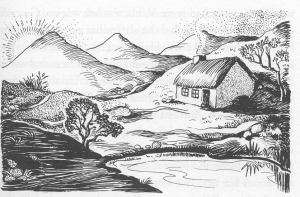
A LATE sunbeam struck the little whitewashed cabin that lay snuggled against the mountainside, and picked out the red flash of a girl's petticoat. She was sitting on the doorstep, her chin cupped in both hands, wide eyes raised to the smoldering sky. Blue shadows stole up around her, hiding the shining playthings of the day; a sound of lamenting and weeping came from the cottage, where candles burned around a still, white figure. The little girl's thoughts had followed her eyes into far worlds. Grannie had gone. What was left was not Grannie any more. Pegeen had fled the unfamiliar presence, fled the kitchen, where bulky neighbors rocked and keened, waiting for the funeral. Pegeen would rather sit here and watch the sky change behind the mountain tops. Up there, somewhere, God sat on His throne with His angels around Him and star-crowned Mary, the Mother of God. Somewhere, there, behind those fading clouds, shone the Glory of Heaven from which the sun borrowed its light. How Grannie always did bless the sun when it warmed up her old bones for her! But Grannie had gone now; Grannie, who had been all the parent Pegeen had ever known, for her father and mother had died before she was old enough to remember. Grannie, whose knotted fingers had smoothed away Pegeen's first pains, whose wrinkled lips had taught her her first prayers. Dearest, darling Grannie, she was up with God now, sitting in His golden light with His holy saints and angels. If only Pegeen could be quite sure that she was happy now. But Grannie had been so fond of her old gray shawl and her cup of black tea, and she had so loved telling stories. Pegeen couldn't help wondering how she'd get on in Heaven, standing up all the time in the strong glare of Blessedness and shouting: "Hallelujah!" If only there were a quiet little corner with a rocking-chair and a turf fire, to keep Grannie in comfort. The more Pegeen thought about it, the more she doubted it. Och, it was a pity, it was indeed, that Grannie couldn't have taken her shawl and slippers with her. She'd be lonesome in one of those thin white dresses they do be wearing up in Heaven, and she wouldn't look right in it, either. And she wouldn't find anyone to listen to her tales, for once you came to Heaven you knew everything naturally, like the angels, Father Kelly said, so the others'd be knowing the end before she had begun, and what was the fun of that!
Oh, if only Pegeen could die too! She'd take care of Grannie all right, all right. She'd torment old Saint Peter till he gave Grannie all she wanted. But perhaps he wouldn't let her in even if she did die, because of all the wickedness with which she had been filling her days. No, she had better bide awhile and learn to be good first, so she could be with Grannie later. It would be easy to be good now, for there'd be no 'one to forbid her anything. She could manage very well by herself, so she could. Hadn't Grannie often praised the tea she made? And wasn't she able to cook stirabout and mind the pig, that contrary creature? Och, it wouldn't be any trouble at all, at all. ...
But in the kitchen of the little white cabin the neighbors were planning other things for Pegeen. "Who's going to look after the child?" one of the women asked, when the quietness in the room had grown too heavy.
"She has got relations in America, hasn't she?" said Mr. Coyle, between two puffs from his pipe.
"Maybe she has, but the news won't reach them for a long while, and they may not be wanting her at all."
"Sure, old Mrs. Murphy was a poor hand at raising childer, God have mercy on her soul," said the widow Magee, shaking her head. "They all up an' left her, except the one that died, an' he small use to her."
"They say her son Dan has been making a fortune in America," chirped Mrs. Coyle. "He'd be able to take the child surely, an' bring her up in comfort."
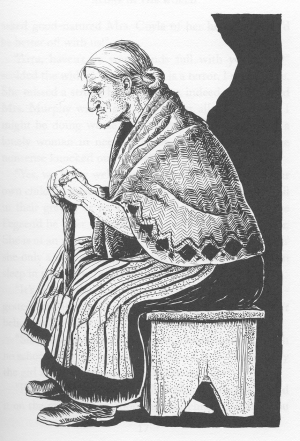 "Little ye know," croaked the widow ominously. "I've heard that he has lost his religion an' has gone into society! I wouldn't expect too much of himself!"
"She'll have to go to an orphanage so," said Mrs. Coyle.
"An' they do say the poor childer never get enough to eat in those places." !
"Not enough to please' em, but enough for their health," said the widow Magee grimly; "I don't hold with spoiling charity childer. Sure, it'll only make it harder for 'em later on, when there'll be no one to look after 'em."
"God spare the child! Can't we take her home, Mike?" asked good-natured Mrs. Coyle of her husband. "She'd be better off with us!"
"Arra, haven't ye your hands full with your own?" scolded the widow. "An' this one is a terror, I promise ye. She missed a strong hand over her, indeed she did. Old Mrs. Murphy wasn't equal to her at all, at all. Sure, I I might be doing worse than to take her meself, an' I a lonely woman in need of company. I'd soon have the nonsense knocked out of her!"
"Yes, we know well ye were a miracle at rearing your own childer," teased Mrs. Geoghan. "It's a pity they're all in their graves, or we could be admiring them. Maybe Pegeen'd be safer with meself; I could find a use for her. She is of an age now to lend a hand around the house an' she only a skinny wee thing that won't eat much an' can sleep in the bed with my Sheila."
"It's my opinion she should be going to school," suggested Pat Finney. "She is as ignorant as a donkey. I don't believe she'd know a letter if she saw one."
"Small blame to her, living in this lonesome place with no school for miles around," said Mrs. Coyle. "Sure, I pity the girl an' the wild way she was brought up!"
"I'm thinking it suited Mrs. Murphy; she always blamed it on the modern education that her childer left her. You leave Pegeen to me an' I'll see to it she soon knows her letters," and the widow waved her hand as if it held a stick.
"Och, it isn't learning, it's companionship she needs most," argued Mrs. Coyle. "She hasn't played with other lassies the way she should. She is too shy entirely."
"Shy! She's as bold as brass. She needs a firm hand, I'm telling ye!"
The women raised their voices as they continued to disagree, and their talk drifted down to Pegeen, filling her ears.
The sun had gone and the vision of Heaven faded before the black arm of the night. Pegeen felt like a treasure washed ashore for anyone to pick up. She didn't want to go to an orphanage, where girls are packed like peas in a pod and kept hungry for their own good. She didn't want to go with Mrs. Coyle to her shouting, quarrelsome family. She didn't want to go with the widow Magee to be whipped into her likeness. She didn't want to go with Mrs. Geoghan, to sleep in a bed with Sheila, whose mouth stood open and who never understood anything until you said it twice. And least of all did she want to go to America, the place that had swallowed up all Grannie's happiness. This was her home, this little cabin in which she had spent the seven years of her life. No one should have the power to drag her away from it. But grown people could always do what they liked to children. You were never safe from them until you were big yourself "Please God, make me grown up at once," prayed Pegeen, her fists against her eyes. She waited a moment, hopefully, but when she felt no miraculous force tugging at her limbs she gave it up and slipped off silently into the gloaming.
The moon was in full sail when Father Kelly came clip-clopping around the mountains on his old brown horse. Something had drawn him to the little white cabin where his old friend Mrs. Murphy now slept her last sleep.
"Sure, ye needn't be traipsing around at this hour of the night," his housekeeper had grumbled. "As if ye didn't need yer rest more than anyone, what with calls coming for ye here an' calls coming for ye there, till ye look as if I didn't give ye anything fit to eat. Couldn't ye be sending a message now, like, instead of going yerself?" But Father Kelly had shaken his head. A message wouldn't do at all, for what was driving him out into the cold September evening was the memory of two startled eyes watching him from afar as he sat by old Mrs. Murphy's bed, holding her dying hands. When all was over, he had wanted to comfort the child, but she had fled from him like the wild thing she was, not trusting the touch of his hand on her sorrow. Now the memory of it was urging him. Something must be done for Pegeen as soon as possible, before gossiping crowds came trampling into the intimacy of her life with Grannie. So he had saddled his horse and gone the long way around the mountains, leaving Mrs. Malone to her grumbling.
As Brownie ambled along, Father Kelly had plenty of time to think. He loved the endlessness of a sky filled with stars and the fragrance of sleeping earth. The spiritual world seemed nearer then, as if day were only a prison, holding captive the noise and glare of each moment, whereas night poured itself out into eternity. But the very vastness around him made the priest feel more tenderness for the small creature left on the mountainside like a homeless kitten. He had written to Pegeen's uncle in New York, and he expected that the child would be sent for, sooner or later. But he was not happy about it. Even if it were true that Dan Murphy had made a fortune and lived in great elegance, Father Kelly doubted whether a mountain lassie would fit into the life of a great city such as New York. Of course children did adapt themselves quickly to new surroundings, but he wasn't sure Grannie Murphy would have liked that. She had been heartbroken at her own children's flight from the soil of their birth. She had been a great patriot in her own day, 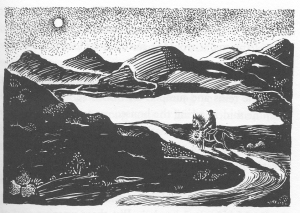 had Mrs. Murphy. It seemed to him that he had read her last wish in her fading eyes. She had entrusted Pegeen to him. But a priest isn't the person to bring up a young girl; she needs a mother. And mothers' don't grow on trees.
Besides, Dan Murphy might insist on having her. He was her guardian now, and bound to take an interest in his brother's child. If only America weren't so far away! Father Kelly sighed. He could see the lighted windows of the little cabin from afar. All the neighbors were at the wake, of course. He hoped they were considering the child. Perhaps he had better take her for the night. She'd have to go somewhere until it was settled what was to be done with her. Of course Mrs. Malone would protest, but she'd have to find out some time who was boss in his own house. Anyway, it wouldn't hurt her to look after a wee girl for a while.
"Whoa, Brownie, here we are!" Father Kelly threw down the reins and jumped off his horse. "God bless all here," he said, entering the house.
"God bless yourself, Father."
"I came to make arrangements for the child," said the priest, with a rapid glance around the crowded kitchen. "Where is she?" Yes, where was she? No one had missed her, each thinking that she was sitting in some quiet corner, grieving over her loss. But there wasn't a sign of her anywhere. Father Kelly grew anxious. What strange fancy had driven the child out into the night? He hoped she hadn't done something rash. ...With two of the men he went to look for her, darting the rays of his lantern under every shadowy bush, into each secret nook.
"Pegeen! Pegeen!" The sound of his voice crashed and echoed against the wall of night, followed by the rustling of startled creatures scampering to safety. "Pegeen! Pegeen!"
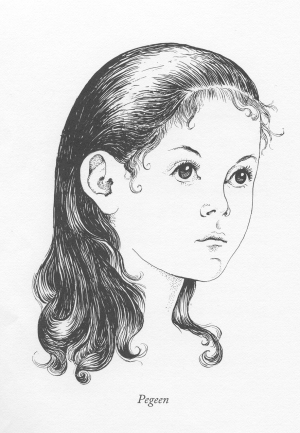
At last they found her, half buried under wet ferns, her face pressed down on the earth and hidden by the tangle of her dark curls. For a moment Father Kelly's heart stood still, then he saw that she was only asleep. He roused her gently. She sat up, eyes fluttering like drugged moths before the lantern light.
"No, I won't, I won't!" she cried, beating and kicking with her arms and legs. "Ye can't take me away; I won't go! I won't! I won't!"
"Come along, child, it's dreaming ye are," said Mr. Coyle, putting out strong arms to lift her. But he jumped back as suddenly, sucking at his fingers and crying: "She bit me, the vixen!"
Pegeen laughed wildly, showing her sharp teeth. "I'll bite ye again!" she cried triumphantly. "I'll bite ye in little pieces an' spit ye out one by one! See if I won't!"
"If ye were me own daughter. .." growled Mr. Coyle ominously.
"I'm not, an' I won't be! I won't! Do ye hear?" screeched the child.
"Leave her to me," said the priest, putting a hand on Mr. Coyle's shoulder. "You men go back, we'll follow."
"It's as ye say, Father," grumbled Mr. Coyle. "But look out she doesn't snap off your nose for ye!"
When the rustle of the men's departing footsteps had died away; the priest began to talk. "Ye're not on your best behavior tonight, Pegeen. What ails ye? Sure, don't ye know Father Kelly is your friend an' longing to lighten the burden that has fallen on ye this day, God help ye?"
"Will ye not let them take me away, then? Will ye let me stop in Grannie's house, same as ever?" and Pegeen raised such mournful eyes in such a pinched, tear-stained little face, that it smote Father Kelly's heart.
"Is that what's vexing ye, Pegeen mavourneen?" he said tenderly, sinking down beside the child on the soft, damp turf, and taking her hand in his. "Sure, an' I can well understand it. It's a hard thing to leave the house ye were born an' reared in, a hard thing indeed."
"But, Father, I don't need to be leaving it at all, an' I as good at the housekeeping as Grannie herself, an' able to make the bed, too, if I stand on the footstool!"
Father Kelly smiled in the darkness. "Ye're only a lassie," he said, stroking the little fingers that lay curled in the palm of his hand. "Ye don't know the dangers an' hardships that'd come pouring down on ye if ye took such an independent position. Sure, I know it's seven years old ye are, but there's still a few things left for ye to learn."
"Oh, Father Kelly," sighed Pegeen. "I wish God would listen to me an' make me grow up at once so that I can do what I want. ..."
"Ho! Ho!" laughed the priest. "Is that your view of it! An I thinking to meself I'd like to be young again an' without duties for a while. Don't ye be wishing life shorter than it is already, me foolish girl. Ye don't know what lovely 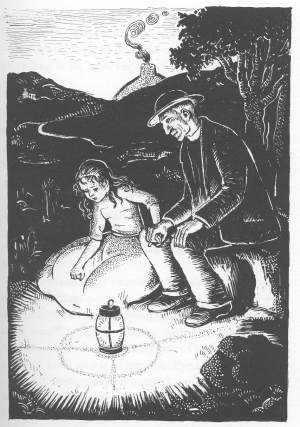 surprises God may be hiding up His sleeve for ye an' what beautiful countries ye may not be visiting. ..."
"I don't want to see beautiful countries; I don't want to go visiting at all," said Pegeen stubbornly. "I want to stay here."
"But the little cabin will be cold an' comfortless without Grannie," argued the priest. "Ye mustn't be like a cat, which has no reason an' wants to stay in a place for the sake of old times. Sure, Grannie won't be any nearer to ye here than anywhere else. Where she is now all places are alike to her."
'"Do ye think so, Father?" said Pegeen, and in the pale lamplight her eyes looked like ripe, black plums. "Don't ye think she'll be lonesome for her place by the fire? They do be so grand up in Heaven, I wonder will it suit her at all!"
Father Kelly's lips twitched. "Surely ye don't believe that God would promise us happiness an' then pay no attention to our wishes, trying to please us with what we don't want?" he asked, playing with Pegeen's curls. "Ye may be sure He knows exactly what Grannie would like most, an' He'll give it to her. For 'Eye hath not seen nor ear heard, neither hath it entered into the heart of man what things God hath prepared for them that love Him.' No, no, Pegeen, I wish I could be as easy about you as I am about Grannie. Can't ye try an' tell me what it is that makes ye want to stay here instead of traveling in a great big ship?"
"I. ..I do want to go traveling," said Pegeen dreamily. "In a white ship. ..to the end of the world. ...Oh, Father Kelly, now I know why I can't go away! It's because of Francie!"
"Francie?" For a moment the priest didn't know what she was talking about. "Which Francie?"
"Oh, ye know, Father, the little boy that helped me chase the pig last summer till we got lost in the fog an' then ye found us an' brought us home again. ..."
In a flash Father Kelly understood. How could he ever forget the bright little boy who had managed to escape from a Dublin hospital only to wander all over Ireland in search of his home in Glengarriff? Father Kelly had been able to put him on the right track at last. "Francie, indeed," he said, smiling to himself "But what on earth has he got to do with it?"
"Sure, an' didn't he promise to fetch me as soon as he had grown a little older, for to go sailing with him in a white ship, all the way to the end of the world? How will he find me at all, at all, if it's somewhere else I am entirely, an' the cabin full of strangers? 'Deed I can't leave, 'deed I can't, Father Kelly. Ye can see it for yourself now!"
"Did ye never think of writing him a letter?" the priest asked her.
"A letter. ...But I can't write at all!" cried Pegeen.
"If ye come with me, I'll help ye with it," promised Father Kelly, and he made a move to get up, for his legs were growing stiff from sitting on the damp soil.
"Oh, will ye?" cried Pegeen, clutching at him. "An' ye'll not forget? Honest to goodness not?"
"An' ye won't let Mrs. Coyle take me to her house? Or widow Magee? Or Mrs. Geoghan? An' ye won't send me to the orphans? Or to America?"
"Och, there's a thousand worries on ye, I see," said Father Kelly, pinching her ear. "Sure, I wouldn't dare take ye anywhere without your permission."
"Then I'll go with ye," and Pegeen placed a trustful little fist into Father Kelly's outstretched hand.
"That's the girl," said the priest, picking up his lantern. "An' now we'd better be going back or they'll be thinking the fairies took us. May I ask if ye have any objection to staying with me for a while? I know the housekeeper is not as sweet-spoken as she might be, but if ye're willing to put up with her I'll be very happy to have ye for a guest.
"Oh, Father Kelly, indeed I'd love it!" cried Pegeen, rubbing her cheek against his sleeve like an affectionate kitten.
"That's settled then, even if it does mean a fight with the ladies," said Father Kelly bravely and, full of content- ment, the two walked back to the cabin.
Excerpted from Pegeen by Hilda Van Stockum
Copyright 1941/1996, Used with permission of Bethlehem Books
The Countersign
One fine moonlit night, during a late war in Europe, a lonely sentinel was pacing up and down his solitary beat when, suddenly, he heard a faint sound, like that of a stealthy footstep. It came from a clump of trees which formed the boundary to a portion of the land occupied by the camp.
He at once concluded that someone was trying to enter secretly, and so moved forward to the spot just as a man in uniform came into view.
Loud and clear rang the sentry's voice, as placing himself in front of the stranger he spoke the words usual at such a time -"Who goes there?" " A friend," was the feebly uttered answer. "Advance, friend, and give the countersign."
I ought to explain here to my young readers, that, in time of war, soldiers are every night placed at regular distances from each other, on all sides of the camp, to act as watchmen, and are forbidden under pain of death to permit anyone to pass them in any direction, unless sent by an officer.
To make sure of this, a word or two, or a sign, is chosen every night by the officers, which none know but their own men and the sentinels. This is called the countersign. Of course, anyone who does not know the countersign is considered to be an enemy.
When the sentinel said, " Advance! and give the countersign," the stranger replied, "I do not know it. If I did, I would not have tried to enter secretly; but do you not see by my dress that I am one of you. Three months I pined in the enemy's prison; yesterday, I escaped. Let me pass, for the love of God. I am ready to die with fatigue."
The sentry shuddered at the words, "for the love of God;" for he was a devout Catholic, and his heart ached to have to refuse this request. Besides, he believed the stranger was speaking the truth.
Still his orders were to shoot anyone who attempted to enter the camp without giving the countersign. "You have broke our rule," he said, sorrowfully. "You have broken it, and the punishment is death."
"I am not fit to die" said the other, in a hoarse voice. "I have offended God grievously in the past; I must have time to repent before death."
"I give you five minutes to pray." The young man sank upon his knees, raised his eyes to heaven, and made the sign of the cross. "You are saved!" cried the sentry, "because of our holy Faith. The Sign of the Cross is the countersign tonight."
Vocabulary
1. solitary
2. stealthily
3. feebly
4. pined
5. fatigue
6. shudder
7. hoarse
8. grievous
9. sentry
10. repent
Reading Comprehension Questions
1. Why did the sentry have to refuse the soldier's request even though he believed he was telling the truth?
2. What did the soldier mean when he said, "I am not fit to die"?
3. What saved the soldier?
Project
1. What sentry do you have posted at the entrance of your mind and heart? What is the countersign of your soul? Do you let in whatever feels good and pleases you, or what you know pleases God? Draw a picture of your Guardian Angel and on the back, list the ways he guards your soul. Ask your parents to help you.
Excerpted from Rare Catholic Stories and Poems
1999, Catholic Heritage Curricula, Used with permission.


Excerpted from Reading Comprehension: Stories of the Saints (Volume 1) by Elaine Woodfield
Copyright 1997, Catholic Heritage Curricula, Used with permission.