No name

Math Memory

A Game of Concentration to Build Math Skills
Book cover: 'Math Memory: A Game of Concentration to Build Math Skills'
Subject(s): 
Resource Type: 
Review: 

Creative Toys, 1997, 140 study cardboard cards in a standard game box

This is a fun and well-made math version of the classic Memory game. Instead of finding matching pictures, children match equations with answers. (Equation cards and answer cards look different on the backs so you can select one of each.) The answer cards have a sample equation for each operation printed in the corners. Equations are color-coded according to operation so you can easily sort out ones that you aren't currently focusing on (it's also a little difficult to use all the cards at once - there are so many!)

Review Date: 
2-1-05
Reviewed by: 
TitleSort: 
Math Memory

Math Talk

mathematical ideas in poems for two voices
Book cover: 'Math Talk: mathematical ideas in poems for two voices'
Author(s): 
Theoni Pappas
Subject(s): 
ISBN: 
933 174 748
Resource Type: 
Copyright: 
1999
Review: 

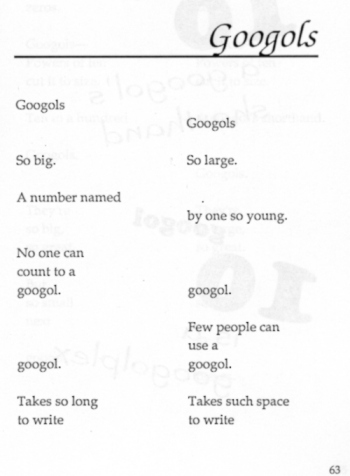
I have long been a fan of the poems for two voices books by Paul Fleischman. This book puts a twist on the idea by covering math topics in poems. It's a really unique and engaging way to memorize a math concept, reciting it as a poem. A poem for two voices is a poem recited by two people where sometimes the same words are said in tandem, sometimes alternately, and sometimes, the speakers speak at the same time saying different things.

Here is a sample of part of a poem from the book: (The first column is the first speaker and the second column, the second - shown smaller than actual size)

Some of the math concepts in the poems are fairly simple ideas that would pertain to a grammar school student, however most of the ideas are for middle schoolers or high schoolers. There were a few math concepts I had never heard of, such as fractals, (the geometry of nature), Fibonacci numbers (adding the last two numbers in a series to give the next number), and Mobius strips (circular strip with a twist in it).

While you don't learn everything you need to know about the math concepts in the poems, you get an introduction to the idea and the basic or interesting facts. For tessellations, the reader learns that not all figures tessellate; for triangles, the reader learns that the angles in the figure must equal 180 degrees. Some of the accompanying illustrations are also instructive. I could not have visualized the Mobius strip without the drawing of it.

This is a fun way to talk about these concepts. Trying to say the poems as a team takes a lot of concentration and brings a lot of laughs along the way. The book would make a great addition to a living math program or be a nice break from a formal textbook program.

Recommended for grades 4-12

Publisher: 
Wide World Publishing/Tetra
Binding: 
Softcover
Number of pages: 
71 pages
Review Date: 
6-21-05
Reviewed by: 
TitleSort: 
Math Talk

Math-U-See

Book cover: 'Math-U-See'
Author(s): 
Steve Demme
Subject(s): 
Grade / Age level: 
Resource Type: 
Copyright: 
1998
Review: 

Math-U-See is a fairly new Math program, designed especially for homeschoolers, which runs from Kindergarten all the way through high school. The author is a former high school Math teacher who has attempted to balance a solid conceptual understanding of math with enough practice to let it "sink in." The program consists of a student text (workbook format), a teacher's manual, and optional practice sheets, special Math-U-See blocks and a teacher training DVD. I am very impressed with this program. The author does a fine job of allowing the students to become well aquainted with using numbers. I found math concepts very easy to explain to my daughter with the use of the very clever manipulatives (which might be thought of as a cross between "Base-ten Blocks" and Cuisinaire Rods). I was particularly impressed with how clearly place value is taught and how thoughtfully the child is prepared for future lessons (e.g. early on in addition, the child starts doing simple "solve for the unknown" problems in preparation for subtraction). Other skills learned include telling time, measurement and a heavy emphasis on skip counting (in preparation for future multiplication and factoring). My only complaint is that some of the material is contained only in the teacher's manual (I can imagine that this might have been done intentionally to force the parent to follow along in the teacher's manual rather than letting the child work entirely on their own. The author demonstrates how each concept works on the DVD so that the parent may more confidently teach the concept to the child.

Over the years we haven't always used Math-U-See as our primary Math text, but we have always found the DVDs and blocks useful no matter what we were using.

Publisher: 
Math-U-See Foundation
Review Date: 
7-7-05
Reviewed by: 
TitleSort: 
Math-U-See

Meat & Potatoes Catholicism

Author(s): 
Rev. Joseph F. Classen
Grade / Age level: 
Resource Type: 
Copyright: 
2008
Review: 

Are you malnourished? Many Catholics feel that they don’t know the faith, they are spiritually malnourished. To satisfy your hunger for the faith, Fr. Classen wants to feed you the fundamentals of your faith in Meat & Potatoes Catholicism.

Determined to write a book that makes sense to those who sit in the pews, Fr. Classen has set out to educate you in the essentials of the faith. As he says, “We need to nourish ourselves and feed voraciously on the basic fundamentals of our Catholic faith and redefine the way we live our lives.”

Broken down into nine chapters, he addresses the real questions of our faith. In chapter one, he tackles the question of why people quit the Church and why they should stay. Chapter two deals with how God leaves signs in our lives. One of the most important ways is through his sacraments. The subsequent chapters in the book each cover a sacrament.

What makes this book different is his friendly conversational style and his real life examples. Given a choice between reading a catechism, which can be dry at times, or sitting down with someone and discussing the faith, most people will take the latter. That is what he offers the reader, a friendly conversation about the faith, with real life examples.

Imitating Christ’s example of drawing on real life analogies, he uses vivid examples to answer the usual questions about our faith. “What is the Church?,” “Why can’t I just confess my sins directly to God?” He doesn’t shy away from the tough questions like, “What’s wrong with a homosexual marriage?”

Each chapter follows a similar format. He introduces the chapter with an interesting story, explains the important information about the topic and follows up by answering the typical questions people have about that subject, all in a lively conversational tone. Woven throughout are quotes from both scripture and the CCC to help define the topic at hand.

The highlights of the book include his clever analogies and interesting stories. My favorite analogy is his comparison of a priest during confession to a spiritual garbage man. His vocation story is particularly inspiring. It demonstrates how the example of others can dramatically influence our own personal decisions.

If you know someone who has questions about the faith or could use a refresher course in the sacraments, Meat & Potatoes Catholicism sets out the truth in a friendly readable manner. Entertaining and informative, Meat & Potatoes Catholicism may be just what they are looking for.

Publisher: 
Our Sunday Visitor
Binding: 
Sewn Softcover
Perspective: 
Catholic
Number of pages: 
238 pages
Additional notes: 

Ordained in 2003, this is Fr. Classen's second book published by Our Sunday Visitor.

Review Date: 
1-10-2009
Reviewed by: 
TitleSort: 
Meat & Potatoes Catholicism

Meet the Masters

Homeschool Edition Curriculum and CD-ROM, Level 2
Subject(s): 
Resource Type: 
Review: 

Years ago, a friend who teaches university-level art classes, told me that the best way for me to teach my children art was to combine how-to instruction with art appreciation. She suggested learning about the life of a particular artist by reading biographies and then learn how to imitate his or her technique. This made perfect sense to me, but I did not feel knowledgeable enough in the subject matter to put together my own curriculum and I did not know of any such art program that could be used in the home.

Enter Meet the Masters. This program integrates how-to instruction with art appreciation.

To review Meet the Masters, I invited two other families to join me and my children in using the program, forming a co-op of sorts. My desire was to get a feel of the program myself, as well as see how other families responded to the instruction. I am happy to report that our little art co-op was very successful.

In the first lesson the children learned about the life of Vincent Van Gogh, through the CD-ROM that comes with the program and the Internet. All of the children gathered around me and the computer, as I read from the script that comes with the program. It is good that Meet the Masters provides scripted instruction, as my personal knowledge of famous artists is admittedly limited. I learned about the life of Van Gogh alongside my children.

After reviewing Van Gogh's biography, we moved to the dining room table where we learned about his art technique and the children could mimic it. The program provides careful instructions on how to help the children with the lesson. It also provides a supply list and set-up instructions, so I was well prepared before our friends arrived.

I enhanced the program a little by searching out more of Van Gogh's artwork on the Internet and even saved one of his paintings to use as "wallpaper" on the children's computer (just left-click on the picture). That way every time the children booted up the computer, they were treated to a beautiful piece of art. I also picked up a children's biography at the library.

We met with our friends every other week until the program was finished. During that time we learned about Mary Cassatt, Piet Mondrian, Pablo Picasso, Claude Monet, and Winslow Homer. My children and the children of my friends (ages seven to twelve) all enjoyed the program and were even heard speaking about things such as texture, complementary colors, contrast, and the such throughout the weeks. On more than one occasion, my children recognized, and were excited to see, prints of the artists that we studied while visiting friends' homes or the doctor's office.

Though I do like this program very much, I am disappointed at the high price tag. It is expensive and parents must weigh the benefits with the cost carefully. However, the publisher does offer a generous discount if customers order more than one grade level at one time. A computer with a CD-ROM and Internet access is necessary to use Meet the Masters.

Note: This review is a bit out-dated. You can look at their current offerings here: http://meetthemasters.com/

Review Date: 
1999
Reviewed by: 
TitleSort: 
Meet the Masters

Memoria Press' Henle Latin Guides

Author(s): 
Cheryl Lowe
Martin Cothran
Subject(s): 
Grade / Age level: 
Resource Type: 
Copyright: 
2000
Review: 

Fr. Henle's Latin course is now well recognized as a superior choice among Catholic homeschoolers. Many curricula have adopted it and recommend it, and also publish syllabi and course plans of their own to aid families in breaking it down the lessons day by day. For instance, Mother of Divine Grace School and Kolbe Academy both have their own plans available beginning at the High School freshman level.

Memoria Press, publisher of Latina Christiana and other Latin texts, has introduced a syllabi with a different formula: a slower pace lesson plan/study guide for use after elementary Latin studies, beginning in 5th to 8th grade (but is not limited to students with previous Latin studies).

The lesson plans are well organized daily, and every page is a five day week. Each day lists the suggested activities and students can check the box by each of them. On the first pages the layout is simple and crisp, but as the course progresses and more text is necessary each day, it becomes a bit confusing, especially since the days are numbered outside of a margin. On this “side bar”, as I will call it, there are occasional extra daily lesson notes, helpful and simply put. Unfortunately once in a while these notes are a little longer and get trampled with the day numbering. Hopefully Memoria Press will fix these two problems simply, by removing the days' numbers from this side bar and placing them right by the beginning of each day’s activities where they belong.

Our children’s Latin tutor looked at this and was very pleased with this text's format—it is a plus to have the five days on a weekly page and a system of boxes that can be checked as the work is done. It looks like it would be very helpful especially for students tackling Latin on their own. Latin, as the author comments, has a way of “piling up quickly”. Memoria Press’s Guide to Henle Latin I may be a very helpful tool for homeschool Latin students. Included in the course plans are many resources such as a cumulative grammar tests and a section on how to make vocabulary and grammar cards.

You can access information on these products, and see sample pages at Memoria Press' website.

Publisher: 
Memoria Press
Binding: 
Spiralbound
Additional notes: 

Second volume published in 2003.

Review Date: 
10-9-06
Reviewed by: 
TitleSort: 
Memoria Press' Henle Latin Guides

Memorize the Faith! (and Most Anything Else): Using the Methods of the Great Catholic medieval Memory Masters

Author(s): 
Kevin Vost
Grade / Age level: 
Copyright: 
2006
Review: 

This is neither a textbook nor a homeschool book, yet it could very well serve as basis for a religion curriculum for a year! The author, Kevin Vost Psy. D., teaches not only a time-proved, centuries old method of memorization, he also guides readers step by step through memorizing the major tenets of the Faith.

The book has the usual uncluttered, crisp Sophia Press lay-out, and is divided into 5 major parts. Part 1 introduces the method and explains how it works, in a language accessible to an average reader. Parts 2 and 3 include step-by-step guides to memorizing lists from Sacraments and Commandments to Beatitudes, to works of Mercy, Holy Days of Obligation and even the Six Sins against the Holy Spirit. Part 4 goes further into memorization of important basics of our faith, covering all of the books of Bible, the Twenty-One centuries of Church History, virtues, sins, and the list goes on. Truly impressive! Along with these five major parts, there are twenty-nine Memory Master Tips and Facts gray blurbs throughout the book that are informative and interesting as well.

From the publisher:

" (...) over 700 years ago, St. Thomas Aquinas perfected an easy method for his students to memorize most any information, but especially the truths taught by Christ and His Church. As the years passed, our need for this ancient art of memorization grew, yet somehow our culture largely forgot it . . . which is why today, when you and I try to remember a list of things, we have to repeat their names over and over. (...) Now, thanks to the delightful pages of Memorize the Faith!, you can easily keep all these in mind — and learn the Faith! — by tapping into the power of the classical memory system that helped St. Thomas become the Church’s preeminent theologian, and made it easier for him to become one of its greatest saints. (...) By the time you finish this book, you will have memorized dozens of key teachings of the Church, along with hundreds of precepts, traditions, theological terms, Scripture verses, and other elements of the Faith that every good Catholic needs to know by heart."

The best as far as homeschoolers are concerned is the fifth part, entitled "Application for all ages". Here the author addresses exactly the business of how to use the book for children and young adults, and more. Under specific homeschool use he suggests using the method for test prep--such as SAT, ACT, etc., and as and aid to good public speaking.

This book would also lend itself well, I think, to an extra-curricular club activity of middle/high school students, perhaps under the name "Aquinas Mnemonics Club". As the the author states, the ages that would be best suited to learn and use this method would be upper elementary and High School. If they would meet once weekly with the energy and camaraderie typical of that age, I bet they'd have the content of all of these chapters under their belts (or in their minds) in one year!

Publisher: 
Sophia Institute Press
Binding: 
Softcover
Perspective: 
Catholic
Number of pages: 
271 pages
Review Date: 
4-30-2007
Reviewed by: 
TitleSort: 
Memorize the Faith! (and Most Anything Else): Using the Methods of the Great Catholic medieval Memory Masters

Men of Iron

Author(s): 
Howard Pyle
Subject(s): 
Grade / Age level: 
Copyright: 
1919
Review: 

This is a stirring tale in the tradition of the Knights of the Round Table and Ivanhoe. It takes place in the early 15th century. Myles Falworth is a young boy brought up in a poor but noble household, late in the reign of Henry IV of England. His father, a supporter of Richard II, has been unfairly accused of treason and outlawed. As a youth, Myles is sent as squire to the household of an old family friend, where his unpolished manners, fierce strength of will and impulsive actions win him both loyal friends and fervent enemies.

Over the course of time he finds that he is being prepared to clear his father's name. The first part of the book tells about his training in the chivalric arts of war; the second part tells of his young adulthood. In the final encounter with his family's bitter enemy, the stakes are high; not only his father's good name and the family fortune, but also his future happiness with his chosen bride, and his very life.

Men of Iron is written and illustrated by Howard Pyle, who lived around the turn of the century and was also the author of many other classics such as Otto of the Silver Hand, The Merry Adventures of Robin Hood, several Arthurian romances, and Garden behind the Moon. The language is old-fashioned and complex by today's standards, and some passages of historical detail might slow this book down as a read-aloud, but the story is involving and inspiring. I think it could be read aloud to a child as young as nine, and a 12 to 16 year old would enjoy reading it alone.

Publisher: 
Lepanto Press
Binding: 
Sewn Hardcover
Perspective: 
Catholic
Number of pages: 
328 pages
Review Date: 
3-20-02
Reviewed by: 
TitleSort: 
Men of Iron

Mental Math: Fifth Grade

Book cover: 'Mental Math: Fifth Grade'
Author(s): 
Kathy French
Subject(s): 
Copyright: 
1998
Review: 

Problems at this level include a review of 4th grade math and practice in the topics usually introduced at the 5th grade level. In the 10 questions for each day, concepts of numbers, computation, application, mixed practice, decimals, fractions and percents are covered. Sample questions chosen at random include the following: What number when multiplied by six and divided by three becomes 12? Write seven and four tenths as a mixed number with a decimal. How much time has elapsed from 4:31 a.m. to 7:01 a.m.? 72 people were on the train. 1/8 of them got off at the first stop. How many people were left on the train? What is the volume of a box that is 2 cm by 2 cm by 2 cm?

Publisher: 
Math Concepts, Inc.
Binding: 
Comb-bound
Number of pages: 
141 pages
Review Date: 
1999
Reviewed by: 
TitleSort: 
Mental Math: Fifth Grade

Mental Math: First Grade

Book cover: 'Mental Math: First Grade'
Author(s): 
Kathy French
Subject(s): 
Copyright: 
1998
Review: 

Problems at this level center around practice in the topics usually introduced at the 1st grade level. In the 5 questions for each day, concepts of numbers, computation, application, and mixed problems are covered. Sample questions chosen at random include the following: Write the number 203. What comes next: 50, 100, 150, ___ ? What month comes after March? A square has ___ sides. Jenny is six months old. Nicki is ten months old. Which one is almost one year old?

Publisher: 
Math Concepts, Inc.
Binding: 
Comb-bound
Number of pages: 
75 pages
Review Date: 
1999
Reviewed by: 
TitleSort: 
Mental Math: First Grade