Sample Pages from [em]A Look at Minerals: From Galena to Gold[/em] by Jo So. Kittinger


Excerpted from A Look at Minerals by Jo S. Kittinger
Copyright 1998, Franklin Watts/Grolier, Used with permission from the Author

Excerpted from A Look at Minerals by Jo S. Kittinger
Copyright 1998, Franklin Watts/Grolier, Used with permission from the Author


Excerpted from A Look at Rocks by Jo S. Kittinger
Copyright 1997, Franklin Watts/Grolier, Used with permission from the Author


Excerpted from A Year with God Volume One: Celebrate the Saints Throughout the Year
Copyright 2000, Catholic Heritage Curricula, Used with permission.


Excerpted from Accent Your Syllables by Cathy Behrens
1999, Cathy Behrens, Used with permission.
St. Martin of Tours by Sister Mary Margaret, S.N.D.
(from the American Cardinal Readers, Book Five, pgs. 247-249)
"God of the Christians." Our Lord rewarded him by letting him find Christian teachers who taught him the Catholic faith. He became the bihsop of Tours and as a saint is honored as one of the apostles of France.
When Martin was a young man, he was sent to France with his regiment, for his pagan father had forced him to become a soldier in the Roman army. He believed in Christ,a nd tried to live a good life for His sake, so that even his pagan fellow-soldiers noticed how different he was from themselves; but he had not yet received Baptism, and was still but a catechumen. One cold winter's day, as his troop of cavalry came rattling down one of the old streets of Amiens, a poor old beggar, crouching by the roadside, the icy wind fluttering his rags about, held out his hands and cried for alms. Martin's heart was touched as usual, but having no money left to give, he took off his military cloak, cut it in half with his sword, and wrapped the warm folds about the shivering old man. The other soldiers laughed, but Martin rode on, happy to have been able to serve Christ's poor.
That night he received a wonderful grace in a dream. He saw Our Lord in heaven, surrounded with the angels. Upon Our Lord's shoulders was Martin's half cloak! "Martin," He said, "dost thou know this mantle?" Then turning to the angels, He added, "Martin, still only a catechumen, hath clothed me with this garment."
When St. Martin awoke he was very happy to think Our Lord had taken the kindness as done to Himself; but he also felt there was a gentle reproof in His words, for not yet having received Baptism. It was very difficult during his time of military service, but nevertheless he went to the priests and asked to be baptized.
Shortly after the left the army. He was so happy in his faith that he even succeeded in converting his mother.
Study Suggestions:
Questions on the Text. In this short story is told an incident in the life of St. Martin of Tours. Read it silently.
1. How did Martin happen to be a soldier in the Roman army? 2. In a brief paragraph relate the incident of Martin's meeting with the poor old beggar. 3. How did God reward Martin for his charity? 4. Whom did he succeed in converting later in his life? 5. Locate Tours on a map of France.
Words to Study. Catechumen; reproof.

Excerpted from American Cardinal Readers, Book Five, pgs. 247-249
Used with permission.
CONTENTS
To THE BOYS AND GIRLS OF OUR CATHOLIC SCHOOLS.... iii
INTRODUCTION... ix
A CHRISTMAS CAROL. Charles Dickens... 1
THE POWER OF PRAYER. ..John Henry Cardinal Newman.... 72
THE HOLY CROSS Eugene Field ....73
ON THE DEATH OF EUGENE FIELD. Slason Thompson..... 88
LETTER: EUGENE FIELD TO HIS FRIEND MR. GRAY Eugene Field .....90
WITH TRUMPET AND DRUM Eugene Field.... 92
THE BARREL ORGAN. Alfred Noyes.... 93
WATER Jean Henri Fabre.... 102
NATURE Henry Wadsworth Longfellow. ......111
AT HIGH MASS. Rt. Rev. Msgr. Robert H. Benson.... 112
NOX IGNATIANA Rev.James J. Daly, S.J ....113
THE BLESSED VIRGIN William Wordsworth...... 114
THE TRAGEDY OF JULIUS CAESAR William Shakespeare..... 115
THE LEGEND BEAUTIFUL .Henry Wadsworth Longfellow...... 223
THE WILD RIDE. Louise lmogen Guiney..... 227
LETTER TO MRS. BIXBY ...Abraham Lincoln.... 229
REVERENCE FOR LAW. ...Abraham Lincoln...... 230
THE GETTYSBURG ADDRESS. Abraham Lincoln. .......231
OUR MARTYRED CHIEF ...James Russell Lowell..... 232
ABRAHAM LINCOLN WALKS AT MIDNIGHT ..Vachel Lindsay.... .234
JIMMIE THE WIND. Frank H. Spearman. .....236
THE NAMES OF OUR LADY .Adelaide A. Procter.... 257
THE CHAMBERED NAUTILUS. Oliver W endell Holmes..... 260
MEMORIAL DAY ADDRESS..Wroodrow Wilson..... 262
LETTERS TO HIS CHILDREN. Joyce Kilmer ....266
LETTER TO SIDNEY COLVIN Robert Louis Stevenson....... 268
LETTERS FROM ROME. ...Rt. Rev. Msgr. Robert H. Benson..... 276
AFTER A RETREAT. Rf. Rev. Msgr. Robert H. Benson.... 279
THE CONVICT TRAIL. William Beebe.... 280
THE GENTLE ART OF CHRISTMAS GIVING. Joyce Kilmer...... 294
THE NEW SCHOOL. Joyce Kilmer..... 305
THE SPIRES OF OXFORD. ..Winifred Letts. .....307
HISTORY OF NEW YORK BY DIEDRICH KNICKERBOCKER (Chapter 4, Book 3) Washingoton Irving ....308
CONSCIENCE OR KING? ...Mrs. Lang. ....315
MAKERS OF THE FLAG. ...Franklin K. Lane. .....337
SEA FEVER John Masefield. .....340
MISTRESS CASTLEMAINE'S CHRISTMAS DINNER. ...Rev. Daniel A. Lord, S.J. ....341
THE SOUL OF JEANNE D'ARC Theodosia Garrison..... 363
THE AMERICAN BOY. ..Theodore Roosevelt.... 366
HOWE'S MASQUERADE Nathaniel Hawthorne..... 374
THE PASSING OF CHRIST. .Rickard Watson Gilder..... 396
THE FIRST FLOWER Nicholas Cardinal Wiseman ...400
148TH PSALM The Holy Bible.... 410
THE ANGELIC CHORUS. ..D. J. Donahoe ...411
LITTLE DARBY Thomas Nelson Page..... 412
REVEILLE. Alfred Edward Housman.... 481
THE LAST LEAF Olilver Wendell Holmes... 483
A DISSERTATION ON ROAST PIG Charles Lamb ...485
RUST Jean Henri Fabre..... 495
THE PROPHET LOST IN THE HILLS AT EVENING.Hilaire Belloc....... 501
SALUTE TO THE TREES ...Henry van Dyke.... 502
ON SONG Hilaire Belloc.... 504
THE SOLITARY REAPER ...William Wordsworth...... 510
OXFORD REVISITED. John Henry Cardinal Newman.... .511
THE SIGN OF THE CROSS. .John Henry Cardinal Newman..... 513
A BUILDER'S LESSON John Boyle O'Reilly.... 514
ALICE BRAND Sir Walter Scott ....515
MARZIO'S CRUCIFIX (Excerpt from Chapter XI) F. Marion Crawford... 520
REQUIEM. Robert Louiis Stevenson.... 539
PROSPICE Robert Browning... 540
CROSSING THE BAR. Alfred Tennyson... 541
SUGGESTIONS FOR HOME READING FOR SEVENTH, EIGHTH AND NINTH YEARS.... 543
The Blessed Virgin by William Wordsworth
(from the American Cardinal Readers, Book Eight, pg. 114)
Mother! whose virgin bosom was uncrost
With the least shade of thought to sin allied;
Woman! above all women glorified,
Our tainted nature's solitary boast;
Purer than foam on central ocean tost;
Brighter than eastern skies at daybreak strewn
With fancied roses, than the unblemished moon
Before her wane begins on heaven's blue coast;
Thy Image falls to earth. Yet some, I ween,
Not unforgiven the suppliant knee might bend,
As to a visible Power, in which did blend
All that was mixed and reconciled in Thee
Of mother's love with maiden purity,
Of high with low, celestial with terrene!
Excerpted from American Cardinal Readers: Book Eight
1929, Neumann Press, Used with permission.
CONTENTS
I. FLAG 0' MY LAND (T. A. Daly)................. 1
2. THE SPRINGFIELD Fox (Ernest Thompson Seton )................. 2
3. WORK (Angela Morgan).................... 10
4. OUR NUNS (Rev. J. E. Moffatt, S.J., adapted from Rene Bazin)............... 13
5. THE PROUD KING (Horace E. Scudder)................... 18
6. MOTHER'S WAY (Rev.Abram J.Ryan) ..............27
7. A BLESSING FOR THE BLESSED (Laurence Alma Tadema) ................29
8. THE CHILDHOOD OF ST. JOAN OF ARC (C. M. Antony)................ 31
9. FIGHTING FOREST FIRES (Overton W. Price).............. 40
10. THE AIR-MAIL MAN (Chelsea Curtis Fraser)................. 53
11. WE ARE COME TO WORSHIP HIM (Frances Chesterton)..................64
12. CHRISTMAS AT HOLLY HILL (Thomas Nelson Page).................. 65
13. THE EPIPHANY (Emily Hickey).............. 98
14. OUR STEAM RAILROADS (T. V. Van Metre).................. 99
15. THE DEWS (Rev. John Banister Tabb)........... 105
16. A BENEFACTOR OF MEN (Adapted from the Original of Rene Bazin)............ 107
17. FOR THE HONOR OF THE CITY (Winifred E. Howe) .............114
18. MACARIUS, THE MONK (John Boyle O'Reilly)............... 129
19. OUR LORD AND OUR LADY (Hilaire Belloc) .............132
20. THE HEART OF A PRIEST (Rev. Winfrid Herbst, S.D.S.) ...............134
O 21. THE PIED PIPER OF HAMELIN (Robert Browning)................. 139
22. THE TAX-GATHERER (Rev. John Banister Tabb)............. 150
23. THE DAY IS DONE (Henry Wadsworth Longfellow).................. 150
24. THE ALTAR Boy (Rev. Leonard Feeney, S.J.)................. 155
25. THE YOUTH OF THE HOLY PRIEST OF ARS (Kathleen O'Meara) ...........156
26. AMERICA (Henry Van Dyke) ..................167
27. THE STORY OF SIR ISAAC NEWTON (Nathaniel Hawthorne)............... 168
28. OLD PIPES AND THE DRYAD (Frank R. Stockton)................. 177
29. A CHILD'S DREAM OF A STAR (Charles Dickens).................. 204
30. SHEEP AND LAMBS (Katherine Tynan Hinkson)............... 210
31. A CHILD'S THOUGHT OF GOD (Elizabeth Barrett Browning).............. 211
32. ALADDIN (James Russell Lowell)................ 213
33. WHERE LIES THE LAND? (Arthur Hugh Clough) ...................214
34. THE SHEPHERDESS AND THE CHIMNEY-SWEEPER (Hans Christian Andersen) .............216
35. DON LOOKS AHEAD (David Carroll)......... 225
36. WHILE APRIL RAIN WENT BY (Shaemas O'Sheel)................ 244
37. THE COMING OF SPRING (Nora Perry) .............245
38. ST. MARTIN OF TOURS (Sister Mary Margaret, S.N.D.) .................247
39. THE MIRACULOUS PITCHER (Nathaniel Hawthorne) .................250
40. THE CIRCUS DAY PARADE (James Whitcomb Riley)................. 279
41. EVERY-GIRL'S FRIENDS (Virginia Olcott).................... 282
42. WHEN MARY WENT WALKING (Denis A. McCarthy) ....................294
43. THE PASSION OF OUR LORD (Adapted from "New Testament Stories" by Rev. C. C. Martindale, S.J.) 296 44. ST. BRIGID, PATRONESS OF IRELAND (Margaret M. Kennedy).............. 313
45. THE WIND IN A FROLIC (William Howitt)......323
46. A SALUTE TO THE FLAG.................. 326
47. THE STAR-SPANGLED BANNER (Francis Scott Key).................. 327
St. Martin of Tours by Sister Mary Margaret, S.N.D.
(from the American Cardinal Readers, Book Five, pgs. 247-249)
 When, but a little boy, the son of pagan parents, Martin built himself a hut on the top of a hill, and often went there to pray to the "God of the Christians." Our Lord rewarded him by letting him find Christian teachers who taught him the Catholic faith. He became the bishop of Tours and as a saint is honored as one of the apostles of France.
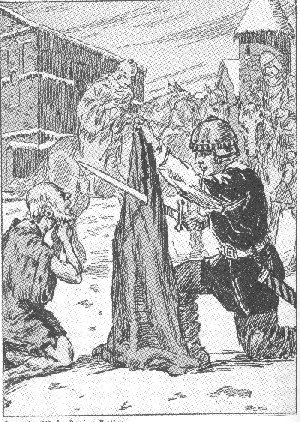
When Martin was a young man, he was sent to France with his regiment, for his pagan father had forced him to become a soldier in the Roman army. He believed in Christ, and tried to live a good life for His sake, so that even his pagan fellow-soldiers noticed how different he was from themselves; but he had not yet received Baptism, and was still but a catechumen. One cold winter's day, as his troop of cavalry came rattling down one of the old streets of Amiens, a poor old beggar, crouching by the roadside, the icy wind fluttering his rags about, held out his hands and cried for alms. Martin's heart was touched as usual, but having no money left to give, he took off his military cloak, cut it in half with his sword, and wrapped the warm folds about the shivering old man. The other soldiers laughed, but Martin rode on, happy to have been able to serve Christ's poor.
That night he received a wonderful grace in a dream. He saw Our Lord in heaven, surrounded with the angels. Upon Our Lord's shoulders was Martin's half cloak! "Martin," He said, "dost thou know this mantle?" Then turning to the angels, He added, "Martin, still only a catechumen, hath clothed me with this garment."
When St. Martin awoke he was very happy to think Our Lord had taken the kindness as done to Himself; but he also felt there was a gentle reproof in His words, for not yet having received Baptism. It was very difficult during his time of military service, but nevertheless he went to the priests and asked to be baptized.
Shortly after the left the army. He was so happy in his faith that he even succeeded in converting his mother.
Study Suggestions:
Questions on the Text.
In this short story is told an incident in the life of St. Martin of Tours. Read it silently.
1. How did Martin happen to be a soldier in the Roman army?
2. In a brief paragraph relate the incident of Martin's meeting with the poor old beggar.
3. How did God reward Martin for his charity?
4. Whom did he succeed in converting later in his life?
5. Locate Tours on a map of France.
Words to Study. Catechumen; reproof.
Excerpted from American Cardinal Readers: Book Five
1929, Neumann Press, Used with permission.
CONTENTS
1. THE RAISING OF THE FLAG (Conde B. Pallen).............. 1
2. THE ANGEL OF THE RESURRECTION (St. Teresa of the Child Jesus)...................... 3
3. THE STORY OF CHRISTOPHER COLUMBUS (Elizabeth Harrison) ...........................4
4. CHRISTOPHER COLUMBUS (Father Tabb).............. 19
5. THREE OF OUR LORD'S MIRACLES: I. THE LOAVES AND FISHES (Sister Mary Gertrude, Sisters of Charity, Convent, N. J.)................. 20
6. THREE OF OUR LORD'S MIRACLES: II. THE MARRIAGE FEAST (Sister Mary Gertrude).................. 23
7. THREE OF OUR LORD'S MIRACLES: III. THE TEMPEST (Katherine Tynan)....................... 26
8. APPLE BLOSSOMS (William Martin).............. 29
9. SONG OF SUMMER (Mary Mapes Dodge)................... 30
10. AUTUMN FIRES (Robert Louis Stevenson)..................... 31
11. THE WONDERFUL TAR BABY (Joel Chandler Harris)....................... 32
12. A TRAGIC STORY (William Makepeace Thackeray)..................... 38
13. A MAD TEA-PARTY (Lewis Carroll).................. 40
14. THE LITTLE POOR MAN (Si,ster Mary Ambrose, Sisters of St. Dominic., Adrian, Michigan) ....................53
15. THE SERMON OF ST. FRANCIS (Henry Wadsworth Longfellow) ...................... 57
16. FRIENDSHIP (Mother M. Salfmte)....................... 60
17. THE STORY OF DANIEL (Rev. C. C. Martindale, S. J.- adapted)................. 64
18. LITTLE JESUS (Francis Thompson)................... 69
19. THE MAN OF THE HOUSE (Katherine Tynan).................. 72
20. THE PINE-TREE SHILLINGS (Nathaniel Hawthorne) ....................75
21 THE BASQUE SONG............. 84
22. WHAT I USED TO LOVE (St. Teresa of the Child Jesus) ..................86
23. THE MINSTREL'S SONG (Maude Lindsay).................. 92
24. THE LEGEND OF ST. CHRISTOPHER (Helen Hunt Jackson)................... 101
25. CANOE TRIP DOWN THE MISSISSIPPI (Eva March Tappan) ................106
26. THE MASS (Sister Mary Gertrude) .................112
27. THE LAMB (William Blake).............. 118
28. CHILD'S EVENING HYMN (S. Baring-Gould) .................119
29. THE STONE IN THE ROAD.................... 121
30. MONI AND THE GOATS (Johanna Spyri-adapted)...................... 123
31. To My LITTLE BROTHERS IN HEAVEN, THE HOLY INNOCENTS (St. Teresa of the Child Jesus ) .................132
32. No (Chauncey Giles)..................... 134
33. THE SUGAR-PLUM TREE (Eugene Field).......................... 140
34. HIAWATHA 's CHILDHOOD (Henry Wadsworth Longfellow)......................... 142
35. THE RACE (Mary Mapes Dodge) .....................145
36. NO Boy KNOWS (James Whitcomb Riley)...................... 169
37. FIRST RAIN (Zoe Akins)...................... 171
38. NAHUM PRINCE (Edward Everett Hale).......................... 172
39. BIRD HABITS (Olive Thorne Miller) .........................175
40. GAY ROBIN (Robert Bridges) .......................178
41. A CHILD'S EVENSONG (Richard le Gallienne)......................... 180
42. THE CHILDREN'S HOUR (Henry Wadsworth Longfellow).......................... 181
43. LITTLE SAN PETER (Howard H. Driggs)...............................183
44. LITTLE WOLFF'S WOODEN SHOES...........................187
45. TWO BOYS AVERT A WRECK (Howard R. Driggs) ..........................194
46. A BOY's SONG (James Hogg) ........................197
47. THE WIND AND THE MOON (George MacDonald)............................ 198
48. THE CLOCKS OF RONDAINE (Frank R. Stockton)........................... 201
49. THE VISION OF SIR LAUNFAL (Lawton B. Evans)....................... 231
50. THE 100% GOOD TURN (Rev. Neil Boyton, S.J.)......................... 237
51. .A. CHURCH UNDERGROUND (Sister Marie St. S. Ellerker, O.S.D.)............................ 248
52. HOW THE TOWER WAS SAVED.............................. 254
53. A WHALE CHASE.................................. 258
THREE OF OUR LORD'S MIRACLES
In order to convince the people that He was the Son of God, our Lord during His public life performed many miracles. Sometimes He raised the dead to life; at other times He cured the sick. He restored sight to the blind, hearing to the deaf, and speech to the dumb. In many other ways He used His almighty power to show that He was indeed the promised Redeemer of the world.
I. THE LOAVES AND FISHES
One day, when He had retired with His disciples to a mountain, He was followed by a vast crowd of five thousand people. This was no accidental occurrence. In the designs of Providence it was brought about to furnish the occasion for His first lesson on the hard subject of the Holy Eucharist. It was a subject very dear to His Heart, and He was anxious to make it known. Here was a golden opportunity! The multitude, assembled from all parts of Judea for the Jewish Pasch, which was "near at hand," would as He knew, spread the news far and wide when they returned to their homes. Some of His miracles He wanted to be kept secret; but this one was to be published to the whole world.
Our Lord had it all planned, but He had not told anyone about it, not even His Apostles. This may be gathered from the opening words of the Gospel which describe the memorable event. Calling Philip, who was one of the twelve, He asked, " 'Whence shall we buy bread that these may eat? ' And this He said to try him, for He Himself knew what He would do." , Our Lord may have hoped by this question to call forth from the Apostle some expression of faith regarding His power to feed the multitude miraculously. Philip, however, instead of exclaiming, Lord, Thou canst do all things!" , tried to figure it out mathematically, and answered helplessly, "Two hundred pennyworth of bread is not sufficient for them, that everyone may take a little. " How little can we do, when we trust only to human means, rather than to the power of God!
Then Andrew, another Apostle, the brother of Simon Peter, hoping to help matters along, remarked, "There is a boy here that hath five barley loaves and two fishes"; but added, "what are these among so many?" How cheerless they were! And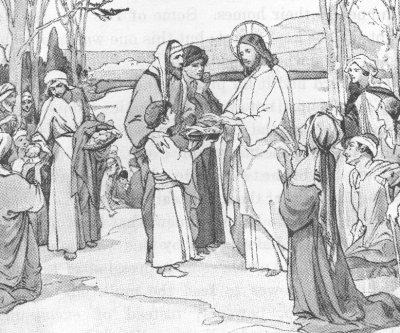 all the while, our Lord, who was looking in vain for some expression of trust in Himself, was preparing for them a most unheard-of repast ! His only answer to their hopeless replies was, ' , Make the men sit down." This done, He took the loaves from the fortunate little boy, "and when He had given thanks, He distributed to them that were sat down. In like manner, also of the fishes, as much as they would." When the people had eaten of the miraculous meal, He directed the Apostles to gather up, what was left ; and lo ! so bountifully had He provided for them, that twelve baskets were filled with the fragments that remained! On seeing the marvel, the people with one accord exclaimed, "This is of a truth the prophet that is to come into the world!" They had seen the miracles, and they believed! But, "blessed are they that have not seen and have believed."
II. THE MARRIAGE FEAST
On another occasion He changed Water into wine in answer to His Mother's wish. It. was at a wedding feast, to which Jesus and Mary and some of the disciples were invited. The bride and bridegroom. who lived in a small town called Calla, were poor, so poor in fact that the wine they had provided was not sufficient for their guests. Before the end of the meal it gave out, a fact which Mary, because of her consideration for others, was quick to notice. Our Lord, who knew all things, must have been aware of it too; but for some reason He did not appear to know it, until His Mother, anxious to save the young couple from embarrassment, whispered to Him, " They have no wine." It was the work of a moment, a brief prayer, like the short aspirations indulgenced by the Church: but it touched the Heart of her Son and caused Him to work His first miracle. She made no request; she merely stated a fact. But no more was necessary when it was His Mother who prayed.
Now consider what followed this brief prayer. Jesus granted her request by changing water into wine! But His answer to her gentle appeal seemed at first like a refusal. It may even sound harsh to our ears, because we do not understand its spirit as she did. "Woman, what is it to Me and to thee If My hour is not yet come!" How should we have acted in Mary's place If How do we act when God seems to refuse what we ask?
Instead of taking this as a denial, Mary turned immediately to the waiters, and said quietly, "Whatsoever He shall say to you, do ye." She never for a moment doubted that He would do her will, even though His time for performing public miracles had not arrived. She understood too well the love and goodness of His Sacred Heart, and her own power over Him. How magnificently were her faith and trust rewarded! She had made no mistake, as none do who trust Him.
To the amazement of the waiters, He commanded that the water-pots be filled with water. What a 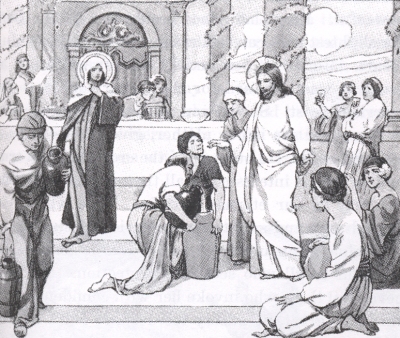 strange order it must have seemed! But Mary had told them to do whatsoever He should say; and lo ! When it was drawn out and brought to the chief steward, it was no longer water, but sparkling wine ! In obedience to a mere suggestion from Mary, He had performed a pubic miracle before His appointed time. Fortunate indeed were the bride and bridegroom to have as their friend the Mother of Jesus!
Now that she is in Heaven, her prayers are no less powerful. From her place beside her Divine Son, her slightest wish can still reach and move His loving Heart. Moreover, her anxiety for our welfare is as great as was her care for the young couple at the marriage feast. She is even more to us than she was to them; for she is our mother, given to us as such by our Lord as He hung upon the cross. Like a true mother, she is interested in all that concerns us, particularly in our eternal salvation. She who stood on Calvary, and saw the awful price of sin, knows the value of an immortal soul. She is tender and merciful to all who seek her protection. She will never fail those who invoke her with confidence. No sin is too great, no misery too deep, to win her help and compassion. Mary "conceived without sin " has been invoked by tempted souls, and they have triumphed over their temptations. She has been appealed to by souls steeped in the depths of shame and degradation, and they have had strength to leave their evil ways and rise to a new life of grace and virtue.
III. THE TEMPEST
As might have been expected, those who saw our Lord's miracles were astonished, and at times terrified, at the power which could work such wonders. This was the case when He walked upon the waters.
After this, He preached in parables, the Parable of the Sower, of the Tares and the Wheat, of the Mustard-Seed and many another, wrapping up His teaching in a story which would bring the point home to His listeners. He spoke to the people in parables but, alone with His disciples, He explained all things to them.
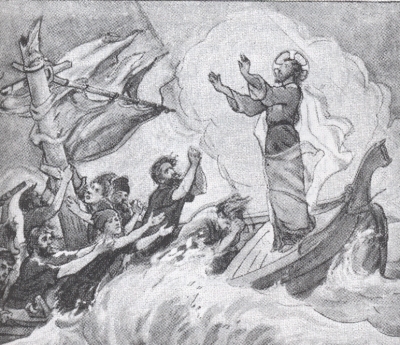 Jesus had charged His disciples, while He preached by the waters of the great Galilean lake, that they should always have a boat in readiness for Him so that He could escape from the crowds when His preaching was done. Once they crossed the lake in a storm, and our Lord, tired out with preaching, fell asleep in the stern with His head upon a pillow. The wind blew and the water came into the ship so that it was sinking. Then they awoke Him, crying out: "Lord, save us: we perish." And He said to them: "Why are ye fearful - O ye of little faith!" He rebuked the waves and commanded them, saying : "Be still!" And the waves of the sea were still, knowing their King and Lord, and fawned on His boat in gentleness. And the storm died away. He stood there and the light flowed upon Him, and His face was like a light so that the disciples, in awe, dared not look at Him. Bending low in the boat, they whispered to each other: "Who is this, thinkest thou, that both the wind and the sea obey Him?"
Excerpted from American Cardinal Readers: Book Four
1929, Neumann Press, Used with permission.


Excerpted from American Cardinal Readers: Book One
1929, Neumann Press, Used with permission.
CONTENTS
TO THE BOYS AND GIRLS OF OUR CATHOLIC SCHOOLS.... iii
INTRODUCTION.... ix
IN MEMORIAM (Introduction) Alfred Tennyson............ 1
THE LEGEND OF SLEEPY HOLLOW Washington Irving.... 3
EVANGELINE Henry Wadsworth Long fellow........ 48
WHAT AMERICA OWES TO THE CHURCH. Rt. Rev. Richard Gilmour......... 147
THE NAME OF OLD GLORY. James Whitcomb Riley.......... 153
OUR COUNTRY. William Cardinal O'Connell .........155
VIGIL OF THE IMMACULATE CONCEPTION. Maurice Francis Egan.......... 161
BALLAD OF TREES AND THE MASTER Sidney Lanier .........162
EXCERPT FROM' , THE LAND OF THE LONG NIGHT"..Paul Du Chaillu....... 163
THE HIGH TIDE AT GETTYSBURG ...: Will Henry Thompson. .....176
"HOW THEY BROUGHT THE GOOD NEWS FROM GHENT TO AIX" Robert Browning....... 180
THE CALL OF THE SPRlNG.Alfred Noyes .........183
A VAGABOND SONG Bliss Carman .........186
THE SIGHT OF THE BLIND. Rev. Daniel A. Lord, S.J. ........187
A HYMN Edgar Allan Poe...... 203
DEFINITION OF A GENTLEMAN. John Henry Cardinal Newman ...204
ROUGE BOUQUET Joyce Kilmer ........206
THE SONG OF THE THRUSH T. A. Daly ........208
TIlE WORK OF A RANCHlMAN Hermann Hagedorn.... 209
THE FOOL'S PRAYER Edward Rowland Sill..... 223
THE GOLD-BUG Edgar Allan Poe.... 225
A LIFE-LESSON James Whitcomb Riley...... 280
TIlE OLD HOME Madison Cawein.... 281
THE HOUSE WITH NOBODY IN IT Joyce Kilmer ......282
A FISHERMAN OF COSTLA..James B. Connolly ....284
HOLY IRELAND Joyce Kilmer.... 315
A BALLAD OF EASTER ...Theodosia Garrison... 327
MALCHUS THE MONK Andrew Lang.... 328
THAT HOLY THING. George Macdonald ...337
SEEING OURSELVES Rev. Francis P. Donnelly, S.J. .....338
STARTING A CONVERSATION. Rev. Francis P. Donnelly, S.J. ......341
IN THE HOLY NATIVITY OF OUR LORD GOD. Richard Crashaw ....344
THE MARTYR OF MOLOKAI. Charles Warren Stoddard... 346
THE SMALLWEED FAMILY .Charles Dickens...356
CHAPTER ONE , "THE BLAZED TRAIL" Stewart Edward White...... 384
A MILE WITH ME ...:...Henry van Dyke..... 386
MARGARITAE SORORI William Ernest Henley ....387
WHEN TULIPS BLOOM ...Henry van Dyke.... 388
ROSES IN THE SUBWAY ..Dana Burnet .....391
THE THREE KINGS OF COLOGNE Eugene Field......392
THE SWORD OF ROBERT LEE Rev. Abram J. Ryan ....394
REUNITED Rev. Abram J. Ryan.... 396
THE MAN WITHOUT A. COUNTRY Edward Everett Hale.....398
SUGGESTIONS FOR HOME READING FOR SEVENTH, EIGHTH AND NINTH YEARS. ....439
Definition of a Gentleman by John Henry Cardinal Newman
(from the American Cardinal Readers, Book Seven, pgs. 204-205)
It is almost a definition of a gentleman to say he is one who never inflicts pain. This description is both refined and as far as it goes accurate. He is mainly occupied in merely removing the obstacles which hinder the free and unembarrassed action of those about him. His benefits may be considered as parallel to what are called comforts or conveniences in arrangements of a personal nature: like an easy-chair or a good fire, which do their part in dispelling cold and fatigue, though nature provides both means of rest and animal heat without them.
The true gentleman in like manner carefully avoids whatever may cause a jar or a jolt in the minds of those with whom he is cast--all clashing of opinion or collision of feeling, all restraint, or suspicion, or gloom, or resentment; his great concern being to make everyone at their ease and at home. He has his eyes on all his company; he is tender toward the bashful, gentle toward the distant, and merciful toward the absurd; he can recollect to whom he is speaking; he guards against unseasonable allusions, or topics which may irritate; he is seldom prominent in conversation and never wearisome. He makes light of favors while he does them, and seems to be receiving when he is conferring. He never speaks of himself except when compelled, never defends himself by a mere retort; he has no ears for slander or gossip, is scrupulous in imputing motives to those who interfere with him, and interprets everything for the best.
He is never mean or little in his disputes, never takes unfair advantage, never mistakes personalities or sharp sayings for arguments, or insinuates evil which he dare not say out. From a long-sighted prudence he observes the maxim of the ancient sage, that we should ever conduct ourselves toward our enemy as if he were one day to be our friend. He has too much good sense to be affronted at insults; he is too well employed to remember injuries. He is patient, forbearing, and resigned, on philosophical principles; he submits to pain because it is inevitable, to bereavement because it is irreparable, and to death because it is his destiny.
He may be right or wrong in his opinion, but he is too clear-headed to be unjust; he is as simple as he is forcible, and as brief as he is decisive. Nowhere shall we find greater candor, consideration, indulgence; he throws himself into the minds of his opponents, he accounts for their mistakes. He knows the weakness of human reason as well as its strength, its province and its limits.
Excerpted from American Cardinal Readers: Book Seven
1929, Neumann Press, Used with permission.