Sample Pages from [em]The Angel's Alphabet[/em] by Hilda Van Stockum


Excerpted from The Angel's Alphabet by Hilda Van Stockum
Copyright 1996, Bethlehem Books, Used with permission.

Excerpted from The Angel's Alphabet by Hilda Van Stockum
Copyright 1996, Bethlehem Books, Used with permission.
Chapter One
The Ring of Power
THE BARN SMELLED of stale hay, chicken droppings, and cabbage. Lorelei, the white hen, cackled. With a swift glance over her shoulder, Janna took the broom and chased the bird off her nest. Sure enough, there was an egg. Janna slid it into her apron pocket. The barn door creaked as Frau Kopp came in, towering over Janna, a mountain of authority.
"Kill me a couple of chickens, Janna, quick," she said. "I’ve unexpected company." Janna looked around in dismay. What she saw were not chickens but Lorelei and Ilsebill, the leghorns; Wilhelm, the rooster; Fritz and Franz, the cockerels; Lieschen, Gretchen, and all the other cackling, scratching friends she knew by name. How could you kill something that had a name? But what could you do against a grownup? Janna began to sweep vigorously.
"Johanna," repeated Frau Kopp, "did you hear me?"
Janna looked up, shaking the hair out of her eyes. "I can’t," she said, trembling at her own audacity.
"You can," Frau Kopp insisted. "I showed you. You wring their necks, like that . . . it’s easy. What a fool they have sent me—and the other one so good, so willing! Why did she have to leave?"
"I’m on duty," said Janna desperately. "We have a Youth meeting."
"But it isn’t Wednesday," protested Frau Kopp. "I know
"I know, I know," Frau Kopp interrupted, "you’ve told me before. Isn’t it early for you to go? Your meetings are always later."
"Not this one," said Janna.
Frau Kopp looked at her suspiciously, opened her mouth to say something, and then closed it again. It was not wise to tangle with the Youth groups; she’d heard stories. . . . on Wednesdays you have your Heim Abend and have to leave early. But today is Tuesday and you can help in the kitchen, can’t you?"
"It’s a special meeting," said Janna, noticing the frustrated expression on Frau Kopp’s face. No one was allowed to interfere with the Hitler Youth meetings: not the church, or the school, parents or employers.
"A special meeting, a special meeting," grumbled Frau Kopp. "You are always having these special meetings and I think it’s just to escape work. What’s this meeting for, then?"
Janna’s face lit up. "It’s a rehearsal," she said. "We’re going to do a play our group leader has written. And imagine . . . they’ve chosen me to be Brunhilde!"
"And who is Brunhilde?" asked Frau Kopp sourly.
"Don’t you know? She is Siegfried’s bride. He gives her the magic ring, which was stolen from the Rhine maidens. But there is a curse on it. Siegfried drinks an evil potion, forgets Brunhilde, and marries someone else. Brunhilde is furious and causes him to die, but she is sorry afterward, and when she lights his funeral pyre she jumps on it herself, and as they burn all the gods burn with them."
Frau Kopp had listened open-mouthed. "Where do you get all that heathenish nonsense?"
"Oh, it isn’t nonsense," said Janna. "It’s all in Wagner’s operas."
"It’s heathenish anyway," sputtered Frau Kopp. "And for that they keep you from honest work!"
"Learning a part is work too. My parents have to do it all the time. They’re famous actors, their pictures are often in the papers, and Hitler has praised them. It’s in an article . . . I’ll show it to you. . . . He says they are an outstanding example of true Aryan culture."
Adjusting her black shawl, she shrugged her shoulders. "All right, go if you must and leave me with all the work." She bent and made a grab at the unsuspecting Lieschen. Janna lifted her coat from a nail and fled.
It was the last half of February. The thick blanket of snow was raveled and torn, showing patches of earth and yellow vegetation. Streams rushed singing down the hills, sweeping mud and pebbles along. The mountains, wrapped in fog, loomed like ghosts. Janna’s boots picked up the sticky snow as she clumped along. A stiff wind tore at her hair and slapped her cheeks. She passed Frau Kopp’s farmhouse with its steep, overhanging roof, half himself on his chain trying to get to her. She patted his straw, half shingle. Bruno, the mongrel dog, almost choked shaggy head, climbed a fence, and stood on the road, where puddles gleamed between ridges of mud. In the distance the church steeple lifted a warning finger at a flock of crows that seemed to be weaving swastikas against the sky.
Janna took a deep breath. She had managed to evade the cruel task Frau Kopp had laid on her because she was a Hitler Youth. Frau Kopp was afraid of Hitler. All grownups were.
"Oh, it isn’t nonsense," said Janna. "It’s all in Wagner’s operas."
"It’s heathenish anyway," sputtered Frau Kopp. "And for that they keep you from honest work!"
"Learning a part is work too. My parents have to do it all the time. They’re famous actors, their pictures are often in the papers, and Hitler has praised them. It’s in an article . . . I’ll show it to you. . . . He says they are an outstanding example of true Aryan culture."
Adjusting her black shawl, she shrugged her shoulders. "All right, go if you must and leave me with all the work." She bent and made a grab at the unsuspecting Lieschen. Janna lifted her coat from a nail and fled.
It was the last half of February. The thick blanket of snow was raveled and torn, showing patches of earth and yellow vegetation. Streams rushed singing down the hills, sweeping mud and pebbles along. The mountains, wrapped in fog, loomed like ghosts. Janna’s boots picked up the sticky snow as she clumped along. A stiff wind tore at her hair and slapped her cheeks. She passed Frau Kopp’s farmhouse with its steep, overhanging roof, half himself on his chain trying to get to her. She patted his straw, half shingle. Bruno, the mongrel dog, almost choked shaggy head, climbed a fence, and stood on the road, where puddles gleamed between ridges of mud. In the distance the church steeple lifted a warning finger at a flock of crows that seemed to be weaving swastikas against the sky.
Janna took a deep breath. She had managed to evade the cruel task Frau Kopp had laid on her because she was a Hitler Youth. Frau Kopp was afraid of Hitler. All grownups were. hero who had fearlessly slain a dragon yet trembled at the sight of Brunhilde’s beauty. And that was another problem: Janna knew she was no beauty. Well, maybe they could do things with stage lights.
What would it be like to have a magic ring that gave you power over everybody? thought Janna. And why hadn’t Brunhilde used it to save Siegfried and conquer her enemies? Why had she given it back to the Rhine maidens? They had hidden the ring and now no one could get it, though some people said it had been given to Hitler and that that was why he had conquered all those countries.
A girl hailed Janna from a neighboring farm. She came running across the fields, darting around rocks and shrubs, her long braids dancing on her back. It was Greta, a classmate.
"Wait for me, Janna!"
"You got away early too," said Janna.
"I said we had a Youth meeting."
"So did I!" The girls burst into laughter.
"They’ll think it’s funny when we have our rehearsal on Friday. They’ll say we have too many special meetings!"
"They can’t do anything," said Greta. "We’re allowed as many meetings as we like."
"As long as our group leader doesn’t tell on us."
"She won’t. Hildegarde is nice. The other group leader we had, Hannelore, was awful, really strict. She used to make us march with heavy packs and take cold baths in freezing weather because she said we should be as tough as the boys. We were going to be the mothers of future German soldiers and she wasn’t having any weaklings."
"Did you bag anything today?" asked Janna.
"Not much. I think Frau Hahn is noticing. But if she says anything, I’ll tell on her. I’ll tell she slaughtered a pig illegally."
"Did she?" asked Janna.
"Of course. They’re always doing it, those farmers. They don’t care if our soldiers starve. I got some onions anyway. They’re good in soup."
"I got an egg," said Janna.
"An egg? But they count those!" exclaimed Greta.
"I got it before it was counted." They walked for a moment in silence, listening to a robin chirping on a bare branch.
The old mailman, his brown leather bag over his shoulder, was bicycling past. He was bent over the handlebars against the wind, treading down the pedals heavily with his big boots. Slush sprayed up and the girls jumped back.
"Gr�ss Gott!" said the mailman, nodding at them.
"Heil Hitler!" answered the girls, arms outstretched. Janna thoughtfully picked her way among the puddles.
"Did you ever see Hitler?" she asked.
"Yes, once," said Greta, "at that Youth rally we went to."
"There were too many people, I couldn’t see a thing."
"I climbed a tree," said Greta, enjoying Janna’s look of admiration. "But I didn’t see much," she confessed. "Only the back of his head and his raised arm. And do you know, he didn’t raise it high enough, not even as high as his shoulder!" Hildegarde made the girls raise their arms well above their heads, and no matter how long the occasion lasted, you were never allowed to rest your arm on the girl in front.
But of course Hitler didn’t have to raise his arm at all; the greeting was to him. Besides, laws were for other people, not for Hitler.
"Why did you want to go home early today?" Janna asked.
"Because of the test tomorrow," said Greta, looking worried. "They keep us working so late, I’m too tired to do my homework. I did badly all this term. Race science is our most important subject and I want to do as well as I can, but I can’t memorize all that stuff. Those terribly long words!"
"I know, like ‘brachycephalic,’ " said Janna. "That’s a kind of skull. There are round, square, and long ones, and it’s very important which kind you have. The Aryan ones are the best."
"Why?"
"It has something to do with room for your brains. Monkeys don’t have much. Aryans have the most. We’re Aryans, the only true race. We’re supposed to become supermen."
"What other races are there?"
"Oh, Slavs and Mongolians and Semites . . . that’s the Jews. When you don’t know the answer to a question, just say something bad about the Jews and they’ll give you a good mark. They’ll forget what they asked."
"Really?"
"Sure, I tried it. It sometimes works with Slavs too, they’re almost as bad as the Jews . . . that’s the Russians, you know. But the Jews are the worst. They made us lose the First World War. We were winning the war, the soldiers were winning it—and Hitler was a soldier then so he knows—but the Jews in Berlin made us sign the Treaty of Versailles and that made us lose the war. We lost a lot of territory so we hadn’t enough Lebensraum and we had to pay so much money to our enemies that we became poor. We even used our paper money in the toilets!"
"Why?" asked Greta.
"Because it was worth less than toilet paper. No one had work and people fell dead in the streets with hunger, but the democratic government did nothing. When Hitler came, he got back our lost territories and everyone had work. We had an army again and enough food. That’s why we have to thank Hitler before and after meals."
"But what has that got to do with race?"
"Don’t you see, Greta? It’s race that makes the Jews so bad. They’ve got the wrong blood. We were pure Aryans before the Jews came and we must become pure Aryans again. That’s why our boys have written on their daggers: ‘Blood and honor.’ It’s shameful to let your race deteriorate by mixing it with inferior races. In the ancient days of Atlantis the Aryans had magic powers. The swastika is a magic Aryan sign, you know. But the Jews have weakened us and we’ve lost those powers. Hitler wants to give them back to us, but he can do it only if we stamp out the evil influence of the Jews."
"Did you ever see a Jew?" asked Greta.
"No, only in pictures."
"A Jew used to visit our village before you came," said Greta. "Every Friday he stood in the marketplace, selling a pig. He had a big yellow star on his coat. But there was always something wrong with the pig. We were glad when he didn’t come any more."
"I think they’re like the Nibelungen dwarfs in our play . . . sly and dangerous," said Janna. "It’s the Jews in England and America that are Wghting us. All the Aryan people would like to belong to us. And the Jews gave us Christianity, which is making us weak. Christians have to love their enemies, do good to those who hate them, and give more to those who steal from them. If you believe that, how can you be a strong nation and conquer the world? Hitler says it’s impossible to be a good German and a Christian at the same time."
"Do you believe that?" asked Greta.
"Hitler says so," said Janna.
"And why are the Slavs bad?"
"They’re Communists; the Jews gave them Communism. They say that everyone is equal, and that’s a lie. There’s a master race, that’s us, and inferior races. The inferior races must serve the master race."
"You make it sound so simple, Janna. I wonder how you do it . . . all those long chapters in Mein Kampf . . ."
"I suppose it’s because of my parents," said Janna. "They’re famous, you know. Hitler said . . ."
"Yes, you told me," Greta broke in. The only thing she disliked about Janna was the way she boasted about her parents. "Here’s my road. See you tomorrow."
Greta lived in a hut in the mountains, while Janna’s home was in the village with her nurse Erna and Erna’s mother. The celebrated Mechtild and Otto Oster, Janna’s parents, had been traveling about for over two years, entertaining troops in foreign countries. They kept writing Janna that they would get a house soon and send for her, but so far it hadn’t happened. Janna consoled herself by writing them long letters and talking about them to anyone who would listen. They were always present to her, an admiring audience for all she did.
Erna took great interest in Janna’s Youth meetings, but the old mother, who mumbled away her last days in a rocking chair beside the huge blue porcelain stove, a rosary in perpetual motion between her fingers, disapproved of the Youth movement. She said it was wicked to hold meetings on Sunday mornings so that Janna could not go to church. She warned Janna not to listen to the pagan things she was being taught. She would go on to mutter threats against a mysterious being called Antichrist and predict all manner of evil for Germany, till Erna made her be quiet.
"Don’t mind her," Erna would say contemptuously. "The old one is crazy."
Janna loved her Youth group. It was the only pleasant thing in her life. All the rest was grim. School from eight to twelve, much of the time taken up preparing bandages or doing other work for the soldiers, as well as writing letters to them. Then midday dinner, which consisted of potatoes with a flavor of meat. Then farm work in the afternoons. When there was no Youth meeting, Janna often had to work late, so that her homework suffered. The farmers forgot how young their helpers were and they piled on the work. If it had not been for the Hitler Youth, Janna didn’t think she could have stood it.
The Youth meetings were delightful—except for readings from Mein Kampf or lectures on early Germanic tribes, which were dull. But the girls also learned handicrafts, practiced on musical instruments, played games, acted in plays, held songfests, and went on hikes. In the summer there were camping trips and excursions to Youth rallies. Those were the high points. When Janna was on a camping trip with her group, she felt confident, strong, and alive. The fresh air, the lovely woods and mountains, the comradeship of the other girls: it was glorious. They all felt they mattered, their country needed them—and what a beautiful, beautiful country it was!
In the evenings, tired out, they would gather around a leaping bonfire. Then Hildegarde would tell stories: old tales grown from the soil they sat on. They heard of the great Norse gods and their fiery matings, of curses and spells, of heroes with magic powers and of their malicious foes . . . till their eyelids pricked and the fire dwindled to a few glimmering worms. Then the night wind would blow them into their tents to dream of blond gods.
Janna loved it all. She sang enthusiastically with the rest:
"Today we own Germany,
Tomorrow the world."
She was nearing the village and looked forward to Erna’s face when she saw the egg. Erna would tell her to thank Frau Kopp. Janna grinned. Frau Kopp would as soon part with her false teeth as with her eggs!
She had passed the first pastel-colored village houses with their wooden latticework, smoke curling from their chimneys. Usually Hans, the shoemaker, sat in front of his window, nodding at her, but today the window was empty. A bit farther on lived the clockmaker. His shop was full of interesting, carved wooden clocks, ticking and wheezing away, but Janna did not linger to look. She saw an ambulance standing before the little hotel. Frau Bauer, the hotelkeeper’s wife, was opening the door for two men, who were carrying out Frau Bauer’s old aunt on a stretcher. She was covered with a blanket and her face looked pale and anxious as she clutched the blanket with emaciated fingers.
"Now remember, Aunt Hedwig, it’s for your own good. They are going to make you better," said Frau Bauer.
"I know . . ." quavered Aunt Hedwig. "They have this new treatment . . . but . . ."
"You don’t want to go on having those pains," said Frau Bauer.
"But it’s so far . . ." complained Aunt Hedwig. "You won’t be able to visit me!"
"I wouldn’t be able to anyway. The hotel . . ."
"I know, I know . . ." Aunt Hedwig’s voice trailed off.
A group of villagers had gathered around the ambulance. The men carrying the stretcher had no expression on their faces. They did not talk to Aunt Hedwig or to Frau Bauer. They waited till the goodbyes were over; then they pushed the stretcher into the ambulance and slammed the doors shut. They climbed into the front seat. A stink came from the exhaust pipe as the ambulance sputtered into action, its wheels spraying slush, and growled off. The villagers watched it getting smaller and smaller till it disappeared down the hill. Frau Bauer sobbed and hurried into the hotel, her handkerchief pressed against her face.
"If she had to have new treatment, why not send her to the hospital in Freiburg? Why to Hademan? It’s so far away," said a woman.
"I think that’s decided by the government," another voice remarked.
"Hademan is for the aged and for incurables and feebleminded," said Hans, the shoemaker. "It’s a special place."
"That’s true," the postmistress chipped in. "My sister’s boy wasn’t right in the head and they took him there, but he died soon after. They said it was pneumonia."
"Grandpa went there with a sore foot, and he died of pneumonia too," said a messenger boy. "It must be drafty in that place."
"He was old; perhaps the change was too much for him."
"Maybe," said the postmistress grimly. "But has any of you ever heard of anyone who came back from Hademan alive?" There was a silence. Somewhere a radio blared:
"Adolf Hitler’s favorite flower
Is the simple edelweiss."
Janna shivered. Was something wrong? Was something dreadful going to happen to Aunt Hedwig? Gentle Aunt Hedwig, always lying on her long chair in front of the window and welcoming children with a box of homemade candy. She had been like a grandmother to Janna, telling her stories of long ago, when women wore long skirts and men had whiskers. Together they had pored over albums with stiff pages full of dried ferns and faded brown snapshots. If Aunt Hedwig had been in pain she had never shown it.
The tall youth standing beside Janna saw her distress. He belonged to the Jung Volk the older boys’ group. His name was Kurt Engel.
"Don’t listen to those gossips," he said, putting his hand on Janna’s shoulder as he walked beside her. That was a great honor.
"Do you think she’ll be all right?" asked Janna timidly, gazing up at him. Kurt looked away into the distance. The main street was sloping down steeply now, and they could see the misted valley with row upon row of snowcapped mountains melting into a haze of purple.
"Does it matter?" he asked. "Aunt Hedwig is a useless old woman of no further value to our nation. Why worry about her? Don’t you realize what is happening to our young people, our soldiers in Russia? Have you seen the list of the dead? Why don’t you worry about them?" He was gazing at the sky where the last rays of the sun slanted down like spears from a gap in the clouds.
"We’re in a crisis," he said. "Only four times in history was there a similar crisis in Europe: when the Greeks warded off the Persians, when Charles Martel defended France against Islam, when Vienna held out against the Turks, and when the Teutonic knights stopped the hordes of Genghis Khan at Liegnitz. Now, once again Europe is threatened by barbarians from the East and we Germans are called to save it." Kurt’s closely cropped head, lifted against the sky, looked stern and noble, thought Janna.
"There is a prophecy," Kurt went on, "that after the gods were killed, the horn of Heimdall, the guardian of the border line between gods and men, would sound one day to awaken the Germanic race. I think it has happened: Hitler is that horn. He has special powers and is sent to lead us to a great victory, which will be spoken of for centuries to come. We must trust him and follow him, even unto death."
"Oh, I hope not death," cried Janna.
Kurt looked down at her as if he had just discovered her. His smile lit up his face. "You’re all right, Janna," he said. "Don’t worry. Hitler is invincible, a man of destiny. With him we can do anything. See you Friday. I suppose you know I’m playing Siegfried . . ." Nodding affably at her, he strode off, tall and handsome in his leather jacket. Janna stared after him. So he was to be Siegfried! What a stunning Siegfried he would make! She began to think about her costume: a flowing white dress with silver breastplates, a girdle studded with jewels, and a helmet on her head. She also needed silver sandals and a spear. She wondered where she’d get all that, but Hildegarde would help, she always did. Janna was almost home before she remembered the egg.
"See what I’ve got for you, Erna!" she cried, bursting into the kitchen. Erna looked around. She was holding a letter.
"Janna!" she exclaimed, scarcely noticing the egg. "I’m so glad you are early! We just got this special-delivery letter. Your father and mother have found a house in Amsterdam. They want you to join them as soon as possible. You’ll be traveling with a Frau Mueller, an officer’s wife who is visiting her husband. So much to do, I don’t know where to start! But . . . what’s the matter? Don’t you want to go to your parents?"
Excerpted from The Borrowed House by Hilda Van Stockum
Copyright 1975, Used with permission from Bethlehem Books
CONTENTS
INTRODUCTION. Our Life's Purpose
Our Desire for Happiness. Earthly Goods and Happiness. "God Alone Sufficeth." How We Can Possess God. Grace and Our Life's Purpose. The Study of Religion the Most Important Study. ........xv
SECTION I
FAITH AND THE SOURCES OF FAITH
CHAPTER I. Our Knowledge of God
How We Know God. What Our Reason Tells Us About God. God Reveals Himself. God's Revelations Known by Faith. God's Spokesmen and Their Credentials: Miracles and Prophecies. Who Were God's Spokesmen? Revealed Mysteries. .....1
CHAPTER II. The Church, the Guardian and Teacher of Divine Revelation
How God's Revelations Were Preserved and Handed Down. Faith, a Divine Gift to Help Us Believe God's Revelations........ 5
CHAPTER III. The Sources of Faith: Holy Scripture
A. HOLY SCRIPTURE IN GENERAL
1. Definition and Division...... 9
2. Divine Origin: Inspiration .... 10
3. Canon, or Official List, of the Sacred Books....11
4. The Languages of the Bible... 14
5. Translations of the Bible.... 15
6. Interpretation of the Scriptures....17
7. Reading of the Bible.... 17
CHAPTER IV. Sources of Faith: Holy Scripture (Continued)
B. THE BOOKS OF THE OLD TESTAMENT
1. The Historical Books ......20
2. The Doctrinal or Poetical Books .....27
3. The Prophetical Books .....34
CHAPTER V. Sources of Faith: Holy Scripture (Continued)
C. THE BOOKS OF THE NEW TESTAMENT
1. The Gospels and the Acts of the Apostles...... 42
2. The Epistles .....45
3. The Apocalypse...... 48
ix
CONTENTS
x
CHAPTER VI. The Sources of Faith: Tradition
1. MEANING AND NECESSITY OF TRADITION
What Tradition Means. Scripture and Tradition of Equal Value. Necessity of Tradition. The Catholic Rule of Faith.... 50
2. THE RECORDS OF TRADITION
Traditions Recorded. Decrees of General Councils and Popes. Acts of Martyrs. Liturgical Books. Works of the Fathers. Monuments. Creeds. ......51
CHAPTER VII. Necessity and Qualities of Faith
1. Faith Necessary to Salvation ......55
2. Qualities of Faith. Dangers to the Faith.....56
CHAPTER VIII. Profession of Faith. Sign of the Cross. ......60
SECTION II
CHIEF TRUTHS OF FAITH
INTRODUCTION. The Apostles' Creed and the Nicene Creed. ......63
CHAPTER I. Nature and Attributes of God
1. NATURE OF GOD
Who God Is. What Scripture Tells Us About God. God and Human Reason. ......66
2. ATTRIBUTES OF GOD
A. Attributes of the Divine Nature
God is Eternal, Unchangeable, Immense......68
B. Attributes of the Divine Intelligence
God is All-Knowing, All-Wise......69
C. Attributes of the Divine Will
God is Almighty, Holy, Just, Good, Merciful, Patient, Truthful,
Faithful ......70
CHAPTER II. The Most Blessed Trinity
The Blessed Trinity in the Old Testament. Christ Reveals the Mystery of the Blessed Trinity. The Church Defends the Mystery against Heretics. The Athanasian Creed. The Trinity, the Greatest of Mysteries. The Trinity and Human Reason. Importance of the Doctrine of the Trinity ......73
CHAPTER III. The Creation of the World
God, the Creator of Heaven and Earth. The World Not Eternal. God Created the World of His Own Free Choice for His Own Glory. The Work of the Six Days. The Work of Creation and the Week of Seven Days. Science and the Biblical Account of Creation......79
CONTENTS
xi
CHAPTER IV. Divine Providence
God Preserves and Governs the World. Divine Providence and the Problem of Evil. Christian Optimism. ......82
CHAPTER V. The Spirit World
The Invisible Creation. Scripture and the Spirit World. The Spirit World and Human Reason. Number and Dignity of the Angels. Good and Bad Angels. Our Guardian Angels. The Evil Spirits. Possession and Exorcism. ......85
CHAPTER VI. Origin of the Human Race
Man the Crown and Lord of the Visible Creation. Origin of the Human Body. Origin of the Human Soul. The Soul of Man Spiritual and Immortal. All Men Are Descended from One Pair. The Age of the Human Race. ......91
CHAPTER VII. Elevation and Fall of Man
1. ELEVATION OF MAN
Man an Image of God. The Supernatural Image of God in Man. Special Privileges of Our First Parents. " A Little Less than the Angels."' The Golden Age. ......96
2. THE FALL OF MAN
The Trial. The Fall. The Consequences of the Fall. ......97
CHAPTER VIII. Original Sin, the World's Tragedy
Why Adam's Sin is Called Original Sin. Scripture and Original Sin. Tradition and Original Sin. Original Sin a State, not an Act. Original Sin and Baptism. Importance of the Doctrine of Original Sin. ......100
CHAPTER IX. The Immaculate Conception
What is meant by the Immaculate Conception. Definition of the Dogma. An Argument from Reason. ......103
CHAPTER X. Promise of a Redeemer and Preparation for His Coming
Need of a Redeemer. Promise of a Redeemer. His Coming Delayed. Preparation of the Jews for His Coming. Preparation of the Pagan World. The Great Advent. ......106
CHAPTER XI. Jesus Christ-the Promised Redeemer
The "Fullness of Time." The Names of the Redeemer. Jesus Christ the Promised Messias. Prophecies and Figures Fulfilled. ......109
CHAPTER XII. Jesus Christ-True God and True Man in One Person
1. JESUS CHRIST IS TRUE GOD
The Testimony of the Church. The Testimony of the Apostles. The Testimony of Christ Himself. Christ Confirms His Testimony
CONTENTS
xii
by the Holiness of His Life, by Miracles and Prophecies. He Seals His Testimony by His Death. ......114
2. JESUS CHRIST IS TRUE MAN
The Incarnation. Jesus Christ a Perfect Human Being. The Ideal of Human Beauty? ......118
3. JESUS CHRIST GOD AND MAN IN ONE PERSON .......120
4. SUMMARY OF THE CHURCH'S TEACHING ON THE INCARNATION ......121
CHAPTER XIII. Prerogatives of the Human Nature of Christ
Vision of God Face to Face. Absolute Sinlessness. Christ's Human Nature Claims Our Adoration. The Sacred Heart of Jesus. Cardinal Newman on Devotion to the Sacred Heart. ......122
CHAPTER XIV. Mary, the Mother of the Redeemer
Mary, the Mother of God. Mary's Co-operation in the Redemption. Mary's Divine Motherhood the Source of all her Graces and privileges. An Objection Answered. The Assumption. St. Joseph, the Spouse of Mary and Foster-Father of Jesus. ......126
CHAPTER XV. The Work of Redemption Accomplished
The Redemption a Great Mystery. The Savior's Sacrifice Freely Offered. Why Christ Chose Suffering and Death. The Cross, the School of Love. The Savior's Sacrifice Offered for All Mankind. The Fruits of the Redemption. The Church's Thanks to God for the Redemption. ...131
CHAPTER XVI. The Functions of the Redeemer
Christ Our High Priest, Teacher, and King. Our Duties to Christ the King. ......137
CHAPTER XVII. The Redeemer Living and Working in His Church
Christ Invests His Apostles and Their Successors with His Threefold Office. How the Church Discharges Her Threefold Office. Christ and His Priests. The Holy Ghost and the Threefold Office of the Church. The Work of the Holy Ghost in the Church and in the Hearts of the Faithful. ...142
CHAPTER XVIII. The Work of Sanctification: Sanctifying Grace
Christ Restores the Supernatural Order. What is Sanctifying Grace ? How It Is Conferred upon Men. The Indwelling of the Holy Spirit. Can We Be Certain of Being Justified ? Cardinal Newman on the Indwelling of the Holy Ghost. ......145
CHAPTER XIX. Actual Graces
Difference between Actual and Sanctifying Grace. Efficacy of Actual Grace. Necessity of Actual Grace. God Gives Sufficient Grace to All, but not an Equal Amount. Grace and the Freedom of the Human Will. Predestination. The Little Flower on the Unequal Distribution of Grace. ......151
CONTENTS
xiii
CHAPTER XX. Fruits of Sanctifying Grace: Good Works
Every Christian Bound to Perform Good Works. Good Works Meritorious only through Sanctifying Grace. The Good Works of the Sinner. What We Merit by Good Works. Good Works and Good Intention. Some Objections Answered. ......156
CHAPTER XXI. Eternal Life
The First and Last Words of the Creed. The Beatific Vision. The Bliss of Heaven not Equal in Degree for All. St. Augustine, St. Columban and St. Thomas on the Joys of Heaven. ......159
CHAPTER XXII. Purgatory
There Is a Purgatory. The Doctrine of Purgatory Most Reasonable. The Lot of the Poor Souls. St. Augustine and His Mother St. Monica. Importance of the Doctrine of Purgatory. Bishop Vaughan on Prayers for the Dead. ......162
CHAPTER XXIII. Eternal Death
Who Will Be Cast. into Hell ? The Punishment of the Damned Eternal. The Sufferings of the Damned. The Doctrine of Hell and Human Reason. ......166
CHAPTER XXIV. The Resurrection of the Dead and the General Judgment
The Particular Judgment. The End of the World. Resurrection of the Body. The Risen Body. The Last Judgment. The Purpose of the General Judgment. The Circumstances of the General Judgment: The Time, the Place, the Judge, the Judged, the Account, the Sentence. A New Heaven and a New Earth. ......170
INDEX ......177
SECTION I
FAITH AND THE SOURCES OF FAITH
CHAPTER I
Our Knowledge of God
'The fool said in his heart: There is no God."-Ps. 52,1.
1. How We Know God.-Our first duty is to know God. In Heaven we shall know Him face to face, but in this life He is hidden from our direct knowledge. We can, however, know something about Him by carefully noticing the things He has made, and still more by firmly believing what He has told us about Himself. In other words, we know God both by the natural light of reason and by the supernatural light of faith.
2. What Our Reason Tells Us About God.-Our reason tells us that there is one true God, the beginning and end of all things, our Creator and Lord; and that we must worship Him and do His will as it is written by Him in our hearts.
That there is an almighty God must be clear to every thinking person, for the fact is clearly proved by the whole visible world with its wise arrangement as well as by the voice of conscience.
a) No one can reasonably think that the world made itself; nor that the heavenly bodies could begin to move through space by their own power .
b) The wonderful arrangement and perfect order of the world lead us to infer that it was planned and carried out by a Being of supreme intelligence and skill.
c) All men who are in a normal state of mind know that they are bound in conscience to do certain acts and to avoid other acts, and feel that they are responsible for their conduct to a Supreme Judge who is the avenger of evil and the rewarder of good.
d) All the nations and races of men have always had an inner conviction of the existence of a Supreme Being. If there are any barbarous tribes that practice no religion, they can be such only as are degraded by vice below the normal condition of human beings. The Scripture says: ..The fool said in his heart: There is no God" ( Ps. 52,1). Those who deny the existence of God are called Atheists (Greek a-,
1
2
FAITH AND ITS SOURCES
not, and theos, God) .Such people usually have reasoned themselves, or have been led by others, into a state of doubt in regard to the existence of God. Their state of mind arises either from pride, or from corruption of heart, or from a misguided education, or from all three. "He Who denies the existence of God," says St. Augustine, "has some reason for wishing that God did not exist."
3. God Reveals Himself.-But God wished us to know much more about Himself-and about ourselves too-than our reason alone can tell us. From time to time, in His wisdom and goodness, He drew aside the veil that hides Him from us. He revealed Himself and His eternal decrees to us. He told us things about Himself which we could not otherwise know at all or not with certainty.
Revelation (Latin re-, back, and velum, a veil) means both the manifestation by God of His will and truths to man, and the body of truths thus manifested. It is called supernatural or divine revelation, as opposed to the natural revelation of Himself that God makes through the visible world.
4. We Know God's Revelations by Faith.-God did not reveal Himself directly to all men, or even to very many, but only to a few. These men were told by Him to make His revelations known to their fellow-men. Since God does not speak directly to each one of us, we have to take the word of those to whom He did speak for what He told them. In other words, we take God's revelations on faith. To take something on faith means to believe or hold as true what another tells us.
If we believe what a fellow-man tells us on his own authority I or on the authority of another fellow-man, we have human faith.. If we hold firmly and without doubting what someone tells us on God's authority, we have divine faith, for in that case we really believe God Himself.
5. God's Spokesmen and Their Credentials.-But how do we know when a human being tells us something on God's authority ? We ask him to present his credentials, that is, we ask him to prove to us that he is really a messenger of God, and speaks in God's name; just as we ask anyone who claims to be the ambassador or representative of an earthly potentate to show us his credentials before we believe him.
Miracles and Prophecies are the only infallible credentials which God gives His spokesmen. If God puts His miraculous power at the disposal of a human being or permits him to look into the
3
OUR KNOWLEDGE OF GOD
secrets of the future, we can say without hesitation or fear of error that such a person has been sent by God.
Miracles are extraordinary works which cannot be done by the powers of nature, but only through the omnipotence of God; for example, to raise a person from the dead.
Prophecy is a clear and definite foretelling of an event that can be known to God alone, because it depends either on the free will of God or on the free will of man. To foretell an eclipse of the sun or of the moon, is not a prophecy; but it is a prophecy to foretell the exact manner of one's own death at the hands of others.
6. Who Were God's Spokesmen?-The things which God wished us to know for our salvation He made known to us by the Patriarchs and Prophets, and above all by His Son Jesus Christ and the Apostles.
Jesus Christ claimed to be not only a messenger of God, but the true Son of God Himself. He proved His claim by the supreme holiness of His life, by numerous miracles and prophecies during His life on earth, and by the crowning miracle of His Resurrection. He guarantees for us the revelations made to the Patriarchs and Prophets, as well as those made by His own Apostles.
7. Revealed Mysteries.-Since, then, God Himself has spoken to us, all that He has told us about Himself and about our own origin and destiny must be absolutely true, for God can neither deceive nor be deceived; if He could, He would not be God. Hence, even when He tells us things which we cannot understand -mysteries-we none the less firmly believe them, because He has revealed them.
Mysteries are revealed truths that are above and beyond our reason though not contrary to it. There are many natural mysteries, such as the growth of trees and plants and the marvelous instinct of birds and animals, which we do not understand; is there any wonder that mysteries should be found among the revealed truths? The Trinity is a mystery, because we cannot understand how one God can subsist in three Persons; but it is in no way contrary to our reason: we do not believe that three gods are one God, nor that three persons are one person, which would be a contradiction.
SUGGESTIONS FOR STUDY AND REVIEW
THE ARAB'S PROOF OF THE EXISTENCE OF GOD
An Arab in the desert was once asked how he knew there is a God. "In the same way," he said, ''as I know by the footprints on the sand that a man or an animal has passed this way."
ST. ANTONY'S BOOK
The thousands of men who visited St. Antony in the desert were astonished at his wisdom and good sense. Asked where he had acquired such solid wisdom, he replied, pointing with one hand to the heavens and with the other to the earth: "There is my book; I have no other: all should study it : in considering the works of God, they will be filled with admiration and love of Him who created all things."
LORD BYRON ON THE EXISTENCE OF GOD
"How, raising our eyes to heaven, or directing them to the earth, can we doubt of the existence of God? - or how, turning them to what is within us, can we doubt that there is something more noble and durable than the clay of which we are formed?"
Excerpted from The Chief Truths of the Faith by Fr. John Laux
1928/1934, TAN Books and Publishers, Used with permission.
r,..,..,.. ~ '.. CONTENTS SECTION I GENERAL MORAL PAGE INTRODUCTION I I. God's Will the End of Life I 2. God's Will the Basis of Morality 2 3. Catholic Moral Science 3 CHAPTER I. Conditions of Morality A. FREE WILL I. Nature of Free Will 5 2. Free Will in the Light of Faith and Reason. 6 l 3. Hindrances to Free Will 8 I B. LAW ! I. The Natural Law 10 i 2. The Positive Divine Law 12 3. Human Positive Laws 15 C. CONSCIENCE 17 D. COLLISION OF RIGHTS AND DuTIEs... 21 CHAPTER II. Moral Good I. Elements of a Moral Act 25 2. Virtue, or Moral Good as a Habit 27 3- The Moral Virtues 28 4. Christian Perfection : 30 5. The Evangelical Counsels 32 6. The Religious State 35 CHAPTER III. Moral Evil I. The Nature of Sin 40 2. Kinds of Sin 42 3. Temptation and the Occasions of Sjn 44 4- Sin and Punishment 47 SECTION n SPECIAL MORAL INTRODUCTION 50 CHAPTER I. Our Duties to God A. THE THRI;;E THEOLOGICAL VIRTUES 53 ix l ~ ~ x CONTENTS PAGE I. Faith: a) Nature, Properties, and Duties of Faith. " 53 b) Sins Against Faith 55 c) Dangers to the Faith 58 2. Hope. 59 3. Chan.ty, or Love of God , 61 B. THE VIRTUE OF RELIGION , 63 I. Direct Acts of Religion: a) Prayer. , ...66 b) Liturgical Prayer and Sacrifice. The Lord's Day. 72 c) Oaths and Vows 75 d) Sins Against the Virtue of Religion. 77 e) Christian Science and Spiritism 79 2. Indirect Acts of Religion: or the Veneration of the Saints: a) Veneration of the Saints 82 b) Invocation of the Saints 84 c) Special Veneration of the Mother of God. 86 d) The Veneration of Images 88 e) The Veneration of Relics 89 CHAPTER II. Duties Towards Ourselves I. Duties in Regard to the Intellect and the Will. 98 2. The Dignity of the Human Body 99 A. Positive Duties Towards the Body: a) Food and Clothing 100 b) Recreation and Amusement 103 B. Negative Duties Towards the Body: a) Suicide. 104 b) Indirect Suicide and Risking One's Life 105 c) Cremation 106 3. Chastity and Its Violation 107 4. Duties Concerning Material Goods : a) The Right of Private Property 112 b) Capitalism and Socialism 115 CHAPTER III. Our Duties Towards Our Neighbor I. Nature and Properties of Christian Charity. 122 2. Well-Ordered Charity 123 3. Corporal and Spiritual Works of Mercy. 126 4. Love Your Enemies 129 5. Violations of Charity 131 6. Thou Shalt Not Kill 133 7. Thou Shalt Not Steal 136 8. The Duty of Truthfulness and Fidelity. 138 9 Our Neighbor's Reputation 140 CONTENTS xi PAGE CHAPTER IV. Our Duties as Members of the Family, the State, and the Church I. The Christian Family ; 147 2. Masters and Servants; Workmen and Employers 150 3. The Rights and Duties of Citizens 151 4. Sancta Mater Ecclesia 153 5. The Christian Ideal 155 INDEX " , , 161 ! I. -, .c SECTION I GENERAL MORAL --- Introdu~tion I. GoD'S WILL THE END OF LIFE What Is the Meaning and Purpose of Life?-This is the all- important question for every human being; for what will ~ll the world beside profit us if we miss the whole purpose of our existence, if we fail to attain our true destiny ? I. Both reason and revelation tell us that God is the author and the last end of our life. Being creatures of God, the work of His hands, we belong to him absolutely. "In Him we live and move and are" (Acts 17,28). The last end of man can be nothing else but God from whom he came, "for of Him, and by Him, and in Him are all things (Rom. 11,36). Hence the pur- pose of our life is to do the will of God, as it is written in indelible characters in every human heart, as it was proclaimed on Sinai and on the Mount of the Beatitudes, as it is manifested in the duties of our state and calling, and as it is made known to us by those who share in God's authority here on earth in the family, the State and the Church. But our submission to God's holy will must not be founded on servile fear; it must be a voluntary, loving and generous self- surrender to His will. Our service must be the service of a soldier who unhesitatingly carries out the commands of his general; but also the service of a child that sees in God his loving Father and his greatest benefactor . 2. This ideal of perfect harmony between the human will and the divine will is realized in the life of the God-M an J esus Christ. He came on earth, as He Himself tells us, simply to glorify His Father and to do His will. He speaks of His Father's will as His food and drink, as the atmosphere He breathes, as His unfailing consolation. His whole life from the Crib to the Cross was one act of obedience to His heavenly Father. In His life and death He fulfilled most perfectly what the Angels I -~- ~;:r~_'r"i SECTION I GENERAL MORAL Introduc;tion I. GoD.S WILL THE END OF LIFE What 18 the Meaning and Purpo8e of Life?-This is the all- important question for every human being; for what will all the world beside profit us if we miss the whole purpose 0'� our existence, if we fail to attain our true destiny ? I. Both reason and revelation tell us that God is the author and the last end of our life. Being creatures of God, the work of His hands, we belong to him absolutely. "In Him we live and move and are" (Acts 17,28). The last end of man can be nothing else but God �rom whom he came, "�or of Him, and by Him, and in Him are all things (Rom. 11,36). Hence the pur- pose of our life is to do the will of God, as it is written in indelible characters in every human heart, as it was proclaimed on Sinai and on the Mount of the Beatitudes, as it is manifested in the duties of our state and calling, and as it is made known to us by those who share in God's authority here on earth in the �amily, the State and the Church. But our submission to God's holy will must not be �ounded on servile �ear; it must be a voluntary, loving and generous sel�- surrender to His will. Our service must be the service of a soldier who unhesitatingly carries out the commands of his general; but also the service of a child that sees in God his loving Father and his greatest bene�actor . 2. This ideal of perfect harmony between the human will and the divine will is realized in the li�e of the God-M an J esus Christ. He came on earth, as He Himself tells us, simply to glori�y His Father and to do His will. He speaks of His Father's will as His food and drink, as the atmosphere He breathes, as His unfailing consolation. His whole life from the Crib to the Cross was one act of obedience to His heavenly Father. In His li�e and death He fulfilled most perfectly what the Angels I ~ ~i;~ - 2 GENERAL MORAL proclaimed in their Christmas message: "Glory to God in the highest." Hence He could say on the eve of His Passion: "I have glorified Thee on the earth, I have finished My work Thou gavest me to do; and now glorify Thou Me, O Father, with Thyself" (John 17,4). Christ is, therefore, the bright and shining example for all who seek to attain their life's purpose in its "height and breadth and depth", and thus to lay the foundation of their own perfect happiness; for true happiness can be found only in seeking God's honor and glory by doing His will. "God asks no service from us," says a wise and holy man, "which does not promote our highest welfare, and no glory in which we, His creatures, do not share. God seeks His glory in our happiness." Hence the simple words which we find on the first page of the little Catechism express the highest wisdom: "We are in this world to do the will of God and thereby to gain everlasting happiness in H eaven." 2. GOD'S WILL THE BASIS OF MORALITY I. To give glory to God by doing His holy will: this is the end, the purpose of human life. All our actions should be directed to this end. Every action that brings us nearer to this end is a i good action; every action, on the other hand, that leads us away [ from this end, is a bad action. Because "only one is good, God" , (Mark 10,18), all morality, all moral goodness is based on Him; only that is good which corresponds to His holy will. But God is also the Creator, the Lord of heaven and earth, and therefore He alone can impose His will on mankind, from Him alone comes all moral obligation. 2. That our actions are morally good or morally bad according as they agree or disagree with the divine will, is clearly taught in Scripture. "N ot everyone that saith to Me, Lord, Lord, shall enter into the Kingdom of Heaven, but he that doth the will of My Father who is in Heaven, he shall enter into the Kingdom of Heaven" (Matt. 7,21 ) ."If thou wilt enter into life," Christ said to the rich young man, "keep the commandments" (Matt. 19,17). For the Son of God Himself the will of God is the rule of life and action. "Did you not know that I must be about My I. Father's business ?" he said to His Mother, who had gently up- i braided Him for remaining behind in the temple. -~~ INTRODUCTION 3 3. For the Apostles, too, the �ulfillment of the divine will is the only rule of action. "Be not con�ormed to this world," St. Paul tells the Romans, "but be ye trans�ormed by the renewing of your mind, so that ye may find out what is the will of. Go~, what is good, well-pleasing and per�ect" (Rom. 1;2,2) .It IS his earnest and unceasing prayer that his converts "may be filled with the knowledge of the will of God, that they may walk worthy of God in all things" (Col. I,9-1O). St. John calls those liars who say they know God, but do not keep Hi& commandments. "But he that keepeth His word, in him in very deed the love of God is perfected" (I John 2,5). THE CALL OF CHRIST "If any man will come after Me, let him deny himself, and take up his cross and follow Me." (Matt. 16, 24) 3. CATHOLIC MORAL SCIENCE That part of the science of religion which teaches us how to direct our actions to God, our last end, is called Catholic Ethics or Catlwlic M oral Science. It is based on Christian principles and draws its conclusions �rom divine revelation. As a part of the Christian doctrine-the doctrine of the things we must do, doctrina faciendorwn-it is confided to the keeping of the Catholic Church. Hence the Catholic Church can, in virtue of the divine assistance granted to her, in�allibly define what is good and what is bad, what is permitted and what is �orbidden. k -~~ ;,~,,?:-:::c~~~~~ 4 GENERAL MORAL The general principles of morality are common to all men; but Christian moral differs essentially from purely natural moral : a) Christian moral directs man to a supernatural end, which can be at- tained only by supernatural means, based upon faith and grace ; b) It holds out motives for right conduct of which unaided reason is either totally ignorant or has only an imperfect knowledge ; c) It establishes most of its conclusions on divine revelation, while natural moral derives its principles from the native power of reason alone ; d) It offers means of which natural moral knows nothing. Hence Catholic moral is incomparably more sublime, far-reaching, certain, and effectual than merely natural morality. The history of mankind shows that "morality lives by faith and dies by infidelity." "What Greek culture did for the intellect, Christ did for morality: the human race owes its moral power to Him" (CHAMB~IN). Catholic Moral is divided into "General" and "Special". General Moral treats of the conditions of morality and of moral good and moral evil; Special Moral applies the general principles of morality to the various circumstances of individual and social life. The conditions of morality are freedom of will, law, and conscience: fr?edom is the basis, law is the external, and conscience the internal norm of morality. SUGGES I. What is the purpose of our life ? Briefly explain your answer. How does the Our Father answer this question ? 2. What kind of submission to God's will should we cultivate ? Are we children or slaves of God? 3. Was ever a human will in perfect harmony with the divine will ? Would not such a Person be a perfect model for us ? Show how the God-Man Jesus Christ is such a model. + When are our actions good ? When are they bad ? Prove your answers from Holy Scripture. S. Wha,t is the science called which teaches us how to direct our actions to God? 6. How is CiN"istian Moral divided ? What does each division treat of ? 7. What are the conditions of morality ? If you had no free will, could you perform a moral act; that is, an act for which you could be held responsible ? 8. Reading: I mitation of Christ, Bk. III, ch. 9, "That all things must be referred to God as the final end."
Excerpted from The Chief Truths of the Faith by Fr. John Laux
Used with permission.
CONTENTS
INTRODUCTION. Our Life's Purpose
Our Desire for Happiness. Earthly Goods and Happiness. "God Alone Sufficeth." How We Can Possess God. Grace and Our Life's Purpose. The Study of Religion the Most Important Study. ........xv
SECTION I
FAITH AND THE SOURCES OF FAITH
CHAPTER I. Our Knowledge of God
How We Know God. What Our Reason Tells Us About God. God Reveals Himself. God's Revelations Known by Faith. God's Spokesmen and Their Credentials: Miracles and Prophecies. Who Were God's Spokesmen? Revealed Mysteries. .....I
CHAPTER II. The Church, the Guardian and Teacher of Divine Revelation
How God's Revelations Were Preserved and Handed Down. Faith, a Divine Gift to Help Us Believe God's Revelations........ 5
CHAPTER III. The Sources of Faith: Holy Scripture
A. HOLY SCRIPTURE IN GENERAL
I. Definition and Division...... 9
2.Divine Origin: Inspiration .... 10
3. Canon, or Official List, of the Sacred Books.... II
4. The Languages of the Bible... I4
5. Translations of the Bible.... I5
6. Interpretation of the Scriptures.... I7
7. Reading of the Bible.... I7
CHAPTER IV. Sources of Faith: Holy Scripture (Continued)
i B. THE BOOKS OF THE OLD TESTAMENT i I. The Historical Books 20 I 2. The Doctrinal or Poetical Books 27 i 3. The Prophetical Books 34 I iCHAPTER v. Sources of Faith: Holy Scripture (Continued) C. THE BOOKS OF THE NEW TESTAMENT I. The Gospels and the Acts of the Apostles. 42 2. The Epistles 45 3. The Apocalypse. 48 \ ix -- ' f", x CONTENTS !' CHAPTER VI. The SoUl"ces of Faith: Tradition I. MEANING AND NECESSITY OF TRADITION What Tradition Means. Scripture and Tradition of Equal Value. Necessity of Tradition. The Catholic Rule of Faith. 50 I2. THE RECORDS OF TRADITION Traditions Recorded. Decrees of General Councils and Popes. Acts ~re~::tyr.s: .~~~~~~i~~~ .~.~~~~.. ~~r.~s. .~f. ~~~ .~~t~.e.r~: .~~~~~~~t.s: 5I 1 CHAPTER VII. Necessity and Qualities of Faith I. Faith Necessary to Salvation 55 2. Qualities of Faith. Dangers to the Faith. 56 CHAPTER VIII. Profession of Faith. Sign of the Cross. 60 SECTION n CHIEF TRUTHS OF FAITH INTRODUCTION. The Apostles' Creed and the Nicene Creed. 63 ICHAPTER I. NatUl"e and Attributes of God I. NATURE OF GOD Who God Is. What Scripture Tells Us About God. God and Human Reason. 66 2. ATTRIBUTES OF GOD A. Attributes of the Divine Nature God is Eternal, Unchangeable, Immense. 68 B. Attributes of the Divi,~e Intelligence God is A1I-Knowing, A1I-Wise. 69 C. Attributes of the Divine WiU God is Almighty, Holy, Just, Good, Merciful, Patient, Truthful, Faithful. 70 CHAPTER II. The Most Blessed Trinity The Blessed Trinity in the Old Testament. Christ Reveals the Mystery of the Blessed Trinity. The Church Defends the Mystery against Heretics. The Athanasian Creed. The Trinity, the Greatest of Mys- teries. The Trinity and Human Reason. Importance of the Doctrine of the Trinity. 73 CHAPTER III. The Creation of the World God, the Creator of Heaven and Earth. The World Not Eternal. God Created the World of His Own Free Choice for His Own Glory. The Work of the Six Days. The Work of Creation and the Week of Seven Days. Science and the Biblical Account of Creation. 79 I f I. CONTENTS xi CHAPTER IV. Divine Providence God Preserves and Governs the World. Divine Providence and the Problem of Evil. Christian Optimism. 82 CHAPTER V \ The Spirit World The Invisible Creation. Scripture and the Spirit World. The Spirit World and Human Reason. Number and Dignity of the Angels. Good and Bad Angels. Our Guardian Angels. The Evil Spirits. Possession and Exorcism. 85 CHAPTER VI. Origin of the Human Race Man the Crown and Lord of the Visible Creation. Origin of the Human Body. Origin of the Human Soul. The Soulof Man Spiritual and Immortal. All Men Are Descended from One Pair. The Age of the Human Race. ,..,"', 91 CHAPTER VII. Elevation and Fall of Man 1. ELEVATION OF MAN Man an Image of God. The Supernatural Image of God in Man. Special Privileges of Our First Parents. " A Little Less than the Angels."' The Golden Age. 96 :2. THE FALL OF MAN The Trial. The Fall. The Consequences of the Fall. 97 CHAPTER VIII. Original Sin, the World's Tragedy Why Adam's Sin is Called Original Sin. Scripture and Original Sin. Tradition and Original Sin. Original Sin a State, not an Act. Original Sin and Baptism. Importance of the Doctrine of Original Sin. 100 CHAPTER IX. The Immaculate Conception What is meant by the Immaculate Conception. Definition of the Dogma. An Argument from Reason. 103 CHAPTER X. Promise of a Redeemer and Preparation for His Coming Need of a Redeemer. Promise of a Redeemer. His Coming Delayed. Preparation of the Jews for His Coming. Preparation of the Pagan World. The Great Advent. 106 CHAPTER XI. Jesus Christ-the Promised Redeemer The "Fullness of Time." The Names of the Redeemer. Jesus Christ the Promised Messias. Prophecies and Figures Fulfilled. 109 CHAPTER XII. Jesus Christ-True God and True Man in One Person I. JESUS CHRIST Is TRUE GOD The Testimony of the Church. The Testimony of the Apostles. The Testimony of Christ Himself. Christ Confirms His Testimony - xii CONTENTS by the Holiness of His Life, by Miracles and Prophecies. He Seals His Testimony by His Death. 114 2. JESUS CHRIST Is TRUE MAN The Incarnation. J esus Christ a Perfect Human Being. The Ideal of Human Beauty? 118 3. JESUS CHRIST GoD AND MAN IN ONE PERSON .120 4. SUMMARY OF THE CHURCH'S TEACHING ON THE INCARNATI()1t 121 CHAPTER XIII. Prerogatives of the Human Nature of Christ Vision of God Face to Face. Absolute Sinlessness. Christ's Human Nature Claims Our Adoration. The Sacred Heart of Jesus. Cardinal Newman on Devotion to the Sacred Heart; 122 CHAPTER XIV. Mary, the Mother of the Redeemer Mary, the Mother of God. Mary's Co-operation in the Redemption. Mary's Divine Motherhood the Source of all her Graces and privi- leges. An Objection Answered. The Assumption. St. Joseph, the Spouse of Mary and Foster-Father of Jesus. 126 CHAPTER XV. The Work of Redemption Accomplished The Redemption a Great Mystery. The Savior's Sacrifice Freely Of- fered. Why Christ Chose Suffering and Death. The Cross, the School of Love. The Savior's Sacrifice Offered for All Mankind. The Fruits of the Redemption. The Church's Thanks to God for the Redemption. .131 CHAPTER XVI. The Functions of the Redeemer Christ Our High Priest, Teacher, and King. Our Duties to Christ the King. ; 137 CHAPTER XVII. The Redeemer Living and Working in ms Church Christ Invests His Apostles and Their Successors with His Threefold Office. How the Church Discharges Her Threefold Office. Christ and His Priests. The Holy Ghost and the Threefold Office of the Church. The Work of the Holy Ghost in the Church and in the Hearts of the Faithful. 142 CHAPTER XVIII. The Work of Sanctification: Sanctifying Grace Christ Restores the Supernatural Order. What is Sanctifying Grace ? How It Is Conferred upon Men. The Indwelling of the Holy Spirit. Can We Be Certain of Being Justified ? Cardinal Newman on the In- dwelling of the Holy Ghost. 145 CHAPTER XIX. Actual Graces Difference between Actual and Sanctifying Grace. Efficacy of Actual Grace. Necessity of Actual Grace. God Gives Sufficient Grace to All, but not an Equal Amount. Grace and the Freedom of the Human Will. Predestination. The Little Flower on the U nequal Distribution of Grace. 151 ~f~ r' CONTENTS xiii CHAPTER XX. Fruits of Sanctifying Grace: Good Works Every Christian Bound to Perform Good Works. Good Works Meri- torious only through Sanctifying Grace. The Good Works of the Sinner. What We Merit by Good Works. Good Works and Good In- tention. Some Objections Answered. 156 CHAPTER XXI. Eternal Life The First and Last Words of the Creed. The Beatific Vision. The Bliss of Heaven not Equal in Degree for All. St. Augustine, St. Co- lumban and St. Thomas on the Joys of Heaven. 159 CHAPTER XXII. Purgatory There Is a Purgatory. The Doctrine of Purgatory Most Reasonable. The Lot of the Poor Souls. St. Augustine and His Mother St. Monica. Importance of the Doctrine of Purgatory. Bishop Vaughan on Prayers for the Dead. 162 CHAPTER XXIII. Eternal Death Who Will Be Cast. into Hell ? The Punishment of the Damned Eternal. The Sufferings of the Damned. The Doctrine of Hell and Human Reason. 166 CHAPTER XXIV. The Resurrection of the Dead and the General Judgment The Particular Judgment. The End of the World. Resurrection of the Body. The Risen Body. The Last Judgment. The Purpose of the Gen- eral Judgment. The Circumstances of the General Judgment: The Time, the Place, the Judge, the Judged, the Account, the Sentence. A New Heaven and a New Earth. 170 INDEX 177 ~~ ~ ;;! SECTION I FAIm AND THE SOURCES OF FAIm CHAPTER I Our Knowledge of God .'The foot said in his heart: There is no God."-Ps. 52,1. 1. How We Know God.-Our first duty is to know God. In Heaven we shall know Him face to face, but in this life He is hidden from our direct knowledge. We can, however, know something about Him by carefully noticing the things He has made, and still more by firmly believing what He has told us about Himself. In other words, we know God both by the natural light t of reason and by the supernatural light of faith. t 2. What Our Reason Tells Us About God.-Our reason tells us that there is one true God, the beginning and end of all things, our Creator and Lord; and that we must worship Him and do His will as it is written by Him in our hearts. ; That there is an almighty God must be clear to every thinking person, for the fact is clearly proved by the whole visible world with its wise arrangement as well as by the voice of conscience. a) No one can reasonably think that the world made itself; nor that the heavenly bodies could begin to move through space by their own power . b) The wonderful arrangement and perfect order of the world lead us to infer that it was planned and carried out by a Being of supreme intelligence and skill. c) All men who are in a normal state of mind know that they are bound in conscience to do certain acts and to avoid other acts, and feel that they are responsible for their conduct to a Supreme Judge who is the avenger of !;. evil and the rewarder of good. ' d) All the nations and races of men have always had an inner conviction I. of the existence of a Supreme Being. If there are any barbarous tribes that ' I' practice no religion, they can be such only as are degraded by vice below the normal condition of human beings. ' The Scripture says: ..The fool said in his heart: There is no God" ( Ps. 52,1). Those who deny the existence of God are called Atheists (Greek a-, I :;~ :,~ - 2 FAITH AND ITS SOURCES not, and theos, God) .Such people usually have reasoned themselves, or have been led by others, into a state of doubt in regard to the existence of God. Their state of mind arises either �rom pride, or �rom corruption of heart, or �rom a misguided education, or �rom all three. "He Who denies the existence of God," says St. Augustine, "has some reason �or wishing i that God did not exist." ~ 3. God Reveals Himsel�.-But God wished us to know much more about Himself-and about ourselves too-than our reason alone can tell us. From time to time, in His wisdom and goodness, He drew aside the veil that hides Him from us. He revealed Himself and His eternal decrees to us. He told us things about Himself which we could not otherwise know at all or not with r certainty. Revelation (Latin re-, back, and velum, a veil) means both the mani�esta- tion by God of His will and truths to man, and the body of truths thus mani�ested. It is called supernatural or divine revelation, as opposed to the natural revelation of Himsel� that God makes through the visible world. 4. We Know God's Revelations by Faith.-God did not reveal Himself directly to all men, or even to very many, but only to a few. These men were told by Him to make His revelations known to their fellow-men. Since God does not speak directly to each one of us, we have to take the word of those to whom He did speak for what He told them. In other words, we take God's revelations on faith. To take something on faith means to believe or hold as true what another tells us. I If we believe what a fellow-man tells us on his own authority I or on the authority of another fellow-man, we have human fait If.. [ If we hold firmly and without doubting what someone tells us on t iGod's authority, we have divine faith, for in that case we really believe God Himself. 5. God's Spokesmen and Their Credentials.-But how do we know when a human being tells us something on God's authority ? We ask him to present his credentials, that is, we ask him to prove to us that he is really a messenger of God, and speaks in God's name; just as we ask anyone who claims to be the ambassador or representative of an earthly potentate to show us his credentials before we believe him. Miracles and Prophecies are the only infallible credentials which God gives His spokesmen. I f God puts His miraculous power at the disposal of a human being or permits him to look into the r- OUR KNOWLEDGE O:i" GOD 3 , secrets of the future, we can say without hesitation or fear of error that such a person has been sent by God. .Miracles are extraordinary works which cannot be done by the powers ! of nature, but only through the omnipotence of God; for example, to raise a person from the dead. Prophecy is a clear and definite foretelling of an event that can be known to God alone, because it depends either on the free will of God or on the free will of man. To foretell an eclipse of the sun or of the moon, is not a prophecy; but it is a prophecy to foretell the exact manner of one's own death at the hands of others. 6. Who Were God's Spokesmen?-The things which God wished us to know for our salvation He made known to us by the Patriarchs and ProPhets, and above all by His Son J esus Christ and the Apostles. Jesus Christ claimed to be not only a messenger of God, but the true Son of God Himself. He proved His claim by the supreme holiness of His life, by numerous miracles and prophecies during His life on earth, and by the crowning miracle of His Resurrection. He guarantees for us the revelations made to the Patriarchs and Prophets, as well as those made by His own Apostles. 7. Revealed Mysteries.-Since, then, God Himself has spoken to us, all that He has told us about Himself and about our own origin and destiny must be absolutely true, for God can neither deceive nor be deceived; if He could, He would not be God. Hence, even when He tells us things which we cannot understand -11tysteries-we none the less firmly believe them, because He has revealed them. Mysteries are revealed truths that are above and beyond our reason though not contrary to it. There are many natural mysteries, such as the growth of trees and plants and the marvelous instinct of birds and animals, which we do not understand; is there any wonder that mysteries should be found among the revealed truths? The Trinity is a mystery, because we cannot understand how one God can subsist in three Persons; but it is in no way contrary to our reason: we do not believe that three gods are one God, nor that three persons are one person, which would be a contradiction. SUGGESTIONS FOR STUDY AND REVIEW I. What do we know about God by the light of reason ? 2. What is the difference between human and divine faith ? 3. What does the word "reveal" mean ? Explain its origin. 4. Give five examples from the Old Testament illustrating the manner in which God revealed things to men. -- 4 FAITH AND ITS SOURCES 5- How did Moses prove to the Pharao that he was sent by God ? 6. How did Our Lord prove that He is the Son of God ? 7. Is the following statement true or false: "A mystery is a revealed truth [that is contrary to our reason" ? 8. Copy the following texts: Heb. 1,1-2; Rom. 1,20; Acts 14,16; John 1,18. IUse these texts to illustrate various points touched upon in this chapter : for example, Rom. 1,20 shows that we can know God by the light of reason. ! 9. Reading: Rev. Bertrand L. Conway, The Question Box, pp. 41-45, on r Miracles. THE ARAB'S PROOF OF THE EXISTENCE OF GOD An Arab in the desert was once asked how he knew there is a God. "In the same way," he said, ''as I know by the footprints on the sand that a man or an animal has passed this way." ST. ANTONY'S BOOK The thousands of men who visited St. Antony in the desert were astonished at his wisdom and good sense. Asked where he had acquired such solid wisdom, he replied, pointing with one hand to the heavens and with the other to the earth: "There is my book; I have no other: all should study it : in considering the works of God, they will be filled with admiration and love of Him who created all things." LORD BYRON ON THE EXISTENCE OF GOD "How, raising our eyes to heaven, or directing them to the earth, can we doubt of the existence of God ?-or how, turning them to what is within us, can we doubt that there is something more noble and durable than the clay of which we are formed ?"
Excerpted from The Chief Truths of the Faith by Fr. John Laux
Used with permission.
CONTENTS PAGE IINTRODUCTION: The Nature and Value of Apologetics A. Knowledge and the Sources of Knowledge. , xi B.FaithandltsJustification xii C. Nature and Division of Apologetics xiv D. The Value of Apologetics xiv SECTION I REASONABLENESS OF OUR BELIEF IN GOD CHAPTER I. The Exist~nce of God A. The Arguments for the Existence of God in General. I B. The Teleological Argument, or the Reign of Law in the Universe 4 C. The Cosmological Argument, or God and the Origin of the Universe 10 D. The Moral Argument, or God in Conscience. !4 E. The Historical Argument, or Man's Need of God. 17 F. The Nature and Attributes of God 19 CHAPTER ". Man and His Place in the Universe A. The Immortality of the Soul 25 I. The Possibility of Immortality 26 2. The Fact of Immortality 28 3. Objections to the Belief in Immortality 3! B. Man and the Lower Animals 32 C. Prehistoric Man 35 D. The Age of Man 37 SECTION n REASONABLENESS OF OUR BELIEF IK CHRIST CHAPTER 1. Revelation and the Signs of Revelation. 47 CHAPTER ". Sourees of Our Knowledge of Christ and His Teaching A. Non-Christian Sources 53 B. Christian Sources 55 I. The Epistles of St. Paul and the Other Apostles. 55 2. The Four Gospels 5; a) The Gospels are Genuine 58 b) The Gospels are Intact 62 c) The Gospels are Truthfnl 65 3. TheActsoftheApostles 68 ix x CONTENTS ! CHAPTER III. The Claims of Jesus A. JesusClaimedtobetheMessias.,..., , ",.,...,"" 71 B.Jesus Claimed to be the SonofGod ",..., , 7] C. Some Difficulties Solved ,...,..,.,.."..."..., , 75 CHAPTER IV. Jesus Justified His Claim!; A. The Perfect Holiness of Jcsus , ,. 82 B. The Superhuman Wisdom of Jesus , ,. R3 C. The Miracles of J esus , 86 SECTION In REASONABLENESS OF OUR BELIEF IN THE CHURCH CHAPTER I. The Founding of the Church, , ..., , , , , 93 CHAPTER II. The Constitution of the Church. ., , , ., ., .., , .99 CHAPTER III. The Primacy of St. Peter. , ., , 1O3 CHAPTER IV. The Primacy of the Roman Pontiff. , .., .., 1o9 CHAPTER V. The Infallibility of the Church and the Pope A. The Church of Christ Must Be Infallible , 115 B. The Infallibility of the Pope 117 C. Some Objections Answered , " 118 CHAPTER VI. Outside the Church There Is No Salvation. 123 INDEX ,', , 131 r ! Introduction THE NATURE J\ND V ALUE OF ApOLOGETICS A. Knolvledgc (uld the ,~ources 01 Knolvledge I. We possess all our knowledge in the form of judgments. -We know something only when '\'e state, at least mentally, that two ideas or concepts, one of which is called the subject, the other the predicate, agree with each other, or do not agree with each other, I f I say: "Shakespeare is a dramatist," I assert the agree- ment of the two concepts "Shakespeare" and "dramatist." I f I say: "Men are not angels," I assert the disagreement of the t\VO concepts "men" and "angels." 2. If our judgment is in harmony with reality, it is a true judgment, as "Heat expands iron" ; if it is not in harmony with reality, it is a false judgment, as " A circle is not round," I four judgments are uttered without fear of error, they are cerfain; if they are uttered with fear of error, they are ftnccrfain, and therefore mere opinions. "Twice two is four," is a certain judg- ment; "Tomorrow will be rainy," is nothing but an opinion. 3. Before making a judgment we must have a reason for doing so.-We get our reasons for forming our judgments from what are cal!ed the sources of knO'ltIledgc. There are of various kinds : a) Some truths are in themselves so evident as to be clearly understood by al! who have the use of reason, as soon as they are put in words. Such truths are cal!ed sclf-evident, because they require no demonstration. For example, when once we understand the meaning of the terms, we cannot fail to grasp that "the whole is greater than its part," or that "the radii of a circle are equal," or that "everything which begins to exist must have been brought into existence by something distinct from itself," or that "what is, is, and cannot at the same time not be." b) From these self-evident and necessary truths another class of truths is drawn by a process of reasoning, that is, not by com- paring two concepts directly ,vith each other, but by comparing each with a third, on the principle that two things which are equal to the same thing are equal to each other. xiii -:T- INTl{ODUCTION c) Other things we know to be true from the evidence of our se1JSes. We can trust our senses unhesitatingly if the sense we are using, e.g., sight or hearing, is in a normal condition and properly applied to the object. d) Lastly, there, are many things which we do not know of our- selves, but which we accept on the authority of otl1er people. If our belief rests on the testimony of man, who can err, it is human faith; i f it rests on the testimony of God, who cannot err, it is Divine Faith.. B. Faith and Its Justification I. To have Divine Faith means to hold firmly and without doubting, all that Go<.! has revealed and, through His Church, pro- poses for our belief. The truths of revelation are the Object of Faith; the authority of God, implying infallibility in knowledge, and truth in utterance, is the M olive of faith, the reason 'It,hy we believe what God has revealed. The Church is the ordinary and infallible means by which we know the truths revealed by God. Our reason left to itself gives assent only to such judgments as are evidently true. Hence, since the Articles of Faith are not evident, the u.j/l plays a very important part in the making of an Act of Faith. O11ly he can belil"lle '(('ho is '(t.illillg to believe. The will gives assent to the word of God because it sees in God its highest good. With Simon Peter it says: "Thou hast the words of eternal life" (John 6,69). In giving its assent, the will is ele- vated and strengthened by the grace of G od. By grace, our Faith becomes supernatural; by the assent of the will, it becomes a free , moral, and, therefore, meritorious act. 2. Our Faith is not an affair of sentiment, a leap in the dark, or an "abdication of our reason" ; on the contrary, it is a "seeing faith," a "reasonable service." Every intelligent Catholic should be in a position to justify his Faith at the bar of his reason and his conscience. He must, in other words, be able to form the fol- lowing judgments : a) I tI~ay and can believe these truths proposed for my belief, because God has revealed them ; b) I must believe these truths, because God is my supreme Lord and my only salvation. The first of these judgments, which is called the judgment of ~- INTRODUCTION xv "Lord to whom shall we go ? Thou hast the words of , eternal life." (John 6, 69) crcdibility (judiciun� credibilitatis) rests on three other judg- ments: I. There is a God who can neither deceive nor be deceived. 2. This God has revealed Himself to tIS in the Old Testament through the Patriarchs and the Prophets, in the New Testament through Christ and the Apostles. 3. Christ fo�mdcd a ChurcJ~ which He endowed with infallibil- ity for the safeguarding and propagation of Divine Revelation. These three judgments are called motives of credibility ( 7notiva rrcdibilitatis) .The first is philosophical, the other two are histori- cal. In the case of the second, viz., that God has revealed Himself to us, it is sufficient to prove that J esus Chrlsl ir Ike S(71t (7/ C(7tt' ond //w rn.rJ'rUntC;1tJ' (7/ .D"VI:'t"" ..R """/al'..0,,,,- He guarantees for us the revelations =ade ir7 the Old Testarnent j and by His teaching and the sending of the Holy Ghost on the Apostles, He also guar- antees the revelations made through the Apostles. 3. The Mysteries of our Faith cannot be proved from reason INTRODUCTION xv "Lord, to whom shall we go ? Thou hast the words of eternal life." (John 6, 69) credibility (judiciunt credibilitatis) rests on three other j udg- ments: I. There is a God who can neither deceive nor be deceived. 2. This God has re'"llealed Himself to us in the Old Testament through the Patriarchs and the Prophets, in the New Testament through Christ and the Apostles. 3. Christ fotmded a Church which He endowed with infallibil- ity for the safeguarding and propagation of Divine Revelation. These three judgments are called motives of credibility ( 1notiva credibilitatis) .The first is philosophical, the other two are histori- cal. In the case of the second, viz., that God has revealed Himsel f to us, it is sufficient to prove that lest's Christ is the Son of God and tlze instruntent of Divine Revelation. He guarantees for us the revelations made in the Old Testament; and by His teaching and the sending of the Holy Ghost on the Apostles, He also guar- antees the revelations made through the Apostles. 3. The Mysteries of our Faith cannot be proved from reason xvi INTRODUCTION and history, because they are beyond reason and therefore incom- prehensible. "The divine mysteries," says the Council of the Vatican, "by their own nature so far transcend the. created intelligence that, even when delivered by Revelation and received by Faith, they remain covered with a veil of Faith itself, and shrouded in a certain degree of darkness, so long as \ve are pilgrims in this mortal life, not yet with God."* In regard to these mysteries we must content ourselves \vith proving that they are not contrary to reason and that they possess an ine~timable value for our souls. It is different with the three truths on which the reasonableness of our Faith rests. The exist- ence of God, the Divinity of Christ, and the divine institution of the Church can be proved by philosophical and historical arguments. c. Nature and Division 01 Apologetics The science which proves the reasonableness of the Catholic Faith is called Apologc.tics, from the Greek word apologia, "de- fense," "justification." "Be ready always," says St. Peter, "to .I"atisfy everyone that asketh you a reason of that hope which is in yOlI" (I Pet. 3,15). I. Apologetics answers three questions.- I. ~Vhy 1nust we worship God? 2. rv.h.v m/.tst 'l{'e be Christians? 3. ~Vhy mJ.tst 'l('e be Caiholics? 2. In our defense of our Faith we have three classes of opponents to deal with.- I. .4thcists, Pantheists, and .L11aterialists, who deny the exist- ence of a Living, Personal God; i.e. of a Being endowed with intelligence and free will, the First Cause of all things distinct from Jlimself. 2. J e'lt'S, M ohammedans, Deists ( Rationalists) , and lndiffer- ('ntists, who deny the divine origin of the Christian Religion. 3. If eretics of various kinds, \V ho deny one or more articles of the Catholic Faith. D. The "alue 01 Apologetics I. Apologetics cannot produce supernatural Faith.-Faith is a gift of God. In Baptism God even "gives us the eyes with which to see Him." Besides, Apologetics appeals entirely to the *Vatican Council I (1870) is referred to here. -Editor (1990). - INTRODUCTION xvii THE HARMONY OF FAITH AND REASON intellect, whereas Faith is a matter both of the intellect and th~ will. "Faith," says St. Thomas, "is an act of the ltnderstanding adhering to Divine Truth by command of the will moved by the grace of God." 2. Apologetics does not claim to be able to prove the foon- dations of Faith with mathematical certainty.- The proposi- tion "The whole is greater than its part" forces conviction on us because the contrary proposition is unthinkable. But the proposi- tion "Jesus of"Nazareth arose from the dead" is not evident in the same way. It is an historical statement, the contrary of which is not impossibIe or unthinkable. The highest kil1d of certainty We can have in regard to it is that Jvhich t';rclttdcs a!! reasonab!r doubt. Our proofs are conclusive, but not coercive. They carry convictiol1 to those who consider them with open minds, but not to those who are blinded by Passion or preJudIce. "lIlathematical propositions," says the French philosopher Malebranche ,re ~ot attacked sim?ly because the human passions are not interested i; ~cki?g t?em. But If the Pythagorean proposition imposed any moral !Igatlon, It would certainly be attacked If Some AcademfS. t h S..Yo Clence re o set up. t. e Ixth and Seventh Commandments as scientific propo- D~S. the valIdIty of these propositions would immediately be called in stlon by all the adulterers and thieves in the world." -- INTRODUCTION xvii THE HARMONY OF FAITH AND REASON intellect, whereas Faith is a matter both of the intellect and th- will. "Faith," says St. Thomas, "is an act of the Itnderstandin9 adhering to Divine Truth by command of the will moved by the grace of God." 2. Apologetics does not claim to be able to prove the foun- dations of Faith with mathematical certainty.-The proposi- tion "The whole is greater than its part" forces conviction on us because the contrary proposition is unthinkable. But the proposi- tion "Jesus of"Nazareth arose from the dead" is not evident in the same way. It is an historical statement, the contrary of which is not impossible or unthinkable. The highest kind of certainty we can have in regard to it is that \vhich e.rclude.1' allreasonabll' doubt. Our proofs are conclusive, but not coercive. They carry conviction to those who consider them with open minds, but not to those who are blinded by passion or prejudice. "Mathematical propositions," says the French philosopher Malebranche, "are not attacked simply because the human passions are not interested in attacking them. But if the Pythagorean proposition imposed any moral obligation, it would certainly be attacked. If some Academy of Science were to set up the Sixth and Seventh Commandments as scientific propo- sitions, the validity of these propositions would immediately be called in question by all the adulterers and thieves in the world." c I a xviii INTRODUCTION 3. The real function of Apologetics is twofold.-(a) to sat- isfy the intellect of the honest inquirer, and, with the aid of grace, to awaken in him the pius credulitatis affectus-the pious longing for the Faith; ( b) to strengthen in the believer the resolve never to barter his holy Faith for the shallow theories of a false philos- ophyor the mess of pottage of a false morality. In a letter dated January 6, 1815, Volta, the famous scientist, declares: "I have always believed and still believe the holy Catholic Faith to be the one true and infallible religion. In this Faith I recognize a pure gift of God, a supernatural grace. But I have not neglected those human means which confirm belief and overthrow such doubts as may arise to tempt me. I have given attentive study to the �oundations of my Faith. I have read in the works both of defenders and assailants of the Faith arguments �or and against it, and have derived thence arguments in its �avor which render it most acceptable even to the purely natural reason and prove it to be such that any mind unperverted by sin and passion, any healthy and generous mind, carnlot but accept and love it" (Kneller, Christianity and the Repre- sentatives of Moder,~ Science, St. Louis: B. Herder Book Co., p. 116). 4. In order to profit by the study of Apologetics, we must approach it in the right spirit-the sfririt of h~tmility; for if there is a God, the attitude of ollr soul towards Him must necessarily be the humble petition: "Lord, that I may see." And we must purge our hearts from the dominion of the passions, for only the pure of heart shall see God-in this life as well as in the next. 5. The student of Apologetics should heed the admonition of St. Augustine : "We must not want to solve all the difficulties against the Faith before \\.e believe, in order that our life may not come to an end without faith. Simple faith gives us an ever deeper understanding of the things of faith. By faith we subject ourselves to God. If we subject ourselves to God, we shall live right; if we live right, our heart becomes pure; and if Ollr heart is pure, we shall see the truth of what we believe." Supplementary Reading Faith Is a Gift of God Faith is a gift of God, and not a mere act of our own, which we are free to exert when we will. It is quite distinct from an exercise of reason. though it follows, upon it. I may �eel the force of an argument for the divine origin of the Church; I may see that I ought to believe; and yet I may be unable to believe. ...Faith is not a mere conviction in reason, it is a firm assent, it is a clear certainty greater than any other certainty; INTRODUCTION xix and this is wrought in the mind by the grace of God, and by it alone. As then men may be convinced, and not act according to their conviction, so may they be convinced, and not believe according to their conviction. ... In a word, the arguments fQr religion dQ not compel anyone to believe, just as arguments for good conduct do not compel anyone to obey. Obedience is the consequence of willing to obey, and faith is the consequence of willing to believe; we may see what is right, whether in matters of faith or obedience, of ourselves, but we cannot will what is right without the grace of God. -NEWMAN, Discourses to Mired Congregations, p. 224. The Study of the Science of Apologetics N ecessary Especially in Our Dajl Though the existence of God is a truth koowable, and easily knowable, \y the light of reason, there are many that call that truth in question. Professed Agnostics are perhaps more numerous now than they have ever been before. How to account for this increase in Agnosticism, who can tell ? The advances made in physical science can give no clue to it. ... But whatever the reason may be, Agnosticism is apparently on the increase. It is difficult to avoid contact with Agnostics. They are to be met with in every rank of life. Some of them are aggressive and wish to meet us in discussion. Others profess a wish to believe, and invite us to remove their difficulties. If we ought to be prepared to justify the faith that is i~ us, much more ought we to be prepared to justify that conviction of God's existence, which is presupposed by all our faith. We ought to be able to defend this conviction against any that might choose to assail it; and still more ought we to be able to extend a helping hand to such as might come tD us in the spirit of honest inquiry. We say in a spirit of honest inquiry, for it may very well be that one who has through no fault of his lost belief in God, is no\V honestly endeavoring to find his way back to the truth. -GILDEA, Introduction to HAMMERSTEIN, Foundations of Faith, St. Louis: B. Herder Book Co., p. ix. SUGGESTIONS FOR STUDY AND REVIEW I. In what form do we possess all our knowledge ? 2. When are our judgments true ? false ? certain ? uncertain ? 3. What is meant by the sources of knowledge ? 4. What is meant by self-evident truths ? Give examples. S. How do we acquire knowledge of truths which are not self-evident ? 6. When are our senses infallible sources of truth ? 7. What is the difference between human and divine faith ? 8. Define divine faith. VlThat is its motive ? its object ? 9. What part does the will play in the act of faith ? 10. Is faith an abdication of reason ? Why not ? 11. What is meant by the judgment of credibility ? On what other judgments does it rest ? What are these called ? - xx INTRODUCTION 12. What is our position in regard to mysteries ? 13. Define Apologetics. What three questions does it answer ? 14. Who are the opponents of the Catholic Apologist ? 15. What kind of certainty can we attain in regard to the foundations of our faith ? 16. What is the real function of Apologetics ? 17. Why should we study Apologetics in the spirit of humility ? 18. Write a brief paragraph on each of the following : Agnostic, St. Tholnas Aq..inas, Vatican Council, J.falebranche, Volta, Sf. Augusfine. (Consult the New Catholic Dictionary or the Catholic Encyclopedia.)
Excerpted from The Chief Truths of the Faith by Fr. John Laux
Used with permission.
CONTENTS PAGE CHAPTER I. The Sacraments in General I. NatureoftheSacraments I 2. Number of the Sacraments 3 3. DivisionoftheSacraments 5 4.EffectsoftheSacraments 6 5. Administration and Reception of the Sacraments. 7 CHAPTER II. Baptism 12 Rite of Baptism. 2I CHAPTER III. Confirmation 26 Rite of Confirmation 32 CHAPTER IV. The Holy Eucharist Introduction. 35 A. THE REAL PRESENCE OF CHRIST IN THE EUCHARIST I. Proofs of the Real Presence 38 a) The Words of Promise 38 b) The Words of Institution...; 40 c) The Words of St. Paul 4I d) Teaching and Practice of the Church. 42 2. Transubstantiation. 44 3. Eucharistic Adoration 46 B. THE HOLY EUCHARIST AS A SACRIFICE I. Nature of Sacrifice 49 II. The Sacrifices of the Old Law 51 III. The Sacrifice of the New Law 53 a) The Sacrifice of the Cross 53 b) The Sacrifice of the Mass , 54 I. Nature of the Mass 54 2. Institution of the Mass 56 3. The Sacrifice of the Mass in the Teaching and Wor- ship of the Church 60 4. The Four Ends of the Mass 62 5. The Fruits of the rv[ass 62 6. The Celebration of Mass 66 7. Assisting at Mass 68 8. The Sacred Liturgy, or the Rite of the Mass. 69 9. The Language of the Mass 73 10. Some Notes on the Liturgy of the Mass 74 ix i , : x CONTENTS C. HOLY COMMUNION I. Nature and Necessity of Holy Communion 83 2. Dispositions for Receiving Holy Communion. 87 3. Effects of Holy Communion 89 CHAPTER V. Penance I. Nature and Necessity of the Sacrament of Penance 95 2. Contrition and Purpose of Amendment. 99 3. Confession a) NecessityofConfession 102 b) Qualities of a Good Confession 103 4. Satisfaction. 104 5. Indulgences. 105 CHAPTER VI. Extreme Unction 114 Riteof ExtremeUnction 117 CHAPTER Vll. Holy Orders. 121 CHAPTER VIII. Matrimony I. Marriage in Pre-Christian Times 129 2. Marriage in Christian Times 130 3. The Marriage Laws of the Church. Mixed Marriages. 133 Rite of Matrimony 137 CHAPTER IX. The Sacramentals of the Church. 139 APPENDIX. The "Ordinary of the Mass" in Latin and English with Rubrics and Explanatory Notes. 143 INDEX. 197 CHAPTER I The Sacraments in General I. THE NATURE OF THE SACRAMENTS I. Means of Grace.- Without grace we can do no good work of ourselves towards our salvation. Hence the all-important ques- tion is, how can we obtain God's grace ? The principal means of obtaining grace are Prayer and the re- ception of the Sacraments. Prayer will be treated under the Ten Commandments; for the present it will suffice to point out the dif- ference between prayer and the sacraments as means of grace : a) The sacraments produce grace in us; prayer obtains it for us. b) Through the sacraments we obtain those special graces for which they were instituted; through prayer we receive all kinds of graces, except those which are given only by the sacraments. The word sacrament comes from the Latin word sacramentum, which the Romans used for any holy or sacred thing, such as forfeit money deposited in a temple or the military oath of allegiance. In the early Church it was applied to any religious object, rite, or ceremony which was hidden from the knowle1ge of the heathen; it was synonymous with mystery. In the course of time it received its present restricted meaning. 2. A Sacrament is an outward or sensible sign instituted by Christ through which inward grace is imparted to the soul. Hence three things are necessary for a sacrament : a) An outward or sensible sign ; b) A corresponding inward or invisible grace ; c) Institution by Christ. a) The Outward Sign.-An outward or sensible sign is some- thing that can be perceived by one or other of the senses. Its purpose is to make something hidden known to us; thus a word, a movement of the hand, an inclination of the head makes known to us what is hidden in another's mind. The outward signs of the sacraments make knO'Z(In to us the inward grace that is being pro- duced in the soul. The outward sign of the sacraments is composed of two things, matter and form. The matter of the sacrament is the sensible thing I I ~ 2 THE MEANS OF GRACE or exterior act used in its administration, such as water, oil, bread and wine. The form consists in the words pronounced by the min- ister when he applies the matter, e.g., "I baptize thee in the name of the Father, and of the Son, and of the Holy Ghost." To constitute a sacrament, the form must be united to the mat- ter. "Take the word away," says St. Augustine, "and what else is baptismal water except ordinary water ? but add the words to the element and it becomes a sacrament" (In Joan. tract. 80,3). The matter of a sacrament is remote or proxi11wte, according as we consider it in itself or in its actual application. Water in itself is the remote, the pouring of the water the proximate mat- : ter of the sacrament of Baptism. b) The Inward Grace.-The outward signs of the sacraments do not merely signify grace, but actually impart the graces which they signify, unless we on our part put some obstacle in the way (Council of Trent, Session VII, Canon 6). When a priest pours water on the forehead of a child and pronounces the words, at that very moment the child is really cleansed from original sin and made holy and pleasing to God.. c) Institution by Jesus Christ.-No sensible things or out- ward signs have of themselves the power to produce inward super- natural grace, nor can any created being give such power to ~ sensible things. If they have this power, it must have been given I to them by God. He who merited grace for us, the God-Man Jesus Christ, attached to certain outward signs the power of imparting inward grace and sanctification to our souls. These signs have thus become the sacred channels through which flow to us the graces which Jesus Christ merited for us by His Passion and Death. 3. But why, it may be asked, should God bestow His super- natural favors upon us by means of outward signs and material symbols ? The reason is because He adapts His methods to our nature. We are not pure spirits, but beings composed of body as well as of soul; so that even in our most spiritual operations we constantly make use of material and physical elements. Thus, when we wish to convey an intellectual idea to others we have to clothe it in language written or oral. In the same way God makes use of visible things as the vehicles of His invisible graces and blessings. We thus have visible Pledges of the invisible graces. There is another reason why God should convey His graces by visible signs, namely, to unite us all more closely together. "Since THE SACRAMENTS IN GENERAL 3 the sacraments are conferred under visible forms, we cannot re- ceive them without giving public testimony of our faith, and of our fellowship with the millions of other Catholics spread through- out the world. We thereby prove ourselves to b~ members of the same Church, and sharers in the same benefits, and sheep of the same divine Shepherd." 4. Sacramental Ceremonies.-Christ gave His Church tht /' power to administer the sacraments. Hence the Church also has the power to prescribe certain cere1nonies and prayers, to be used before and after their administration. Their purpose is a) To direct our attention to the graces received in the sacra- ments; b) To prepare us for those graces ; c) To represent to us the dignity of the sacrament ; d) To increase our devotion and reverence. Some of these ceremonies have Christ Himself as their author ; others were instituted by the Apostles; others, again, by the Church at different times. As the ceremonies do not belong to the matter and form of the sacraments, they can be omitted or abbreviated in case of necessity. 2. NUMBER OF THE SACRAMENTS 1. The Council of Trent declared that there are seven, and only seven, sacraments instituted by Christ.-Baptism, Con- firmatiC/n, Holy Eucharist, Penance, Extreme Unction, Holy Or- ders, and Matrimony. In the case of four of the sacraments-Baptism, Holy Eucha- rist, Penance, Holy Orders-we know when Christ instituted them ; Confirmation and Extreme Unction were administered by the Apostles; the sacramental character of Matrimony is clearly indi- cated in Holy Scripture. The Greek Church, \vhich separated from the Catholic Church in the ninth century, also recognizes seven, and only seven, sacra- ments. The Coptic, Armenian and Syrian Monophysites, who sep- arated in the fifth century, have seven, and only seven, sacraments -a proof that the doctrine of seven sacraments was universally recognized in the Church at the time of their separation. Lutherans admit only two sacraments, Baptism and the Eucharist. Luther at first also counted Penance among the sacraments, but later rejected it. When the Protestants of Germany sent a copy of their articles of faith
Excerpted from The Chief Truths of the Faith by Fr. John Laux
Used with permission.
I.
THIS is the story of Odysseus, the most renowned of all the heroes the Greek poets have told us of -of Odysseus, his wars and his wanderings. And this story of Odysseus begins with his son, the youth who was called Telemachus.
It was when Telemachus was a child of a month old that a messenger came from Agamemnon, the Great King, bidding Odysseus betake himself to the war against Troy that the Kings and Princes of Greece were about to wage. The wise Odysseus, foreseeing the disasters that would befall all that entered that war, was loth to go. And so when Agamemnon's messenger came to the island of Ithaka where he was King, Odysseus pretended to be mad. And that the messenger, Palamedes, might believe he was mad indeed, he did a thing that no man ever saw being done before-he took an ass and an ox and yoked them together to the same plough and began to plough a field. And when he had ploughed a furrow he sowed it, not with seeds that would grow, but with salt. When Palamedes saw him doing this he was nearly persuaded that Odysseus was mad. But to test him he took the child Telemachus and laid him down in the field in the way of the plough. Odysseus, when he came near to where the child lay, turned the plough aside and thereby showed that he was not a mad man. Then had he to take King Agamemnon's summons. And Agamemnon's word was that Odysseus should go to Aulis where the ships of the Kings and Princes of Greece were being gathered. But first he was to go into another country to seek the hero Achilles and persuade him also to enter the war against Troy.
And so Odysseus bade good-bye to his infant son, Telemachus, and to his young wife, Penelope, and to his father, old Laertes. And he bade good-bye to his house and his lands and to the island of Ithaka where he was King. He summoned a council of the chief men of Ithaka and commended to their care his wife and his child and all his household, and thereafter he took his sailors and his fighting men with him and he sailed away. The years went by and Odysseus did not return. After ten years the City was taken by the Kings and Princes of Greece and the thread of war was wound up. But still Odysseus did not return. And now minstrels came to Ithaka with word of the deaths or the homecomings of the heroes who had fought in the war against Troy. But no minstrel brought any word of Odysseus, of his death or of his appearance in any land known to men. Ten years more went by. And now that infant son whom he had left behind, Telemachus, had grown up and was a young man of strength and purpose.
II
ONE day, as he sat sad and disconsolate in the house of his father, the youth Telemachus saw a stranger come to the outer gate. There were many in the court outside, but no one went to receive the newcomer. Then, because he would never let a stranger stand at the gate without hurrying out to welcome him, and because, too, he had hopes that some day such a one would bring him tidings of his father, Telemachus rose up from where he was sitting and went down the hall and through the court and to the gate at which the stranger stood.
'Welcome to the house of Odysseus,' said Telemachus giving him his hand. The stranger clasped it with a friendly clasp. 'I thank you, Telemachus,' he said, 'for your welcome, and glad I am to enter the house of your father, the renowned Odysseus.'
The stranger looked like one who would be a captain amongst soldiers. His eyes were grey and clear and shone wonderfully. In his hand he carried a great bronze spear. He and Telemachus went together through the court and into the hall. And when the stranger left his spear within the spearstand Telemachus took him to a high chair and put a footstool under his feet. He had brought him to a place in the hall where the crowd would not come. There were many in the court outside and Telemachus would not have his guest disturbed by questions or clamours. A handmaid brought water for the washing of his hands, and poured it over them from a golden ewer into a silver basin. A polished table was left at his side. Then the house- dame brought wheaten bread and many dainties. Other servants set down dishes of meat with golden cups, and afterwards the maids came into the hall and filled up the cups with wine.
But the servants who waited on Telemachus and his guest were disturbed by the crowd of men who now came into the hall. They seated themselves at tables and shouted out their orders. Great dishes of meat were brought to them and bowls of wine, and the men ate and drank and talked loudly to each other and did not refrain even from staring at the stranger who sat with Telemachus.
'Is there a wedding-feast in the house?' the stranger asked, 'or do the men of your clan meet here to drink with each other ?'
A flush of shame came to the face of Telemachus. ' There is no wedding-feast here,' he said, 'nor do the men of our clan meet here to drink with each other. Listen to me, my guest. Because you look so wise and because you seem so friendly to my father's name I will tell you who these men are and why they trouble this house.'
THEREUPON Telemachus told the stranger how his father had not returned from the war of Troy although it was now ten years since the City was taken by those with whom he went. ' Alas,' Telemachus said, 'he must have died on his way back to us, and I must think that his bones lie under some nameless strait or channelof the ocean. Would he had died in the fight at Troy! Then the Kings and Princes would have made him a burial-mound worthy of his name and his deeds. His memory would have been reverenced amongst men, and I, his son, would have a name, and would not be imposed upon by such men as you see here - men who are feasting and giving orders in my father's house and wasting the substance that he gathered.'
'How come they to be here?' asked the stranger.
Telemachus told him about this also. When seven years had gone by from the fall of Troy and still Odysseus did not return there were those who thought he was dead and would never be seen more in the land of Ithaka. Then many of the young lords of the land wanted Penelope, Telemachus' mother, to marry one of them. They came to the house to woo her for marriage. But she, mourning for the absence of Odysseus and ever hoping that he would return, would give no answer to them. For three years now they were coming to the house of Odysseus to woo the wife whom he had left behind him. ' They want to put my lady-mother between two dread difficulties,' said Telemachus, , either to promise to wed one of them or to see the substance of our house wasted by them. Here they come and eat the bread of our fields, and slay the beasts of our flocks and herds, and drink the wine that in the old days my father laid up, and weary our servants with their orders.'
When he had told him all this Telemachus raised his head and looked at the stranger: ' O my guest,' he said, 'wisdom and power shine out of your eyes. Speak now to me and tell me what I should do to save the house of Odysseus from ruin. And tell me too if you think it possible that my father should still be in life.'
The stranger looked at him with his grey, clear, wonderfully- shining eyes. ' Art thou verily the son of Odysseus ? ' said he.
'Verily, I am the son of Odysseus,' said Telemachus.
'As I look at you,' said the stranger, 'I mark your head and eyes, and I know they are such a head and such eyes as Odysseus had. Well, being the son of such a man, and of such a woman as the lady Penelope, your spirit surely shall find a way of destroying those wooers who would destroy your house.'
' Already,' said Telemachus, , your gaze and your speech make me feel equal to the task of dealing with them.'
'I think,' said the stranger, 'that Odysseus, your father, has not perished from the earth. He may yet win home through labors and perils. But you should seek for tidings of him. Harken to me now and I shall tell you what to do.
' To-morrow summon a council of all the chief men of the land of Ithaka, and stand up in that council and declare that the time has come for the wooers who waste your substance to scatter, each man to his own home. And after the council has been held I would have you voyage to find out tidings of your father, whether he still lives and where he might be. Go to Pylos first, to the home of Nestor, that old King who was with your father in the war of Troy. Beg Nestor to give you whatever tidings he has of Odysseus. And from Pylos go to Sparta, to the home of Menelaus and Helen, and beg tidings of your father from them too. And if you get news of his being alive, return: It will be easy for you then to endure for another year the wasting of your substance by those wooers. But if you learn that your father, the renowned Odysseus, is indeed dead and gone, then come back, and in your own country raise a great funeral mound to his memory, and over it pay all funeral rites. Then let your mother choose a good man to be her husband and let her marry him, knowing for a certainty that Odysseus will never come back to his own house. After that something will remain for you to do: You will have to punish those wooers who destroy the goods your father gathered and who insult his house by their presence. And when all these things have been done, you, Telemachus, will be free to seek out your own fortune: you will rise to fame, for I mark that you are handsome and strong and most likely to be a wise and valiant man. But now I must fare on my journey .'
The stranger rose up from where he sat and went with Telemachus from the hall and through the court and to the outer gate. Telemachus said: 'What you have told me I shall not forget. I know you have spoken out of a wise and a friendly heart, and as a father to his son.'
The stranger clasped his hands and went through the gate. And then, as he looked after him Telemachus saw the stranger change in his form. He became first as a woman, tall, with fair hair and a spear of bronze in her hand. And then the form of a woman changed too. It changed into a great sea-eagle that on wide wings rose up and flew high through the air. Telemachus knew then that his visitor was an immortal and no other than the goddess Athene who had been his father's friend.
Excerpted from The Children's Home: The Adventures of Odysseus and the Tale of Troy by Padraic Colum, Copyright 1918
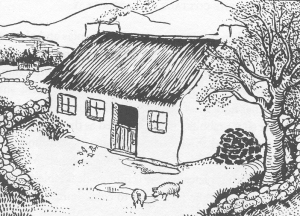 ONE
ONE
Father Tells a Story
BRIGID sat in the corner of the big kitchen, trying to put a patch in one of Liam's breeches. She had to help her mother as much as she could, for Mrs. O'Sullivan had her hands full with the washing and cleaning, and the feeding of the men folk, not forgetting the chickens and pigs and the cabbage patch. Father was out all the time in wind and weather; he did the rough work, the haying and the plowing, the fishing and the cutting of turf. There was little he could not do, from mending Mother s pots and pans and broken furniture to slaughtering pigs and playing the pipes. But he would leave odds and ends scattered about the place and Mother was forever tidying after him. Brigid sighed. She had no liking for needlework; she would rather have been a big boy like Michael, able to help his father shoot rabbits. "Ow!" she cried as the needle stuck in her thumb and the blood pearled up like a round, red jewel. Brigid sucked the sore spot and watched Mother, who was putting plates on the scrubbed deal table for tea. It would soon be time for Father to come home, and then she could stop sewing.
The black kettle, hung on the chain over the fire, sang softly as Mother moved about, cutting the bread and putting scant butter on each slice. Then she kneaded something in a bowl and flattened it out on the table, fashioning nice round slabs.
"Oh, is it potato cakes you're making, Mother?" cried Brigid, sitting straight with sudden interest.
Mother smiled. "It is so bad a day, there was need for something to fill ye all," she said.
Indeed it was bad weather. The rain had been beating against the windowpanes all day long, and dark clouds chased over the mountain tops.
Mother put the cakes into a skillet and crouched in front of the fire, turning them quickly with a fork. A A delicious smell of fried butter filled the kitchen. Suddenly Mother stopped and turned around.
"I haven't heard the twins this long time," she said. "Do you know where they are?"
Brigid gladly put down the breeches and jumped up. "They're sure to be out in the rain," she said. "Shall I fetch them in?"
"Do so. Francie's so delicate he might catch his death of cold."
Brigid threw a shawl over her head and slipped out of the back door. She looked all over the yard, the mud squeezing between her bare toes, and called: "Francie! Liam!" but there was no answer. The chickens left their shelter and ran to her, hoping with greedy little eyes that she would throw them some food. But she was intent on finding the boys and called again, cupping her hands around her mouth: "Francie and Liam!"
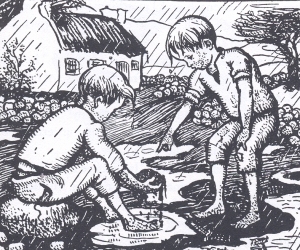 The blue Kerry mountains, looming behind the green fields, threw the sound back at her; still there were no answering shouts from the twins. She went around the whitewashed cottage and peeped down the road. The cottage stood halfway up a hill; below she could see sev eral thatched roofs, with turf smoke curling from the chimneys. Through the trees there were silver glimpses of Bantry Bay. But it was not at the scenery Brigid gazed; there was something else to attract her attention. For, in the middle of the road, where horses' hoofs had pawed a groove which the rain was transforming into a river, two little boys stood ankle deep in the water, spattered with mud from grimy legs to sopping hair. They were scooping up the dirt with some old battered cans, and they hailed her gladly.
"Come and see, Biddy: Come and see!" cried Francie, dancing up and down in his excitement. "We've built a. bridge that'll keep the enemy out of the country entirely. Liam is the Sassenach and I'm a Sinn Feiner. When he comes with his men I'll knock them all into the river. ..." He brandished a stick.
Liam seemed less happy. "I'm no Sassenach," he kept repeating. "I'm a patriot." But Francie would not listen. "Come and see, Biddy," he repeated. "It's the grandest bridge ever you saw, and I've me fleet ready!" He pointed to an empty matchbox which was floating uncertainly in the puddle. But Brigid did not admire.
"Shame on ye!" she cried. "It's kilt ye'll be, with the damp and the dirt. Come along in now, or Mother'll be after ye!"
"You're always spoiling the game!" Francie grumbled indignantly. "It's a real woman ye are an' no mistake." Liam was more lenient. "Sure, she means no harm," he said protectively. "Come, Francie."
"Wait a minute." Francie rescued his matchbox, wiping it carefully and stuffing it into one of his pockets, the one without a hole. He threw one last rueful glance at his lovely bridge and, as he did so, saw something else which made him cry out.
Brigid and Liam turned around and repeated his cry. "Father! What's after happening to him?" It was a sorry pair they saw stumbling up the road, Michael supporting his father, who seemed scarcely able to walk.
Brigid flew to meet them, Liam at her heels, and Francie last, for the poor lad had a crippled foot. Michael hailed them from afar and tried to tell them what had happened, but there was no making it out until they had come closer. It appeared that Father had stumbled into a rabbit hole and twisted his ankle so that he could hardly walk. Michael had had some trouble getting him on his feet again and down the treacherous mountainside. Once on the road, it had been easier, although Father had been forced to rest ever so often and had suffered great pain. His ankle was badly swollen.
"The rabbits got meself this time," he said, with a faint smile; Michael had to do the rest of the explaining because Father was too busy stifling his groans. Brigid offered to support him on the other side and between her and Michael the poor man was brought safely home. The twins ran ahead to tell Mother, who came to meet Father with outstretched arms. Father was soon settled in a comfortable chair by the fire, his sprained foot on a stool. Mother bathed his ankle many times in hot water till he began to feel a little better and was able to eat some potato cakes and drink a cup of tea. What with the excitement and bustle Mother had paid no attention to the twins. Now she noticed their appearance as they stood eating their cakes with grimy hands, the gray mud slowly drying in patches on their faces and clothes.
"Mercy on us!" she said, staring. "Is there any dirt left outside at all, at all?"
After that she had no peace until the little boys were thoroughly scrubbed and cleaned-even their ears got a turn, much to Francie's disgust. Then the two were allowed to sit near the fire to dry and had to drink hot tea to keep colds away.
Mother washed up the tea things and settled herself in a chair with her knitting. Michael fetched Father's pipe and tobacco and took a stool to sit beside him, whilst Brigid and her homemade rag doll shared the bench in the chimney corner with the twins. They made a nice picture, as they sat around the flickering fire. Michael, the eldest boy, had a round freckled face, merry blue eyes, and a mop of red hair; Brigid was the pretty one with red- gold curls and an elfin face. The chubby twins looked like sweet blond cherubs, though they often acted otherwise.
"How are ye feeling now, Father?" Mrs. O'Sullivan asked anxiously, when she had finished counting stitches. "Better, much better," Father said. "But I'm afraid I won't be able to go to Kenmare tomorrow to bring Farmer Flynn the donkey he wanted to buy from me."
"Will he mind, Father?" Michael asked.
Father smiled sadly. "He may not, son-o, but I do. He may buy some other donkey, and then where will we be? Mother needs the money, doesn't she?"
'Mother sighed a little, but she smiled bravely and said: "No harm, we'll manage." By the way her needles clicked the children could tell she did mind. There was always a lot to be bought and never much money to do it with. Though Mother did turn around clothes till they looked like new and managed to use every scrap of food to great advantage, Michael and Brigid knew full well there was need of money always. Never had there been enough to buy Bridy a proper doll, and she did so long for one. For though the doll she had was fondly cherished, it had no face. One misses a face. Brigid wanted a doll with blue eyes and a red mouth full of pearly teeth. She had seen several in the shop windows when Father took her to town on market days, but she was afraid she would never have one. She was now nine years old; when you were twelve, you were too old to play with dolls. What a pity it would be, thought Brigid, if she had to grow up without ever having a real doll! She sighed a little as she thought of it. Grownup people led such dull lives. It was a wonder they got through the days. They were always mending and working and worrying. Of course, she would have to grow up sometime, but she'd like to enjoy herself first, and then, when the mysterious thing happened and she had to let down her skirts and put up her hair, she would at least have something to look back on. But she was afraid there never would be enough money, and so she gazed sadly at the faceless creature on her lap. There were other things that could not be had because they cost money. There was the cow Father had set his heart on, the Sunday hat Mother needed, and Michael wanted to go to a good school, for he was clever and the village teacher said he was getting too knowing for her. Money was needed most for poor Francie, who had a club-foot and could not walk well. The doctor who had seen him said there was a hospital in Dublin where he would be treated free of charge, but Dublin was a long way off, and it would cost so much to get him there.
"Couldn't I sell the donkey for you, Father?" Michael asked.
"It's too far, me lad," said his father, but he looked as though it was not such a bad idea.
"It's not so far. Many's the day I've walked further than that. I'm sure I can do it!"
"Oh, I wish you'd take me with you!" cried Brigid. "I'd love to go!"
Mother sat frowning; presently she looked up and said: "It may be a good plan, Father, to let both of them go. They're fine healthy children, God bless their hearts, and if one of them is in trouble the other can let us know. I'd sooner they went together. It's safer I think, and we're in sore need of the money."
Father stroked his chin, looking doubtful. "It's a deal of money to carry all that way, boy-o," he said. "Are ye able for it, Micky? Can I be trusting you to bring it to me and not to lose it foolishly on the road?"
"Oh, Father, you can surely! I was eleven last Easter."
"Faith and that's true," said Father with a little chuckle. "Your age frightens me." And he put his hand caressingly on the boy's head. "Maybe now you are able to do it, but will it be too much for Biddy?"
"Oh, no, Father!" cried Biddy. "We can be riding the donkey one way and walk back!"
"Well," said Father, pulling at his pipe, "it will ease my mind if you can sell the creature. He is eating all my grass and sorra a bit of work he does."
"Oh! Won't it be the grand journey, Michael?" cried Brigid excitedly. "Isn't it through the tunnel we go?" "We do, and we'll see the fine new bridge over Kenmare River ..."
The word "bridge" woke up Francie, who had been dozing on his bench. "It's meself had the fine bridge," he said with an angry glance at Brigid. "But women will never leave a man alone."
"What's that?" Father asked, and Brigid had to explain Francie's game.
"And I was to be a Sassenach!" Liam cried indignantly. "An O'Sullivan can't be a Sassenach, can he now, Father?"
"But you wouldn't be an O'Sullivan then," said Francie. "It's somebody else you'd be entirely. You wouldn't even know yourself "
Liam looked as though this was small consolation. He was ready to burst into tears, when the thought of his noble O'Sullivan blood restrained him.
"Will you pass the Eagles' Nest tomorrow, Michael?" Francie asked.
"We will then, we'll pass all the high mountain peaks and go right into Kerry; It will be a proud journey."
"Oh, Father," coaxed Liam. "Tell us the story of the Eagles' Nest again. I do want to hear it, and you said you were going to tell us a story if we were good. We have been powerful good, haven't we, Francie?"
"I have," said Francie, virtuously.
"Don't let them bother you, Father, if your foot hurts," Mother warned. "Just take it easy."
But Father said that what with the flickering of flames in the hearth and the rustling of rain on the roof he could not be in a better mood for telling a tale. He filled his pipe anew, and Brigid put some more turf on the grate. Let the winds howl outside; they were going to have a grand time, for Father was the best story-teller in County Cork. Father blew a big cloud of smoke up the chimney, looked at the firelit faces of his four children, and began:
"Ye know that this country was not always a free state. Years and years ago it was independent and was governed by a high king, called Ard-ri. Then the English came with their fine armor and hired soldiers, and the Irish had to put up a fight for seven hundred and fifty years to win their freedom."
"Seven hundred and fifty years!" cried Liam. "Sure an' weren't some of 'em tired fighting that long!"
"Och," said Francie. "Little ye know. Irishmen never get tired of fighting, do they now, Father?"
"They do then, son-o! The story I am going to tell happened when they were weary of it, indeed. The war of Munster had been going on for a long time, and the Irish warriors were half starved, for the crops had failed, and the people were crawling in ditches to eat the greens!"
"Raw?" asked Brigid.
"Raw, indeed," said Father. "They weren't particular. So when our ancestor, the great O'Sullivan who owned a castle on Bantry Bay, was driven out by the English, he took his cattle with him to have something to eat whilst he hid in the woods with his men and his wife and children.
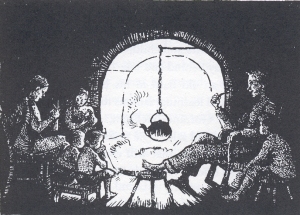 "But och! The English were too wise for him; they pursued him and robbed all his cattle.
"Now the great O'Sullivan and his people seemed lost entirely, the way they were left in the deep dark woods with ne'er a bite to eat. The mistress fell to grieving and weeping over her children, but a great anger came upon our brave ancestor and he vowed to make the English pay.
He gathered his men around him and was for joining his friends who were fighting the English in a different part of Munster.
"It's only me wife and children I'm worried about," he said. "Who'll stay behind and take care of them?"
"There was an old bard in his household, a man of great wisdom and learning, famous for his poetry and wit. His name was Gorrane McEgan, and it was he who stepped forward and said: 'The years weigh upon me and it's not my feeble arm that will conquer the Sassenach. But I will take care of your lady and her babes if you will trust me with them."
"The great O'Sullivan thanked the old bard warmly and took leave of his wife, who clung to him in the way of a woman, crying that it must be a heart of stone he had, to be deserting her. Then he went off with his men to uphold the honor of Ireland. Poor Gorrane was left behind with his weeping mistress and children, and he thought at first that the load of the world was on him, for not a bite nor a sup did he have to give them. And all around the enemy lurked, ready to pounce on them if they moved out of the shelter of the woods. First they must have a home and a place where they could lie down to sleep without fear. So Gorrane used his knowledge of secret places and took the fugitives to a cave in the mountains, so well covered with greenery that ye couldn't find it if ye were a nail's breadth away from it. It was a roomy cave, and he lit a charcoal fire and made beds of fern to lie on. Then he took his gun and went out to look for food. Alas! Too many had been shoot- ing rabbits and squirrels and ne'er a one did he see. He was just going back sadly when he passed a steep rock and looking up he saw an eagles' nest on an outjutting crag. A big parent bird came swooping down with a fat rabbit in its claws and the next minute the young eagles had fallen on it with loud screeches and were tearing it to bits, the way ye could see the fur fly. Gorrane put his finger to his nose and his eyes lit up. 'It's a breakfast I'm seeing, a fine savory breakfast!" he said, and hastened back to the cave. He consoled his mistress for his coming empty handed."Wait now till the morning and then I'll bring ye food as fine as ever ye've tasted," he said.
"The rest of the day and part of the night he spent twisting a big strong rope of bogfir, and at the crack of dawn he wakened his son Patrick, a boy of fifteen years, and told him to come along. The astonished boy followed his father through the gloaming until they reached a mountain top whence they could look down on the ea- gles' nest. They were just in time to see one of the parent eagles soar off in search of food, leaving six screeching babies. "Now, son," said Gorrane. "It's down into that nest I'm wanting ye to go, and you're to tie the bills of those little monsters with bits of string so they can't eat." "But, Father darling," said Pat, wondering greatly. "If it's the birds ye want why can't we kill them and have done with them? There's little enough meat on them anyway. If that's the treat ye're after promising the mistress she must be in a bad way altogether!" "Hold your prate, laddie," said his father impatiently. "There's no time to be telling ye the this and that of it. Do as I bid ye and tie the beaks of these creatures so they can't open them at all, then jerk the rope and I'll haul ye up again."
"So it was done. Gorrane fastened the rope around his son's waist and lowered him carefully into the nest, frightening the little birds out of their wits. Pat then took hold of each fluttering eaglet and tied its bill firmly, after which he was safely drawn up. For an hour or so he and his father watched and waited. At last the parent birds returned, one with a rabbit and one with a grouse in its talons. They dropped their prey into the nest and flew off again. The poor little birds fell upon the feast but pecked vainly, for, sure enough, not the smallest piece could they bite off. Now Pat was let down again and grabbed the rabbit and the grouse, after which he freed the baby eagles' bills. Safely up again, he handed his prey to Gorrane, who cut off the precious meat and threw the skin and bones to the hungry birds, for wasn't it right that they should have something? Oh, the joy that was on the mistress and her children when they saw Gorrane and Pat return laden with food, and the gorgeous feast they made of it! But it's hard work the old eagles had from that day on, for they were obliged to feed a human family as well as their own. They must have wondered at the appetites of their youngsters.
"At last the Sassenach grew weary of the siege and left the neighborhood. Then O'Sullivan's wife and children could move to a place of greater plenty and comfort whilst the eaglets grew up and flew away. In this manner it was that our ancestors were saved and the mountain on which the birds nested is called to this day 'N ead an Iolair', or 'Eagle's Nest.'"
. When Father had finished, the children drew a deep breath for, though it was an old story, they were always thrilled to hear it.
"Were poets cleverer than other people in those days?" asked Michael.
"They were, son. They were the scholars, since the times of the old high kings, before even Saint Patrick came over. The chief poet came next to the king in rank, he was honored greatly and wore a mantle made of the finest bird feathers."
"Did Gorrane wear a mantle like that?"
"Ah, no. He lived much later, when the English were persecuting the bards because they kept the love of Ireland warm in the hearts of her people. When Queen Elizabeth came to rule our country she forbade the teaching of poetry, but the Irish bards couldn't be silenced. They gathered in hedges and ditches with their children and went on teaching history and Latin and the right use of the Gaelic, at the risk of their lives. It was rags they wore in those days.
"Like Paddy the Piper. Is he a bard, Father?" asked Brigid. Paddy the Piper, a traveling musician and the son of Mrs. O'Flaherty, who lived next door, was a great friend of the children.
Father smiled into the fire. "Maybe so," he said. "Did Gorrane's son become a poet too?" asked Brigid again.
"Very likely," Father agreed.
"I would be proud to have been that boy, Father. He was brave, wasn't he?" said Michael.
"Pooh!" grumbled Francie. "Is it him ye call brave an' his father holding him by a rope all the time? It's loose I would have gone into that nest!"
"You would not," said Liam. "Mother wouldn't have let ye!"
They all laughed, but Mother said it was bedtime and carried Francie into the other room, to his great disgust. Liam followed meekly. Though much stronger than his brother, his spirit was gentle. Francie, the delicate one, had the heart of a lion. Brigid and Michael sat up a little longer, chatting with their father. Then it was their turn, and, when they had said their prayers and were tucked under, Mother kissed them and drew the curtains. Outside the rain still fell in long silver streaks; the children heard its pitter-patter on the roof and fell asleep.
Excerpted from The Cottage at Bantry Bay by Hilda Van Stockum
Copyright 1938/1966, Used with permission from Bethlehem Books
Chapter One
First Years
(1786-1793)
The village of Dardilly is set among the low hills that rise in the neighbourhood of Lyons. One of its inhabitants was Pierre Vianney, husband of Marie Charavay. Besides being a prosperous farmer, he was likewise a man of faith,a nd much given tot he practice of the Christian virtue of charity. In July, 1770, the fame of shig ood works brought to hsi door a mendicant who was also a saint.
Tortured by scruples, Benoit Labre had just left the Trappist monastery of Sept-Fonds, where had been a novice under the name of Brother Urban. He had now acquired a certainty that his vocation was to be a wayfarer for the remainder of his life, so he set out for Rome. His first halt was Paray-le-Monial, where he paid long visits to the chapel fo the Apparitions. From Paray he journeyed to Lyons, but rather than etner the city at nightfall he chose to spend the night at Dardilly. On observing a number of poor persons going to the house of Pierre Vianney, he went along with them.
Benoit Labre was strangely attired. He wore the novice's tunic, which he had been permitted to retain on leaving the monastery. A wallet was suspended from his shoulders, a rosary hung round his neck, and a brass crucifix shone on his breast. A breviary, an Imitation, and the book of the gospels constituted his luggage.
In these weird accoutrements he entered the small enclosure in front of the low-roofed house of the Vianneys. the master of the house received him as he received all destitute persons. The children gazed with pity as the hapless man in whom their parents had taught them to see Jesus Christ himself. Matthieu, one of the five boys, was there. little did he guess. Little did he guess, as he contemplated this youthful mendicant, so pale and so meek, who was telling his beads all the time, that oen day he hismelf would be the father of a saint. In the vast kitchen, near the hearth, where, sixteen years later, the child of predestination would warm his little bare feet, Benoit Labre and his companions in distress sat down with the Vianneys before plates of steaming soup, followed by meat and vegetables. Afer grace and night prayers, the guests were shown a place over the bakehouse, where they were to sleep, and where a thick layer of straw was to be their bed. On the morrow, ere they departed, one and all thanks their hosts, but the refined, gentle youth expressed his gratitude in terms which plainly showed that he was no common beggar.
Great was the surprise of Pierre Vianney when, a little later, he received a letter from the poor pilgrim. Benoit Labre wrote but seldom; the hospitality of Dardilly must have touched him deeply; perhaps God had vouchsafed to give him a presentiment of the child of benediction, who was one day to shed undying lustre upon this house.
Eight years after htis event, on February 11, 1778, at Ecully, a village barely a league from Dardilly, Mattieu Vianney married Marie Beluse. If Matthieu was a good Christian, so also was his young wife, who brought him as the most precious of dowries a keen and enlightened faith.
Their union was blessed by God. They had six children, all of whom, as was the touching customf o the time, were consecrated to our Lady even before their birth. The children's names were: Catherine, who married at an early age and died shortly after her marriage; Jeanne-Marie, who departed to a better world when about five years old; Francois, the heir to the ancestral home; Jean-Marie, now scarcely known by any other name than that of "The Curé of d'Ars"; Marguerite, the only one of the six to survive, and that by several years, her holy brother; lastly, another Francois, called Cadet, who, on joining the army, left Dardilly never again to return.
Jean_Marie was born about midnight on May 8, 1786, and baptized that same day. His godfather and godmother were an uncle and aunt - namely, Jean-Marie Vianney, a younger brother of his father, and his wife Francoise Martinon. The godfather, without looking further afield, was content simply to give his own name to his godson.
So soon as the last comer, a favourite apparently from the start, began to notice things, his mother took pleasure in pointing out to him the crucifix and the pious pictures that adorned the rooms of the farmhouse. When the little arms became strong enough to move with some ease, she guided the tiny hand from teh fore head to the breast and from the breast to the shoulders. The child soon grew into the habit of doing this, so that one day - he was then about fifteen months old - his mother having forgotten to help him to make the sign of the cross before giving him his food, the little one refused to open his mouth, at the same time vigorously shaking his head. Marie Vianney guessed what he meant, and soon as she had helped the tiny hand the pursed-up lips opened spontaneously.
Are we to conclude that even from the cradle Jean-Marie Vianney gave unequivocal proofs of future holiness, such as we read of in the lives of St. Raymond Nonnatus, St. Cajetan, St. Alphonsus Liguori, St. Rose of Lima and so many others? Not one of the existing documents suggests such a phenomenon. However, in all that had to do with religion he was a precocious child, and resopnded much more readily than his brothers and sisters to the solicitude of his admirable mother. His was one of those dispositions that are easily directed towards God. From the age of eighteen months, when the family met for night prayers, he would, of his own accord, kneel down with them - maybe merely from natural imitativeness - and he knew quite well how to join his little hands in prayer.
Prayers ended, his pious mother put h im to bed, and, before a final embrace, she bent over him, talking to him of Jesus, of Mary, of his Guardian Angel. In this way did the fond mother lull the child to sleep.
So soon as he could stand on his feet, he was to be found all over the house, though he did not stray far from the threshold, becuase, on the far side of the yard in the direction of the garden, there was a deep trough where the cattle used to drink. For this reason Jean-Marie hardly ever left his mother's side, busy as she was; on her part, she began the task of her little son's education whilst doing her housework, teaching him in a manner that could be readily grapsed by his cihldish mind. In this way she taught him the "Our Father" and the "Hail Mary" together with some elementary notions of God and of the soul.
The little one, who was very wide awake for his age, woudl himself ask naive questions. What interested him most was the sweet mystery of our Lord's birth at Bethlehem and the story of the manger and the shepherds.
These familiar talks were sometimes prolonged far into the night. For the sake of hearing the story of the Bible, Jean-Marie was willing to sit up late with his mother and Catherine, the most devout of his sisters. Soemtimes he even knelt on the stone floor, folding his hands and putting them within those of his mother.
In fine weather Matthieu Vianney set out very early for the fields, where his wife and the children came to join him in the course of the morning. Catheirne and the elder Francois walked ahead, stick in hand, driving the sheep and cows. A donkey brought up the rear, carrying on his back Jean-Marie and Marguerite, whose pet name was Gothon. On arriving at the fields, the children played on the sward or tended the grazing flock. Jean-Marie was a bright and lively boy, who could put endless zest into their games. Contrary to the assertion of his first biogrpaher, he was very far from being one of those youthful prodigies who have none of the charm and vivacity of their age. This brown-haired, blue-eyed boy, with his pale copmlexion and expressive countenance, did not lack a certain petulance, even though his piety was far in advance of his years. "He was born with an impetuous nature"; his perfect meekness was the fruit of prolonged and meritorious efforts. But from his tenderest years the sensitive and nervous child studied the art of self-conquest. His mother, fully aware of the power of example, often held him up as a pattern to his brothers and sisters; "See," she would say, when they refused to obey promptly, "Jean-Marie is much more obedient than you; he does at once what he is told."
However, once, at least, there were tears. The boy had a rosary which he greatly prized. Gothon, who was eighteen months younger, took a fancy to her brother's beads, and, of course, wished to get possession of them. It came to a scene between brother and sister; there was screaming, stamping of feet, and even a preliminary skirmish, when suddenly, full of grief, the poor child ran to his mother. Gently, but firmly, she bade him give the beads to Gothon: "Yes, my darling, give them to her for the love of the good God." Jean-Marie, though bathed in tears, immediately surrendered his precious rosary. For a child of four this was surely no mean sacrifice! Instead of petting and fondling the child with a view to drying his tears, his mother gaev him a small wooden statue of our Lady. The rude image had long stood on the mantelpiece of the kitchen chimney, and the little one had often wished to possess it. At last it was his, really his! What joy! "Oh! how I loved that statue," he confessed seventy years later; "neither by day nor by night would I be parted from it. I should not have slept had I not had it beside me in my little bed... the Blessed Virgin was the object of my earliest affetions; I loved her even before I knew her."
Some of his contemporaries, his sister Marguerite in particular, have related how, at the first sound of the Angelus, he was on his knees before anybody else. At other times he might be found in a corner of the house kneeling before the image of our Lady, which he had placed on a chair.
Children do not fall victims to the foolish disease called human respect. Wherever he happened to be, whether at home, in the garden, in the street, Jean-Marie, following the exapmle of hsi mother, was in the habit of "blessing the hour," - that is, so soon as he heard the clock strike the hour, he would cross himself and recite a "Hail Mary," ending with another sign of the cross. A neighbour who one day saw him carry out this practice, remarked to Matthieu Vianney: "I believe that little brown-haired fellow of yours takes me for the devil." When Matthieu related the incident, the boy's mother asked him for an explanation: "I did not know our neighbour was looking," was the reply, "but do we not cross ourselves before and after prayers?"
Some women of the neighbourhood, hearing the child praying aloud, said to his parents: "He knows his litanies well. You will have to make him either a priest or a Brother."
Marie Vianney may not have had any inkling of the wonderful future of her favourite child; none the less, the beauty of his soul was precious in her eyes, and she spared no pains to keep from him the very shadow of sin: "See, mon Jean," she used to say, "if your brothers and sisters were to offend the good God, it would indeed cause me much pain, but I should be far sorrier were you to offend him."
Her Jean-Marie was no ordinary child. Even before the powers of his mind had reached their full development, the privileged child of grace had made the first step out of the common way, for this seems to be the true explanation of the following occurrence.
One evening - he was then about four years old - Jean-Marie left the house unnoticed. As soon as his mother became aware of his absence she called to him by his name, but no answer came. With ever-increasing anxiety she looked for him in the yard, behind the straw rick and the piles of timber. The little one was not to be found. Yet he never failed to answer the very first call. As she proceeded in the direction of the stable where he might be hiding, the distracted mother suddenly remembered with horror that deep pond full of murky water, from which the cattle were wont to drink! But what was her surprise when she beheld the spectacle that now presented itself to her eyes? There, in a corner of the stable, among the cattle peacefully chewing the cud, was her boy on his knees, praying with folded hands before his little statue of our Lady. In an instant she had caught him in her arms, and, pressing him to her heart: "Oh! my darling, you were here!" she cried, in a flood of tears. "Why hide yourself when you want to pray? You know we all say our prayers together."
The child, unable to think of anything but his mother's grief, exclaimed: "Forgive me, maman, I did not think; I will not do it again."
Whilst these homely scenes were being enacted in a small and obscure hamlet, events of an appalling nature had taken place in France. However, neither the pillage of Saint-Lazare and the taking of the Bastille (July 13 and 14, 1789) nor the decree depriving the clergy of their benefices (November 2); nor that which suppressed the monasteries and the vows of religion (February 13, 1790), appear to have affected the good country folk: they were either ill-informed or unable to grasp the significance of these events. Hence, their peace of mind was not perturbed until the day when, by the civil constitution of the clergy, the Revolution threatened their priests and their altars (November 26, 1790).
Mme. Vianney was a woman of "eminent piety." If at all possible, she would go to daily Mass. Catherine, her eldest daughter, accompanied her as a rule, but soon her favourite companion came to be the little four-year-old, whose precocious piety caused him to relish the things of God. Whenever the bells of the church near by announced that Mass was about to be said, Jean-Marie entreated his mother to let him go with her. The request was granted. She placed him before her in the family pew, and explained to him what the priest was doing at the altar. The child soon developed a love for the sacred ceremonies. However, his attention was divided: the embroidered vestment of the celebrant entranced him, whilst he was wholly overocme with admiration for the red cassock and white rochet of the altar boy. He, too, would haev liked to serve at the altar, but how could his frail arms lift that heavy Missal? From time to time he turned to his mother; it was an inspiration merely to see her so absorbed in prayer, and as it were transfigured by an interior fire.
In subsequent years, when people congratulated him on his early love for prayer and the Church, he used to say with many tears: "After God, I owe it to my mother; she was so good! Virtue passes readily from the heart of a mother into that of her children. A child that has the happiness of having a good mother should enver look at her or think of her without tears."
Excerpted from The Curé of Ars by Abbé Trochu
Copyright 1927, TAN Books and Publishers, Used with permission.