No name

Sample pages from [em]For the Beauty of the Earth[/em]: A Science Supplement for Catholic Parents and Teachers

For the Beauty of the Earth will add the missing ingredients to make your science curriculum (grades one through six) sound.
* The 140 page illustrated student anthology contains all the literature for the units (well over 100 poems, psalms, and excerpts).
* The text is divided into lessons suitable for grades 1 & 2, 3 & 4, and 5 & 6.
* Each lesson begins with a text or reading and includes four kinds of questions (textual questions about the reading, observational questions about the thing being studied, questions of admiration designed to instill wonder, and questions of religious analogy).
* The 57 page teacher's manual contains the lesson plans, questions, answers, and choices of activities designed to lead the student deeper into each subject of study.

by Dr. James Leek, Dr. Kenneth Klassen, Diane Dickerson, and Anne Patrick

Click here to see a sample activity

<* Human in asking children to stand in admiration of the mysteries of creation.

* Integrated to allow parents or teachers to combine literature, art, science, and religion in one lesson.

* Reverent as it guides the student to recognize the Creator in His works.

Excerpted from For the Beauty of the Earth
Used with permission.

Sample Pages from [em]Francie on the Run[/em] by Hilda Van Stockum

ONE

In the Hospital

IN THE kitchen of the Orthopedic Hospital in Dublin the cook stirred the stew in the huge pot. She was an ample person, Mrs. Byrne, though she often wondered why. "Sorra a bit I ever eat," she would say with a hearty laugh. "It must be the smell that fattens me!"

After she had stirred the pot she sank down into a chair and folded her hands in her apron. When she shut her eyes she could imagine herself back in the kitchen of her old home in County Cork, and there was no big range beside her but a sweet, low turf fire with a kettle swinging over it. She could even smell the sea wind and hear the scratch, scratch of the hens as they tripped through the doorway and wandered under the table in search of crumbs.

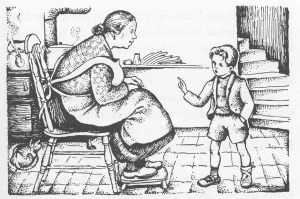
"Please, ma'am," piped a voice by her elbow. With a shock Mrs. Byrne opened her eyes. A little fellow with tousled blond hair looked up at her; he had a bandaged foot, so he must be one of those poor little creatures from the children's ward.

"An' what might you be doing here?" Mrs. Byrne asked, giving the intruder a friendly glance, for she never got angry in a hurry. The boy peeped at her from under black lashes.

"Please, ma' am, they sent me to ask ye could ye make us something else for dessert today? It's sick and tired we all are of milk puddings an' prunes an' milk puddings an' prunes...."

Mrs. Byrne raised her eyebrows.

"Indeed," she said, "they sent ye? Who are 'they,' might I ask?"

"Oh, Tommy Fagan an' Chris Donaghy an' wee Andy - all of them," explained the boy.

; "An' what was it ye had in mind, then, instead of milk puddings?" asked Mrs. Byrne. The boy appeared to think intently with the aid of a wrinkle over his stubby nose.

"Me mother, she made us pies an' cakes," he suggested at last, hopefully. Mrs. Byrne's heart warmed to the music of his Cork accent, and she rummaged in one of her spacious cupboards until she found a slab of fruitcake.

"Will this satisfy your appetite?" she asked. But the boy shook his head.

"One piece isn't enough," he protested loyally. "There's fourteen of us." Mrs. Byrne sat down and laughed.

"Well," she sighed, "I never saw the likes of you before, not in all the years I've been here. So one piece isn't enough, is it?"

"It is not," said the boy firmly. "Sure, there'd be nothing left of it if we divided that. It's a whole cake we'll be needing every day an' no more puddings an' prunes!"

"Anything else?" asked Mrs. Byrne. A smile tiptoed over the boy's rosy face.

"Ye couldn't make it ice cream once in a while, could ye now?" he coaxed.

"Deary me!" cried Mrs. Byrne, raising her hands at this audacious request. "What will ye be asking me for next! The hospital isn't made of money, ye know." The boy nodded.

"Maybe we'd better offer up the ice cream, so," he conceded. Then he looked wistfully about the kitchen. "Ye wouldn't let me stay here awhile, would ye?"

"Indeed I would," said Mrs. Byrne. "But won't they miss ye up in the ward?" The boy climbed onto a chair. "Arra, let them miss me for a while," he said calmly: "Haven't they got me 'most all the time? Sure, it's lonesome I am for a kitchen."

"Och, God bless an' protect ye, me lamb!" cried Mrs. Byrne, her motherly heart running over. "Is it so long since ye left home?"

The boy counted it out on his fingers.

"I was here Christmas, an' Saint Patrick's day, an' Easter - 'deed there wasn't a bit of fun I didn't miss!"

And your parents, don't they visit ye?" The boy sent Mrs. Byrne a pitying glance.

"An' they over in Glengarriff," he said. "Sure, it's too far entirely for them to come!"

"What might your name be, then?" asked Mrs. Byrne curiously.

"Francie O'Sullivan." Mrs. Byrne looked at him with fresh interest. So this was the laddie the nurses were always talking about when they came down for a sup of tea. She had heard tales of how bright he was and how he had all the other children in the ward doing as he pleased.

"And he is the pluckiest boy we ever had," one of the nurses had told her. "Doctor Casey was obliged to operate twice on his foot, and the poor little fellow suffered quite a bit, but he never let out a whimper. The doctor thinks the world of him."

"So you're Francie," said Mrs. Byrne slowly, nodding her head. "It's a pleasure to meet ye, indeed it is. I've heard ye are no coward." Francie looked surprised.

"Why would I be a coward?" he asked. Mrs. Byrne sniffed.

"Ye'd be surprised how many people lose their courage in a hospital," she said. "I've seen men as brave as bulls an' they shaking like jellyfish as soon as they set eyes on a doctor's coat. It's a funny world, so it is." Mrs. Byrne got up and lifted the kettle off the range. She poured out two cups of tea and pushed one toward Francie, who went to sit at the table to drink it.

"I mind one boy," the cook continued, "an' he howled so loud the men could hear it over at the Bank of Ireland, an' they had to stuff the paper money in their ears to keep out the noise. That's the truth."

"Well," cried Francie, "an' him an Irish boy!"

"It's a fact," said Mrs. Byrne.

"It's not from County Cork he was, was he?" Francie asked anxiously.

"Is it likely he'd be? No, he was a Dublin boy." Francie gave a sigh of relief.

"Maybe he couldn't help it so," he said generously. "Dublin boys aren't the same, are they?"

"Indeed they're not, the creatures," agreed Mrs. Byrne, sipping her tea. Francie leaned forward confidentially and whispered:

"There's a boy up in our ward an' him a Protestant!"

"No!" said Mrs. Byrne.

"It's the truth, but he keeps it secret. He doesn't want the other fellows to know. I taught him the 'Hail Mary' an' he says it as well as any."

"Is that so?" and Mrs. Byrne looked properly impressed.

"There's all sorts of boys up in our ward," continued Francie. "One great big fellow called Tom is forever bossing the little ones. Sure, wasn't he the mean one for hitting wee Andy an' knocking him down, an' Andy with his whole leg in a splint!"

"An' what did the nurse do?" asked Mrs. Byrne.

"Oh, she wasn't there, but I grabbed Tommy meself an' fetched him a clout on his head. When the nurse came back she locked us both up."

"She shouldn't have locked yerself up so."

"Well, I wasn't telling on Tommy," said Francie. "How was she to know?"
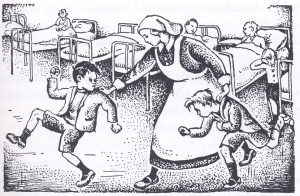
"Are the nurses kind to ye?"

" 'Deed they are, then, the way ye'd think I was a babby; But I do be lonesome all the same," Francie confessed.

"Have ye no friends amongst the boys?" asked Mrs. Byrne, who had Francie well tucked into her heart by now.

"The boys are all right," Francie conceded, "only there's not a one of 'em like Liam."

"And who might Liam be?" asked Mrs. Byrne, getting up to give another stir to the stew.

"Liam is me twin brother," said Francie. "He is the grandest boy in County Cork an' no mistake. He and I used to be always together till I came here. Och, it's himself I do be missing," and Francie let out a sigh that came from the soles of his feet. "Look!" and he pulled a crumpled piece of paper out of his pocket. "Here's the letter he wrote me himself!" Mrs. Byrne had to hunt for her spectacles, and then she went to the window and unfolded the piece of paper Francie had handed her.

The boy watched her with pride as she read:

"DEER FRANSIE WE ARE WELL PLEASE COME BAK SOON I AM SAD WEN U ARE AWAY MIKEL AND BRIGID SEND KISSES I AM RESPEKFULLY LIAM. PADDY CAM ON A WISIT AN BROUT ME A WISTLE ONLY BRAN SWALLOWED IT HE IS SAD TOO LIAM."

Mrs. Byrne had to go over it twice before she could make it all out.

"Glory be to God!" she cried. "It's a wonderful letter, so it is. And what might Liam's age be now?"

"The same as me own; we're six years old."

"And who are Michael and Brigid?"

"They're me elder brother and sister."

"An' Bran, is he another brother?" Francie went into peals of laughter.

"He is not!" he squealed. "He is our dog!" At that moment the door of the kitchen squeaked open and a white-capped nurse looked in.

"Francie!" she cried, "what are you doing here? We've been hunting for you everywhere!"

Francie glanced up reproachfully. "Well, what harm? Can't a fellow have a bit of fun?" he asked. The nurse went over to him and knelt down to feel his foot.

"Walking down those stairs!" she grumbled. "The doctor will be good and angry with you. Can't you be patient a little while? Soon you'll be able to go home and play like other boys." Francie sighed.

"It's been a little while for so long," he murmured.

"Well, you'd better come up now," the nurse said in a friendlier voice. "There's a visitor for you."

"A visitor!" Francie jumped up and hardly gave himself time to embrace his new friend, the cook, and to tell her not to forget the cakes and pies. "I'll be coming back if ye'll let me," he whispered. "It's most like home here."

"Bless your heart, boy, ye're welcome any time," said Mrs. Byrne, looking after him with fond eyes.

"Who is the visitor?" asked Francie, riding upstairs on the nurse's back.

"You'll see," and the nurse smiled mysteriously as she put him down and opened the door of the children's ward.

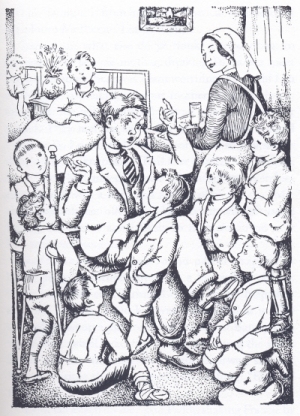
It was a long ward with a shining floor, high windows, a row of white beds, and a couple of screens. In the middle of it, surrounded by eager children, sat a sandy-haired little man with apple-red cheeks. He had put his pointed hat and knapsack beside him on the floor and was telling a story to a spellbound audience, the children in the beds stretching their necks to follow him better.

"And so," he was was saying as Francie entered, "and so he gave a good punch to her nose an' it came off, an' he pulled her gray hair an' it came out, an' he grabbed her hunchback an' it fell down, and then-what do ye think--she wasn't a witch at all at all but a beautiful princess the like of which ye won't find anywhere today, with hair like honey an' eyes like butterflies' wings. So the prince, he said: 'Will ye marry me?' an' she says: 'Maybe I will,' an' so they went to a priest to be wed an' lived happily ever after."

"Paddy!" cried Francie as he limped across the room.

"Paddy! Paddy!" and the children had to make way for his tempestuous figure as he flung himself at the little man with a shriek of joy.

"So, young Cuchulain," said Paddy, holding him at arm's length to have a look at him. "Ye're doing wonderfully well, I see. Played any football yet?" But Francie could only stare with eyes as big as potatoes.
"Oh, Paddy, is it from home ye come?" he whispered at last. "From Mother an' Liam an' all?"

"Indeed, an' what else do ye think? I went down to Glengarriff to see me mother, thinking I'd have a quiet day, but, ochone, there was Liam worriting me would I go an' bring ye a present; an' your mother, bless her heart, must have me tell ye this an' that an' not to forget your prayers. They had me so loaded with messages I could hardly walk. Look!" and Paddy bent down to pull something out of his knapsack. "This here is what Brigid made for ye," and he handed Francie a beautiful handkerchief embroidered with a harp and a sprig of shamrock. "Michael sends ye his old knife. He says it will be useful because the nurses aren't likely to have one. And now look at Liam's present."

Paddy handed Francie a round parcel wrapped in brown paper. It turned out to be a" big yellow cheese. "From your own cow," grinned Paddy. "Liam helped to make it." Francie closed his eyes and sniffed at it. The smell conjured up a picture of the cottage at Bantry Bay, where the cowbell went ting-ling-ling among the gorse bushes and his mother stood in the doorway, shading her eyes against the evening sun and calling: "Francie! Liam!"

"Don't fall asleep on me," said Paddy, shaking Francie by the arm. "There's a deal more I must tell ye but first ye may treat the boys," and he hauled forth a bag of toffees. "Your mother made them for ye," he said. The children cheered and clapped as Francie proudly handed round the bag, not forgetting the poor crippled boys in the beds. When all mouths were filled Paddy pulled Francie beside him.

"Now ye must be answering me some questions," he said, "or it's your people will be disappointed when they see me again. They wanted to know so much I had to write it down." Paddy searched through his pockets. "Faith, if I haven't lost it now! Oh, dear, what'll they say if I don't bring them the right answers! ...Ah, here it is!" and Paddy opened out a paper. "First your father's question: Have ye done your alphabet every day as ye should?"

"I have, then," cried Francie. " 'Deed, an' I wouldn't let Liam get the better of me!"

"All right, then comes question two - that's Liam's: Do ye get ice cream every day?" There was a howl of rage from the children, and instead of letting Francie answer they all began to speak at once, crying out that it was nothing but milk puddings and prunes they ever got. Paddy smiled and quietly put down "No" beside question number two.

"Now, here's something the nurse will be able to answer better," he said. "How is Francie's foot and will he be able to come home soon, nurse?" The nurse rubbed her long nose.

"It depends," she said. "He is a terror for walking. I wonder how we ever kept him in bed at all. He even walks in his sleep."

"In his sleep ?" asked Paddy.

"Sure enough, only the other day I found him wandering downstairs in his pajamas in the middle of the night, an' I had to shake him hard to wake him. But he is doing as well as can be expected and he will be able to go in a few weeks if there is no relapse." Paddy grinned happily and pulled Francie's ear.

"Do ye hear that, Cuchulain?" he asked. "You take care there is no relapse! And now for the last questions. Brigid wants to know about the other children in the ward, but I can tell her that meself. Sure, an' I can see by all your noses that ye're a fine set of youngsters! And Michael, he wanted to know if ye had the electric light in the ward. Nurse, could ye turn it on a minute? I was to see it with me own eyes. There! Isn't that wonderful! Now I can tell him about it. Och, Francie me darling, ye don't know how we're all missing ye. Sure Glengarriff isn't the same place without ye. They're all complaining it's too quiet now with ne'er a bit of mischief about. Liam is as good as bread an' butter since ye're gone, an' Bran is growing fat. Even me mother's cow, Clementine, pines for ye, indeed she does; sorra a bit of cream did we get out of her ever since."

"A cow?" asked wee Andy, incredulously.

"Why not?" said Paddy. "A cow has feelings as well as anyone. Och, an' the way they're all looking out for a word from ye, Francie. Your father goes to the post every day an' when there's a letter the whole village will be coming to hear the news of ye an' your mother'll be reading it to my mother an' the children will be showing it at school."

"An' Liam, what does Liam say?" asked Francie eagerly.

"Liam? Sure, he was that jealous when he heard everyone talking about how the doctor had called ye a plucky boy. He went to your father an' said: 'Father,' said he, handing him a knife, 'ye may cut me foot into smithereens an' ye'll see I won't cry!' " All the children laughed but Francie asked:

"An' doesn't he miss me at all?"

"Miss ye, me boy? Och, ye should hear him, an' he asking his mother every day when ye'll be back! There isn't anyone that don't miss ye. When I'm walking the road ever so often a body will come running out of a cottage, crying: 'Paddy, is it yourself an' have ye news of Francie?' Even the birds an' the beasts do be calling at me from the bushes. 'Give our greetings to Francie and tell him to come back.' Listen to the song I made," and Paddy sang:

"Francie man, Francie man, where has he gone to?
Francie man, Francie man, where can he be?
Where is the little gossoon that we played with?
The hills are all weeping and so is the sea.

"The children are lonesome and asking for Francie,
All creatures on mountains and meadows are sad,
Around Bantry Bay goes the cry: 'Where is Francie?
Our bold, bad, and boastful, our mischievous lad?

"The birds fly around with the news and the gossip:
'He is up in Dublin where houses are tall
And when comes back, 'tis the boys must be watchful
Or he'll beat them at football and hurling and all.'

"Francie man, Francie man, where has he gone to,
Where has he gone to, Francie my man?
Liam sits sighing and watching for hours
And the wee dog beside him is heart-broken Bran."

The children stood still with admiration when Paddy had done. "Did ye make it all up yourself?" asked Tommy Fagan. Paddy nodded. "It's a gift," sighed Tommy from the bottom of his heart.

"I'll tell ye what," said Paddy, ruffling Francie's hair, "the whole of Bantry Bay'll be feasting and dancing the day ye come back."

Francie's eyes shone. "Will there be a band?" he asked. "A band? Three bands and a grand piano! An' we'll get the queen herself over from England to receive ye." Francie frowned.

"I don't want her at all at all," he said severely.

"Faith, an' you're right," Paddy amended hastily. "It was a foolish thought, that was. We'll have no English queens, only plain Irish folk."

"An' what'll we do?" asked Francie, delighted with the idea of a party.

"Well, we'll fetch ye from the station in Dan Murphy's haycart, all done up with flowers. Even the horses will be wearing wreaths, so they will, if they don't eat them, the creatures. An' we'll put the bands out on the platform an' when the train steams in ye'll be seeing us all standing there an' yer mother will be wearing her best hat, an' yer father'll carry ye out of the station an' we'll all cheer an' ye'll go home like a prince entirely." The children clapped their hands at the pretty picture, but Francie's eyes longed for the day he would be home. Paddy saw it and was sorry he had let his tongue run away with him. He pulled Francie onto his knee and kissed him.

"Sure, I know it's hard to wait," he whispered, "but we must be thankful your foot is doing so well. Won't all the boys be wondering at your swiftness and nimbleness when ye're back? Oh, the races we'll run-" Paddy bit his tongue. "Ochone, I do be talking of the day ye'll be back with us an' I mustn't, a mhilis, or ye'll be breaking your heart over it. Be patient now an' I'll say a Novena to the Blessed Virgin to let ye off soon."

"Will ye do that?" asked Francie, with moist eyes raised to Paddy's face. Paddy hugged him again.

"Indeed I will then; haven't I said a wee prayer for ye every night?" he whispered. Then he took out his handkerchief and blew his nose fiercely. "Sure, ye'll have yer old friend Paddy weeping on ye if ye don't cheer up soon. That's right now, smile, there!" and Paddy put Francie down with a last kiss and departed hastily, afraid of making a fool of himself in front of the children. Francie clung to him till the last and watched him out of sight from the window. Then he sat in a corner with his presents and would speak to no one. But when supper time came the nurse walked into the ward with a festive air, bearing a platter with a great big tower of pink ice cream and a card attached which read: "To Francie and his friends, from Paddy."

Excerpted from Francie on the Run by Hilda Van Stockum
Copyright 1939/1996, Used with permission of Bethlehem Books

Sample Pages from [em]Friendly Gables[/em] by Hilda Van Stockum

ONE

Good News

IT WAS the twenty-first of March, the birthday of spring, but in Canada winter still reigned, Snow was whirling allover Quebec, allover its fields and wooded hills, all over the mute St, Lawrence River in its prison of ice.

Steadily the snow came down, covering with its pure mantle the rusty confusion of railway yards and the smoking factories of Lachine, a suburb of Montreal. It also fell silently and daintily on the houses and gardens of its residential district. One of the largest gardens belonged to Friendly Gables, the home of the Mitchells. They had lived there most of the two years since they had moved to Canada from Washington, D.C.

The snow kept falling, falling, muffling all sounds, so that cars whispered past and pedestrians moved like ghosts. In this stillness, if someone had stood at the front gate of Friendly Gables and listened carefully; he could have heard a baby wailing in Mrs. Mitchell's bedroom.

One of the twins had been put into Mrs. Mitchell's arms. The other was being powdered and pinned and bundled by the nurse. The doctor had gone; there was only a slight smell of disinfectant left in the room; the perfumes of powder and baby oil were taking over. Mother lay back on her pillows, one newborn son firmly nestled against her. She watched the other one longingly.

"Is he almost ready, Miss Thorpe?" she asked.

"Just a minute, just a minute," answered Miss Thorpe. She was a tall, angular woman with a firm mouth. Her hands were capable and strong - too strong, thought Mother. No wonder the baby was yelling, he must be seasick, the way Miss Thorpe tossed him about.

"Don't you think he's dressed enough now?" she pleaded. "I want to see if they're alike."

"All babies are alike," mumbled Miss Thorpe through the safety pin she held between her teeth.

"Oh no, they aren't. Mine were all different," protested Mother.

"That's your imagination," said Miss Thorpe, rolling the baby in a blanket as if she were wrapping a loaf. "Give him to me," Mother begged.

"Here you are, then." And Miss Thorpe handed her the second baby, who stopped crying at once. Mother laid the babIes side by side on her lap and compared them. They both had red, crumpled faces and lots of dark, wiry hair.

"They are alike, aren't they?" she said. "I'm going to call them Johnny and Jimmy, after my husband and his brother. Won't John be surprised when he hears it's twins ! We wanted another boy, but we didn't dream we'd get two! That makes it even - four boys and four girls. Does he know yet?"

"The doctor said he'd phone him," answered Miss Thorpe. "I have my hands full. Twins make twice the work. "

"Yes, and I wonder - have we enough diapers and things? I've only one cradle. .." A worried flush spread over Mother's face.

"Never mind, Mrs. Mitchell, they'll both fit in the one for a while, and I'd get diaper service, if l were you. It's no fun, washing for twins. "

"No - you're right," agreed Mother. She glanced at the clock. "It's almost three," she said. "The children will soon be coming home from school. I'm longing to show them the babies - the girls will be delighted! Is Catherine awake yet?"

"No, sound asleep," said Miss Thorpe. "Thank goodness. I had trouble enough getting her to bed. She knew something was happening and she kept wondering what the doctor was bringing in his black bag-was it a kitty? I asked her, wouldn't she rather have a little brother or sister, but she said no. She seems a very determined young lady. Are they all like that?"

"Oh, you haven't met the others yet, have you?"

Mother raised herself on an elbow and listened. "There's Timmy." A pleased smile warmed her face. "Do you hear him?"

"No," said the nurse, folding up some towels. "I don't hear anything." But presently she did notice a faint, clear thread of sound rising from the road below and growing louder all the time.

"Good news, Mommy!" it said. "Good news!"

"Timmy is our evangelist," explained Mother. "He always has good news, and he starts shouting at the beginning of our avenue and keeps on all the way up. Sometimes it's a good mark he got at school, or a game he has won, or a friend he's made, but it's always good news. I wonder what it is this time?"

"You're not thinking of letting him come up here, near the babies?" asked Miss Thorpe, horrified.

"Why not?" asked Mother calmly.

"But - he'll be full of germs," warned the nurse. Mother looked surprised. "I've always let my children see my newborn babies and no harm ever came of it," she protested.

They heard the clomp-clomp-clomp of boots on the stairs, and then the door of the bedroom was flung open and a six-year-old little boy tramped in, snow still melting on his blond hair, his cheeks red, his hazel eyes shining. He was breathing out the frosty air and brought afresh smell into the room.

"Good news, Mommy," he began. Then he stopped as he noticed the bundles on either side of Mother. "Two!!" he cried. "Two babies! You've got two! They came! Two of them!"

"Yes, twins, isn't it wonderful?" Mother smiled.

"Ooooh-twins," breathed Timmy, tiptoeing nearer, a holy awe on his face. " Real twins. I thought they only happened in books." He touched the bundles gently with his finger. "They're rather small, though, aren't they?" he said in a worried way. "I don't think you rested enough, Mother. They don't look quite finished."

"They'll grow," Mother assured him.

"Are they girls?" asked Timmy.

"No, boys."

"Oh, goody!" Timmy sat down at the edge of the bed.

"Do you think they'll ever be big enough to play with?" he asked.

"I'm sure they will, dear-sooner than you think."

"May I hold one?" asked Timmy.

"Not yet, dear; wait till they're a little older. You might hurt them."

"But when they're older I won't want to hold them," said Timmy wisely.

Mother smiled. "What's your good news?" she asked.

"Oh, I forgot!" Timmy's face regained its radiance.

"There's a new girl in our class, called Philosophy."

"Philosophy?" asked Mother. "I've never heard that name before. "

"I don't call that good news," came the cool voice of the nurse suddenly. "I call that bad news." Timmy looked around, startled.

"That's Miss Thorpe, dear, my nurse," explained Mother.

"Oh! How do you do," said Timmy politely.

"Pleased to meet you," said Miss Thorpe, but she didn't smile and Timmy wondered whether she really was.

"Well, tell me more about Philosophy," asked Mother.

Timmy heaved a sigh. "She is pretty," he said.

"She'd better be, with that name," said Miss Thorpe. There was a ring at the door, and Timmy clattered out of the room to answer it, his loose shoelaces tick-ticking on the floor. A little later the door opened again to admit what seemed at first a basket of flowers on legs. Then the basket tumbled on the bed, giving Mother's big toe a jolt, and from behind it emerged a breathless Timmy, waving an envelope.

"Here," he said. "This says who sent it."

The nurse took the flowers and put them on the table by the window. She clucked her tongue in admiration. "Such lovely yellow tulips," she said with a sigh. "They go so well with the pink hyacinths. You'd think spring was here already. " And she sighed again, for she came from England, and there the fields are green in March, and little white lambs gambol over the first primroses. Miss Thorpe found the long Canadian winters hard to bear. Mother had been reading the note. "They're from my husband-isn't it extravagant!" she cried, flushing happily. "He says he'll come home as soon as his meeting is over."

"Yes, and you should be taking a nap, Mrs. Mitchell," warned Miss Thorpe. "You know what the doctor said."

"But the other children haven't seen the babies yet," murmured Mother. Her eyes were falling shut. She was sleepy.

The nurse chased Timmy out of the room and lowered the shades. Then she settled herself in an easy chair with a book. Soon there was only the sound of breathing and the whirring of the electric clock in the room. Mother and babies were fast asleep.

Timmy felt very important. None of the others knew about the twins. He would have to tell them. Their schools got out much later than his. He put on his ski jacket and boots again and stood outside. The snow was still falling in feathery flakes. Timmy saw Mrs. Garneau pass. She was an aristocratic French lady who lived in the brick mansion opposite Friendly Gables.

"We've twins!" he shouted.

The lady stopped. "Comment?" she asked.

Timmy searched for the right French word. " Deux bibis," he said, holding up two fingers.

"Tiens!" Madame Garneau didn't look happy. Already there were too many young Mitchells so far as she was concerned. Two more seemed an imposition. How much extra noise would that make? She hurried into her house.

Timmy waited. He looked longingly down the avenue, where trees marched one after the other, wearing jaunty caps of snow. In the distance he could see the gray streak of the St. Lawrence River, still in its prison of ice.

He could hear the streetcar singing along the wires, coming closer and closer. Now the others would soon be here. Timmy ran to meet the streetcar, the loose straps of his galoshes flapping about his ankles. "Good news," he shouted, "good news!"

He wasn't watching where he was going and ran full tilt into a thick overcoat. Thus abruptly stopped, he looked up into the laughing face of the mailman, who asked, " Ai, ai, where hare you going?" in a strong French accent. " And what is thees good news, hein?"

"We've twins!" crowed Timmy. "Just born! Boys!"

He felt he was making a tremendous contribution to the world in general by spreading this stupendous piece of information before even the papers got hold of it. The mailman was duly impressed, and went on his round, delivering letters and papers and telling everyone he saw, "Did you 'ear, the Meetchells 'ave twins!"

Meanwhile Timmy had caught sight of his brother and sisters, who were descending from the streetcar.

"Joan! Patsy!" he yelled. "Angela! Peter! We've twins - twins! They've come! Two babies! Boys! Come and see!"

Mother Mitchell was in a deep, refreshing sleep. She was dreaming that she was a child again, playing in the meadow. But as she picked the pretty daisies, they began to glitter and twinkle in her hands. They had turned into stars.

Crash! Boom! Her bouquet of stars exploded in her face.

"What's that?" She sat up, trembling. Then she sank back onto her pillows with a sigh of relief. It was only the children. They came storming into the room, and to Miss Thorpe's astonished eyes they seemed an army; Children you don't know always seem more numerous than they do when you know them. Peter, a tall boy of eleven with dark, quarreling hair and lengths of bony, uncovered wrist, reached his mother first. He bent over her with an almost grown-up air of protective tenderness.

"Congratulations," he said, kissing her. "Twins. What a bargain! Two for the price of one, eh?" Mother smiled at him. But Joan was already pushing Peter away. She was a tall blond girl of fifteen.

"Oh, the darlings," she crooned. "Aren't they just like Catherine when she was a baby? Can I hold one, Mommy? Let me have one, may I?" Lifting one of the twins from his reluctant mother's arms she sat down in the easy chair with him. He started to cry, but she put him over her shoulder and patted him in an expert way, to the admiration of Timmy and Angela, who were hanging about her chair. Peter and Patsy were leaning over their mother, admiring the other twin.

Mother was sitting up in bed, flushed, with shining eyes. " Aren't they wonderful!" she kept saying.

Miss Thorpe disapproved of the congestion in the bedroom and frowned at her.

"Oh!" said Mother. "You haven't met Miss Thorpe, who is kindly helping us out till I'm stronger."

The children suddenly sobered and turned their faces toward this unknown person. They had been only vaguely conscious of someone in the background while they admired the babies. Miss Thorpe looked formidable to them in the icy white of her starched linen uniform. Her dark eyebrows met over her nose, and her lips were pinched together. After a momentary hush Patsy got up to shake hands with her and Angela and Peter followed her example. Joan smiled from her chair, as she was holding the baby.

Miss Thorpe was clearing her throat to greet the children when a wail from the next room interrupted her. Catherine had waked up. There was a thud as she rolled out of her crib, then the sound of bare feet pattering on the floor. The door of Mother's bedroom was pushed open and Catherine entered, the wrinkles of her pillow still showing on her soft, pink cheek and her eyes dark and dewy under the pale wisps of her ruffled curls.

"Mommy!" she cried. She was clad only in a vest and panties and her fat tummy peeped through the gap. Miss Thorpe clucked in distress. "Come, dear, let me dress you."

But Catherine avoided her outstretched hands and steered a straight course to Mother's bed.

"Look at the babies!" cried Timmy.

Catherine's eyes darkened ominously when she saw the small bundle in Mother's arms. Her face grew red. She threw herself on Mother's bed.

"I don't want babies," she wailed. "I want a kitty."

"Well, dear -" began Mother.

"Now, Catherine," said Miss Thorpe.

"Babies are much nicer!" cried Joan.

"I want a kitty!" yelled Catherine.

Miss Thorpe pursed her lips. "Really," she said. "There are too many in this room. I'm afraid the children will hove to leave. "

"Yes, you're right, Nurse," Mother sighed. She allowed Miss Thorpe to push the protesting Catherine out of the room. Joan brought the baby back to his mother and smoothed her pillow.

"It's true, Mommy," she said, "you'd better rest. You've had twins, you know." And she herded the other children into the hall.

Miss Thorpe closed the door after her. "It was about time," she sighed. "What you need, ma'am, is a nanny."

The children felt ashamed of Catherine's behavior. Fancy not wanting baby brothers! She was as bad as Mary Jane, who didn't want rice pudding. They'd call her Mary Jane, if she didn't stop howling. What would the new nurse think? What would the neighbors think? There-now the twins were crying too; Catherine had started them. Why did they cry? Because Catherine didn't want them, of course. How would you like not being wanted?

Catherine's sobs subsided. She still whimpered a few times that she had asked for a kitty; Mommy knew she wanted a kitty; but the wails coming from the bedroom impressed her. It wasn't long until she was happily munching a cooky, which she shared with Trusty, the dog. When Father came home all was more or less peaceful - even the twins were asleep - so he and Mother could rejoice for a moment together.

Excerpted from Canadian Summer by Hilda Van Stockum
Copyright 1960, Used with permission from Bethlehem Books

Sample Pages from [em]Heroes of God's Church[/em] by Father P. Henry Matimore, S.T.D.

FORWARD

In writing this volume, the purpose has been to acquaint our children with biographies that will have some particular influence on the development of their characters. Each story has been planned as a real character-training project, not merely as a reading lesson to inspire admiration for faith and religious heroism.

To accomplish this purpose, we have endeavored to stimulate interest in each saint by presenting him or her as a real human being who lived in a real world among real people and not as a superbeing surrounded by miraculous wonders. We have tried to make the saints human, admirable and lovable, and therefore imitable. In order that children may learn that sanctity is not confined to any special nation or historical period, or time of life, or social or financial condition, saints have been chosen from various nations, from all periods of time, from all ages of life, and from all strata of society. Practically every type of sainthood is represented, from the martyr who shed his blood for Christ to the young Sister who did just the little things of life but did them well.

Each story is intended to bring out one or more situations in which the saint's virtue is emphasized. It is sincerely hoped that teachers will take advantage of these situations to develop similar virtues in those entrusted to their care.

Contents:

1 Saint Cecelia
2 Saint Sebastian
3 Saint Agnes
4 Saint Monica
5 Saint Patrick, Apostle of Ireland
6 Saint Columba
7 Saint Boniface
8 Saint Thomas a Becket
9 Saint Francis of Assisi
10 Saint Hedwig
11 Saint Hyacinth
12 Saint Louis, King of France
13 Saint Gertrude
14 Saint John Nepomucene
15 Joan of Arc, the Savior of France
16 Blessed Thomas More
17 Saint Francis Xavier
18 Saint Aloysius
19 Saint Vincent de Paul
20 Saint Isaac Jogues
21 Saint Gerard Majella
22 The Cure of Ars
23 Blessed Theophane Venard
24 Father Damien, the Martyr of Molokai
25 Saint Therese, the Little Flower
TO THE CHILDREN

Dear Boys and Girls :

Sometimes our boys and girls have strange ideas about the saints. They think that God made them so different from other people that it is quite difficult to imitate them. Many, too, have the idea that saints lived only in the early ages of the Church. They never imagine that saints were real people, living in a real world in every age and in every nation.

We have written these stories to give you a better and truer idea of the saints. They were real human, beings who were once boys and girls like you, who enjoyed playing the games of their day just as much as you enjoy playing your games to-day. Some were rich, others poor. Some were of noble birth, others came from humble families. Some died young, others lived to old age. Some belonged to one nation, some to another. Some lived in the times of long ago, others lived in our own day. Some did great deeds in the service of God, others did the little things but did them well.

All this is to show you that saints do not belong to any special class of society or time in history. They are found in all states of life and in all ages of the world. A man can be a saint in almost any walk of life at any time.

Sanctity in our holy Church is not measured by wealth or position, by glory or power, but by a life well spent in the service of our God.

We hope these stories will help you to know and love the saints and inspire you to imitate them in their love and devotion for our divine Savior.

SAINT CECILIA

(Died 230)

1. THE DAYS OF PERSECUTION

For almost three hundred years after the death of our Lord, the church suffered bitterly from persecutions on the part of the pagans. Things became so dreadful that it meant death to be a Christian. The powerful pagan government of Rome did all that it could to stamp out the first seeds of Christianity.

It became impossible for the followers of Christ to worship above ground. They dug long, narrow, secret passages, called catacombs, under the ground, where they held their sacred services. Before sunrise the Christians hurried cautiously through the winding streets and along the Appian Road to the catacombs of St. Callixtus. Here Mass was celebrated and Holy Communion given by the bishop or a priest helping him. Mass was usually followed by a short sermon and a few hymns. Before the people of Rome were roused from their slumbers, the faithful were hastening back to their homes in the city.

2. CECILIA BECOMES ENGAGED

It was during these sad days of persecution that Cecilia lived. Hers was one of the great families of Rome, being both noble and wealthy. Cecilia's father was an honorable pagan, admired and respected by all who knew him. He never interfered with the faith of his wife, who was a devout Christian, and he even arranged to have his servants accompany St. Cecilia and her mother to the Christian meetings so that they would run no risk of being taken by the Roman soldiers.

Cecilia was the idol of his heart. With pride he watched her grow from babyhood and childhood to a charming young lady of seventeen. His friends had often remarked to him about the grace and beauty of his daughter, hinting that their sons would like to seek her hand in marriage. But the careful father turned them aside, one by one, till Valerian came.

Like Cecilia, Valerian was of noble birth and he owned vast estates. He was a virtuous pagan, some years older than Cecilia. The father of the charming maiden liked him and thought that he would be a most acceptable husband for his daughter. Valerian was delighted. He had succeeded where so many others had failed.

When Cecilia heard of her father's plans, her heart almost stopped beating. She had no intention of marrying any man, but she dared not offend her father, who seemed so happy in the choice. The poor girl made no answer to her father's proposal. Hurrying to her room, she burst into tears. She sobbed and sobbed as if her heart were broken.

After some time, Cecilia calmed herself and sought help in prayer. "0 dear Lord," she said, "what shall I do ? To please You and Your holy Mother, I have vowed to live a virgin all my life. If I tell this to my father, he will be angry and will become bitter against our holy faith. My vow I shall never break. Tell me, O Lord, what am I to do ? "

The sweet voice of her guardian angel whispered : "Trust in God. All things will be done according to His divine will."

Relying on the help of God, St. Cecilia wiped away her tears. Lest her parents might see her flushed cheeks, she strolled through the gardens that surrounded the palace. No more tears were shed. There were no more pangs of sorrow.

3. THE WEDDING FEAST

The busy days just before the wedding were soon at hand. The proud father of Cecilia was determined that no Roman bride should surpass his daughter in glory on her wedding day. Money was spent lavishly. The palace was decorated with rich draperies scented with the choicest perfumes from Arabia. Flowers from the royal gardens were placed about the halls in golden vases. Delicious wines, fruits, vegetables, and meats were prepared.

The great day arrived. Guests in their silks and satins were met at the gates by torchbearers, and escorted to the palace. Dressed in flowing robes of cloth of gold and decked with precious jewels, Cecilia became the bride of Valerian.

African slaves moved silently about the banquet hall, carrying golden dishes with their tasty foods. Choice wines were freely poured into shining goblets. The hearty laughter of the Romans grew louder and louder as they drank to the health of the bride.

4. CECILIA TELLS HER SECRET

The parents of the bride were delighted. Valerian was the happiest man in the world. Cecilia, however , was nervous. She knew that she must tell her husband about her vow. She whispered a word at the table and she and her husband arose to make room for some of the other guests. Arm in arm, they walked across the gleaming marble floor and out into the garden.

Once in the garden they strolled among the rose bushes. Cecilia led the way to a bench where they could talk alone.

"Valerian," she began, " I have a secret to tell you, but swear to me that you will tell no one what I say ."

Valerian, with a look of surprise, gazed into the beautiful face of his wife. He saw that she was very much in earnest. " I promise to tell no one," he said.

" I am a Christian," she said, " a loyal follower of the Savior Who died on Calvary for you and me. To Him, I have promised to be a virgin all the days of my life and He has sent an angel to guard and protect me. These many months, I have prayed for you, asking God to grant that you, too, might see the truth as I see it."

Valerian had never heard such things before. For a moment he did not know what to say. Then he spoke: "Where is this guardian angel that you speak about ? Show him to me."

"0 Valerian," she answered, "that holy spirit would never appear to pagan eyes." She saw that her husband was becoming interested. She told him how much her religion meant to her. She said that it had woven itself around every action in her life. " I would sooner die a thousand deaths than give it up," she cried.

" I should like to know more about this religion that you love so dearly. Perhaps I, too, could become a Christian," answered Valerian.

5. AT THE CATACOMBS

Cecilia was delighted. She explained to her husband that on that very night there would be a special meeting of the Christians at the catacombs on the Appian Way. She whispered to him the password and told him to hasten thither .

Without much difficulty, he found the secret place some miles beyond the gates of Rome. A Christian stood guard, ready to give the alarm of approaching danger. Valerian gave the password to the guard and was taken to Pope Urban. When the pope heard that the visitor came from Cecilia, he raised his eyes to heaven and, clasping his hands, murmured, " Thanks be to God."

That night God allowed a great miracle to take place. In a vision, Valerian saw St. Paul with an open book in his hand standing beside Pope Urban. "Read these words," said St. Paul, showing the book to Valerian."

The visitor read, " One Lord, one faith, one baptism, one God and father of all, who is above all, and through all and in us all."

"Do you believe'!" asked the vision.

Cecilia's prayers were answered, for at that moment the grace of God entered the soul of Valerian, and he answered, " I believe."

The vision then disappeared.

With a lighted taper in his hand, Pope Urban led Valerian down the long flight of stairs carved in the hard clay. Then they walked through long, narrow, twisting passages that never saw the light of day. The sides of the walls were covered with white slabs of marble, enclosing niches in which were buried the bodies of Christians.

Valerian grew nervous as his companion kept walking on through the low, black corridors. The faint sound of music was heard. It grew louder and louder as they proceeded. At last they entered a large room far below the surface of the earth, with no windows and no lights, except the faint smoky flames from tiny oil lamps that were hung about the walls.

A priest in his sacred vestments was standing at the altar, giving a sermon to the faithful. Valerian paused to listen. The preacher warned the people that a new persecution was breaking out. He pleaded with them to remain faithful to Christ to the end, picturing for them an eternal happiness in God's kingdom. The simple, earnest words touched the soul of Valerian.

When the sermon. was finished, Pope Urban beckoned Valerian to follow him into another smaller room. Here the earthen walls were covered with crude pictures of our Lord and the saints. These were painted on the plaster that had been placed on the rough walls. There was only one chair in the room and a plain, marble bench near the altar. Urban sat upon this and invited his companion to sit on the step of the altar.

6. VALERIAN IS BAPTIZED

The kind old bishop stroked his long, gray beard as he explained the teachings of the church to Valerian. His voice was soft and low. There was something about him that inspired love and confidence in the pagan who sat at his feet. By the grace of God, the words of the bishop brought light to the Roman's mind. His soul was flooded with grace, and he fell on his knees before the successor of St. Peter and cried out, " I believe, O Urban, I believe."

The venerable pope bowed his head. Tears of joy trickled down his wrinkled. cheeks and a fervent prayer fell from his trembling lips. God had granted the wish of St. Cecilia.

Valerian's heart was happy, both for his own sake and the sake of his lovely bride. He was led to the crude baptismal fount that one of the converts had carved from a white marble column. The angels of heaven rejoiced when the saving words of baptism were pronounced over him.

Urban embraced his new disciple with the affection of a father.

"My son," he said, "you are now a follower of Christ, the God-Man who died on Calvary for the souls of men. With a brave heart may you go forth from this sacred meeting place, determined to help others receive the priceless gift that you have received this morning. May the grace of God be with you and encourage you in the trying days that are to come."

The pope brought Valerian back to the large chapel that they had left some time before. The air was heavy with the smoke from the olive-oil lamps. Two wax candles in earthenware holders burned upon the stone table that served as an altar. The tinkling of the bell had just announced the consecration of the Mass. Fifty heads were bowed in silent adoration. For the first time in his life, Valerian knelt before the altar and adored Jesus, his God.

After Mass, Valerian was introduced to the other Christians. The men embraced him and the women gave a smile of welcome. They had all prayed for the conversion of the husband of their friend, Cecilia.

7. HOME AGAIN

It was just before sunrise when Valerian left the catacombs. He had spent the night with the faithful friends of Cecilia and promised to live and die with them. His anxiety to tell the good news to his wife hastened his steps. He was truly proud of his new-found faith, proud that he adored the same God as Cecilia.

As he entered the garden surrounding his home, everything was silent. A few hours before, that palace was aglow with lights and ringing with mirth and laughter. Now, not even a leaf on the tall oak trees was stirring.

The servants had left a few oil lamps burning dimly in the great reception room. Fearing to disturb the household, Valerian tiptoed through the hall to a richly decorated parlor. As he drew aside the heavy blue draperies, he saw his beautiful bride, still clad in her wedding dress, kneeling in prayer before a crucifix hanging on the wall. Her delicate, white hands were clasped upon her breast. Her eyes were raised toward heaven. How lovely, how pure, how good she looked that morning !

Valerian held his breath, lest he might startle his holy bride. He did not wish to intrude upon such a sacred scene, but to withdraw was impossible. Silent and still as a statue, Valerian waited for Cecilia to finish her prayers. She prayed aloud: " O sweet Jesus, from the bottom of my heart I thank Thee for the conversion of Valerian. He is one of us now. Together, night and day, we shall work for Thy holy cause."

8. THE MYSTERY CLEARS

Valerian was dumbfounded. " How did she find out about my conversion ?" he wondered. "Surely no messenger came before me to the house to tell her." In his surprise, he forgot himself and coughed.

Cecilia was startled. Her face turned pale. She jumped to her feet and turned to glance at the intruder. When she saw Valerian, she threw herself into his arms and cried with joy: " Thank God, it is you. O Valerian, you can never imagine how happy I am to know that you are a Christian. Ever since you asked to marry me, I have prayed night and day for your conversion. Now we can face the whole world together and fight for the cause of Christ."

"But my beloved," asked Valerian, "how do you know that I am a Christian? Has someone been here before me with the good news?"

" As soon as you left," she answered, " I placed that crucifix on the wall and I have knelt before it in prayer ever since. Our dear Lord let me know how His grace and the kind words of the bishop were affecting your soul. At the moment of your baptism, my guardian angel appeared to me and told me the joyful news."

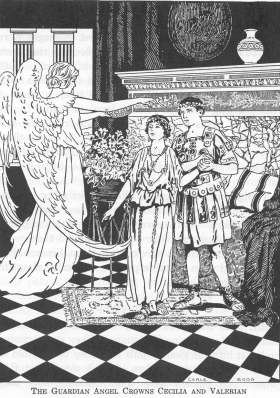
"What does your guardian angel look like?", asked Valerian. "I should be glad -" The sentence was never finished. A golden bright light shone in the room and in the midst of it appeared a beautiful angel in snow-white robes. A feeling of terror crept over Valerian, but Cecilia placed her arm in his and assured him that the sudden visitor was her guardian angel. The angel spoke kindly to the happy couple. He placed sparkling golden crowns upon their heads to show that they both would be crowned martyrs in heaven. Turning to the surprised husband, the angel said: " God promises to grant anything that you wish for. Name your desire and it will be granted."

"God could grant me no greater favor," said Valerian, "than to give my twin brother the gift of faith."

A short time later Valerian stood beside the baptismal fount as the bishop poured the holy waters of baptism over Tiberius, his twin brother .

9. ZEALOUS APOSTLES

God's blessing rested on the home of Valerian and Cecilia. I twas an earthly paradise, with the saintly wife as its queen and her husband as its king. The servants were treated with a kindness that had never been heard of before. Cecilia meekly went among them, teaching them about Jesus and His holy church.

Sometimes the Christians gathered secretly in the house for the celebration of the Mass. On those occasions, the priest always preached to them a short sermon on Jesus, the miracle worker of Galilee.

Valerian and Tiberius became zealous workers in the church. They gave money generously for the care of the poor, suffering Christians. Secret messages were sent to the Christians through them because they were, never suspected of being followers of Christ. With little danger, therefore, they visited those who were imprisoned for their faith and gave them a word of cheer, urging them to remain loyal and true to the religion of Jesus Christ. Many a wavering soul was saved by their kind encouragement. At times these holy men, unknown to the guards, brought Holy Communion to those who were to be put to death for the faith.

Things had been going along quietly for several months and no eye of suspicion had been cast at the twin brothers. As they were men of wealth and prominence, the Roman soldiers always saluted them. All the prisons and courts were open to them, because they were looked upon as noble pagans wandering about to satisfy their curiosity.

10. CONDEMNED

But alas, some vile enemy betrayed them to the Roman police as being Christians. They were arrested and cast into the gloomy jails that they had visited so often. The greedy soldiers gloated over their rich prize. The officers were soon debating how they would divide the riches of their prisoners. All Rome gossiped about the sad plight of Valerian and Tiberius.

The brothers were hailed before a stern Judge, who demanded that they offer sacrifice to the pagan gods. On their refusal they were beaten with lashes. Bruised and bleeding, they fearlessly defied the judge.

"Our heads will never bow before a god of bronze or stone," they cried. " Our God is a living God and Him alone do we adore."

Shouts of " Death! Death! " rose from the rabble that attended the trial. The judge bowed his approval and the prisoners were led off to death. They had known Christ but a short time and now they were to suffer death for Him and receive His crown of glory.

The prefect of Rome and his friends rejoiced in the approaching death of these two wealthy Christians. They made hurried plans for the division of the brothers' riches among themselves. But Valerian and his brother, knowing that their death was certain, gave their palace to Cecilia and the rest of their wealth to Christian friends to be used for the poor. When the prefect found this out, he was enraged. His plans had come to nothing.

11. CECILIA JOINS THE MARTYRS

But these bloodthirsty men were not finished with their wicked work. They decided to arrest Cecilia as a Christian and to take whatever she owned. Forcing their way into her home, they dragged her out and cast her in a filthy prison as if she were a criminal.

Everyone who knew the charming Christian widow loved her. The prefect was, therefore, timid about condemning her to death. In various ways he tried to coax her to give up her faith and turn to the pagan gods of Rome.

" Cecilia will never offer sacrifice to false gods," she exclaimed. " I have pledged my soul to the great God Who, in the days of old, walked the earth with Abraham, Isaac, and Jacob. Throughout my life I have served His divine Son Who died on Calvary's cross for the love of you and me. Shall I fall down and adore a piece of marble ? Shall I burn incense before an image of stone ? Never ! No, never! "

" But remember," said the judge, " unless you do as I ask, I shall be forced to condemn you to suffering and, perhaps -"

Cecilia did not give him a chance to finish. " There is no punishment in your power that can make me deny the Lord Jesus Christ," she said. " I have loved and served Him till now and I shall continue to do so till death. Let the law take its course. The Christian asks for no mercy ."

If Cecilia had had any chance of escaping death I before, she had none after this speech. The judge condemned her to be steamed to death in her own home. The brave girl was hurried to her palace during the night and locked in a room used for steam baths. All night scalding steam was poured into this room, but it had no effect on Cecilia.

The judge was both surprised and angry when he found that his prisoner still lived. He sent one of the soldiers to the house to behead her. Only three blows of the sword were allowed by the Roman law. The blows fell upon the neck of the condemned girl but they did not cut the head from the body. The soldier placed his bloody sword in its scabbard and returned to report to the prefect.

For several days the saint lay dying. Drop by drop, she was shed.ding her blood for the sake of Jesus Christ. The Christians came to visit her and to receive a smile or a word of encouragement to keep up the good fight. She gave all her wealth to the poor, suffering Christians of Rome, begging God to bless them and help them. Slowly her strength gave out with the loss of blood.

" How sweet it is to die for the Lord," she whispered faintly and closed her eyes in death.

The body of St. Cecilia was buried in the catacombs. Several hundred years later, the grave was opened and the body was found to be just as beautiful as when it was first buried. It was then placed in a marble tomb in the church of St. Cecilia.

TRUE OR FALSE

Number a paper from 1 to 12. After each number write T if the statement to which it corresponds is true; write F if the statement is false.

1. The early Christians had beautiful churches.
2. The catacombs were built underground.
3. Cecilia's father was a pagan.
4. Cecilia had a fine wedding.
5. Valerian was not surprised when he heard Cecilia's secret.
6. Valerian saw Pope Urban holding a book.
7. Pope Urban led the way with a lamp.
8. On the night of her wedding, Cecilia told Valerian her secret.
9. Valerian was proud of his faith.
10. An angel told Cecilia about the conversion of Valerian.
11. Cecilia treated her servants harshly.
12. She was steamed to death.

Excerpted from Heroes of God's Church by Father P. Henry Matimore, S.T.D.
Copyright 1931, Neumann Press. Used with permission.

Sample Pages from [em]Hittite Warrior[/em] by Joanne Williamson

"The kings came and fought, then fought the kings of Canaan...
The river of Kishon swept them away..."
The Song of Deborah

This story, based on an episode in the Bible's Book of Judges, took place about 200 years before the days of Saul and David, and about 1200 before the birth of Christ.
� PROLOGUE �
Introducing a Hittite
I, URIAH-TARHUND, son of Arnandash the horse breeder, am a Hittite. I was born of a race of men who came down from the unknown north a thousand years ago and became the rulers of half the world. But that world has come to an end, and I can never go home again.
I was born in the Hittite province of Arzawa. My father was a kinsman of the chief of the province and raised horses in the grasslands to draw the battle chariots for which our land of Great Hatti was famed.
When I was a child, the world was as it had always been, or so I thought. We, the Hittites, lived in Great Hatti with its rocky mountains, its plains and its forests, stretching to the Black Sea of the north and the great sea of the west. We ruled the northern world; and Egypt, the accursed land, ruled the world of the south.
Other people did not matter. There were the lands of Canaan and the Amorites to the south, with their rich trading cities, divided between us and Egypt. To the east, the lands of Hurri and Mitanni sent us tribute; and sometimes traders from the great city of Babylon came to our towns and villages, but I never spoke to them.
For the nobles of Great Hatti, whose ancestors came down from the northern wilderness a thousand years ago, scorned all merchants and scribes and left such work to the dark skinned, ancient peoples of the land, who had lived there since the world began. Our women, like my mother and my sister Annitis, were kept close at home to guard them from these people; and I myself was not allowed to speak even to the elders of the ancient village where we lived. It was so wherever our fair skinned ancestors had settled and conquered... even, the story tellers said, in the far off Hindus valley.
The world was as it had always been, and it was protected by the gods. We Hittites worshipped all the gods, some of them our own, brought with us from the unknown north; many of them the gods of the people with whom we traded or who sent us tribute. We worshipped them all, and we knew that they would always keep us safe and strong.
But they did not. My story will tell of how they failed us, how disaster came upon us all, and how strangely I have survived it. It will tell of the rise and fall of nations, the fading of old glories and the birth of new. And it will tell much of that little strip of land called Canaan to the south, between us and the accursed land of Egypt, which was only a name to me when I was a child. For all the wealth and all the armies and all the glories of the nations have passed through that little land and probably always will; and the story of the kings of Canaan is the story of the world.
� 1 �
THE SEA PEOPLE

I BEGIN MY story with the day I was thirteen years old, the day my father told me I must give up the great horse, Labarnash.
Labarnash was the best horse we ever bred. My father had bought the mare who gave him birth from a trader who had gotten her from the lands around the southern desert. The horses there are larger, more slender, and swifter than our small stocky horses of the north; and Labarnash showed his greatness in his large, well set out eyes and longer ears, his sloping shoulders and round ribs, and his dark gold color.
He was to have been my horse, and I had named him with the titles of the old kings of Hatti, meaning "Great One." I had been in the stable when his mother had first given him birth, and it was I who first saw him stagger onto his long, wobbly legs.
My father had given me full charge of his training and promised that if I handled him well, he would give him to me for my own. So it was I who first haltered him; who first fed him grain; who cared for his hoofs, who combed his mane and tail and groomed him with my own fingers. And it was I who, a year after his birth, first harnessed him beside his mother to a light chariot and drove him out across the steppes.
But now my father had broken his promise. He saw the wonder and reproach in my eyes as I stood before him, my hand on Labarnash's neck, and he tried to make me understand.
"It is the thirteenth year of the reign of the king," he said, "and thirteen is a holy number. All loyal vassals must offer tribute, the best they have to give, and Labarnash is our best. And Uriah, there is more."
He drew me closer to him and spoke slowly, as if to give his words more weight.
"I have kept these things from your mother and sister," he said to me. "But you are a man now, and may know the truth. There is trouble in the land of Hatti. Do you remember the stories of the rebel chief, Maduwattas?"
I shivered. Every child knew the stories that were told of Maduwattas. For many years there had been a shadow across our world. Out across the western sea lived the men we called the sea people, whose great island was Crete and whose great city was Mycenae on the western mainland. They called themselves Achaeans. Their princes were sometimes sent to Hattusas, our great city, to learn the arts of chariots and horsemanship, and they had become jealous of our lands and power.
In the years when my father was a child, a Hittite traitor called Maduwattas had sold himself to Atreus, an Achaean chief, and had come raiding and burning into the province of Arzawa. Some of the old Arzawans, who hated their Hittite masters, had joined him and a time of terror had come upon the land that had never been forgotten.
"But Maduwattas has been dead for many years," I said. "And Atreus the Achaean must be a very old man."
"Their spirit is still alive," said my father. "Rumors have come to us from the north of strange tribes from over the border who are bringing terror upon the people there. And even here in the south strange sights have been seen and strange stories are being told. There are those who say that such trouble is coming upon the land as has never been seen before, and that the hand of the king is not as strong upon the country as it has been before. He did not make the holy pilgrimage this year, to lead the worship of the gods of the provinces." He stared before him a moment, then smiled and laid his hand on my shoulder. "You see why we must all prove our loyalty and our faith in this holy year."
"I understand," I said at last, though my hand tightened on the mane of Labarnash.
"Good," said my father. "Then tomorrow we will go to Haballa and find a caravan to take us to Hattusas."
"Hattusas?" I cried. "The great city?"
"Yes," said my father, pleased that my spirits had been raised. "There will be a great pilgrimage and great celebrations. If our king will not come to us, we will go to him."
And for a moment I almost forgot my grief over Labarnash in my excitement over the journey we were to make. For I had never been to Hattusas, or to any town except Haballa, for the horse fairs.
My father told the servants of our plans for the journey and gave strict orders for the guarding of our house and lands. He commanded all the men of the household to keep themselves well armed. For my mother and sister, being women, were to be left behind.
"If I were an Egyptian woman I would be allowed to go," said my sister Annitis bitterly, and my mother frowned at the name of the accursed land.
"Women in Egypt are as evil as the men," she said.
My father watched them with troubled eyes. And once, during that last night before the journey, I thought he had changed his mind. Then he shook his head as if in anger.
"I will not stay at home in fear in this holy year," he said, "because of rumors and old women's stories. There are people in Arzawa who have always hated the king of Hatti. It is they who are trying to spread fear among those of us who are loyal. Still, I could wish that Hattusas were nearer home."
I was not worried. "Nothing could happen to Mother and Annitis," I told my father. "The gods will protect us all."
And so we joined a caravan, my father and I, for the journey to the great city.
It was a journey of many days through grasslands, hills, valleys, and later the rocky mountainous lands of the north. For Hattusas lay in its mountains like the nest of a giant bird. A robbers' retreat, the Egyptians called it. My heart still beats faster as I remember the road that led to it marked, as we neared the city, by giant images in stone .. . lions for the holy goddess of Arinna, bulls for Teshub, god of thunder, god of the double axe. To reach the city, we had to ford a great river, which I did not like; for I was afraid of water.
"Will it be as big as Haballa?" I asked my father. "Will there be a fair with jugglers and fire eaters? I wish it were time for the winter festival. I would like to see that play of the god slaying the dragon again."
My father laughed.
"Once you have seen Hattusas," he said, "all others, even Haballa, will be as mud villages in your eyes."
And it was true. The first sight of the great, rock-hewn wall of the city struck awe into my heart. The gateways and buildings of solid stone were such as I had never seen before; and I was so taken up with the great sights that I forgot that we must leave Labarnash in the stables of the king until the moment was upon us; and, for the first time, I realized that I would probably never see him again.
If I had been alone, I would have thrown my arms around his proud neck and wept and kissed him. But I was not alone, and could only watch while they took him away ... Labarnash whom I had raised and come to love, and whom I had named "Great One."
When he had disappeared from sight, I turned to my father in a kind of amazement.
"I will never see him again!" I cried.
"How can you be sure?" said my father. "It is in the hands of the gods."
But I was not comforted. For the first time in my life, I had lost a thing I loved.
That night they held the celebration in honor of the thirteenth year of the reign of the king. My father and I, being related to the great families of Hattusas, were allowed a place in the hall.
I forgot my grief for a while in wonder at all I saw. All the loyal chiefs of great Hatti were there. . . our own noble kinsman, the chief of Arzawa, in fashionably braided hair, pointed shoes, tall hat with upturned brim, earrings and a cane. There were ambassadors from Egypt in pleated kilts and elaborately curled wigs. There was the Dardanian chief Paris Aleksandus, from distant Troy, whose grandfather had fought with us against the second Rameses of Egypt at the battle of Kadesh.
The young prince who would be the second Subiluliuma was with his father the king and, when they stood together on the great stone stairway, all shouted and clashed their wine cups.
"Labarnash! Labarnash!" they cried, meaning "great one." And tears came to my eyes at the thought of my own Labarnash. But my father looked strange and grim; and many there must have known in their hearts that such a sight would never again be seen in Hattusas. For, though we did not know it on that day, the glory of Great Hatti was at an end.
We did not stay long in the great city. Things had become strangely quiet in Hattusas. People spoke little, and my father said it was as if someone had muffled the sounds of the streets with a blanket. On the morning of our departure, a madman ran through the temple square shouting:
"Midas is coming! Midas is coming to destroy us all!"
But two soldiers seized him and dragged him off. I suppose he was killed and hung up by the gates of the city, like other criminals that we had seen there.
"What was he saying?" I asked my father.
"He spoke of Midas the Phrygian," he replied. "A barbarian chief, one of the sea people. There are stories that he has come into the north with his tribe and is laying waste wherever he passes, but the King has forbidden it to be told, for fear of frightening the people. Whether this is true or not, I give thanks that it is still far from Arzawa."
As we passed from the city with the returning caravan, I looked back at the great walls. I am glad I stared at them so long and remember them so well, for I never saw them again.
It was on the road back into Arzawa that we saw it. From a valley some distance away a strange smell reached us and the sight of smoke curling into the air. The master of the caravan was a Babylonian and interested only in the merchandise he was carrying toward the western sea. He would not stop or leave the road to see what the trouble was, or if there were any in need of help.
"Uriah," said my father, "you and I are men of Arzawa and cannot pass by when our brothers may be in distress."
So we left the caravan and rode our sturdy little northern horses as fast as we could toward the strange thing in the valley. Though I have seen many terrible sights since then, I still remember that one.
A village had been burned to the ground along with the land around it. Many men lay dead and dying, and some women and children; though many of these had perhaps fled or been carried off. Only one man was left unharmed, sitting dazed and staring against the stone wall of a half-destroyed hut.
"Who has done this thing?" cried my father, speaking to him as if he had been a brother, though he was only a serf, of the ancient people of the land.
"Maduwattas," replied the man. I shuddered and drew closer to my father.
"Maduwattas is dead," said my father.
"But he has come back," said the man. "And he has brought the sea people with him."
"Surely he is mad, father," I whispered, shuddering again and trying to draw him away.
But my father spoke gently to the man; and soon he began to sob and talk to him, telling him how a great line of ox carts had come into the valley, guarded by armed men in chariots, and carrying women and children and all manner of riches.
"They came from the west," said the man, "and did not speak our language, so they are surely from the sea. The armed men fell upon us and killed us all, except some of our women and children that they took away to serve them. Why did they do it? Our village was not loyal to the King of Hatti."
I knew father ought to kill the man at once for saying that, but was glad when he did not.
"The sea people," said my father softly. "Atreus is old or dead; but his sons are mighty among the Achaeans. They have come into Arzawa, as Midas the Phrygian has come into the north. Come, we will ride for home."
We did not go back to the road or rejoin the caravan, but rode across the country with all speed till we came to our own acres, and found that we had come too late. Our village too had been burned, our home and our land destroyed, and our servants slain.
My father said nothing at the sight, but threw himself from his horse and ran among the bodies and the smoking ruins, searching for some sign of my mother and my sister. I stayed on my horse, for I could not have moved.
But then my father gave a great cry and fell on his knees, and I knew what he had found. I knew that I would never see my mother and my sister Annitis again and that all the world, as I had known it, had been destroyed.
This happened in my fourteenth year. They say that four years later, Hattusas itself was destroyed. The armies came down from the north and the west and from the islands in the western sea, with giant shields and plumed helmets decorated with the tusks of boars. Wives and families followed in ox carts laden with all their possessions .. . precious iron ornaments and dainty gold and silver objects of the old style from Crete and Mycenae. None stood before them. No Dardanians from Troy came to our aid, for Troy had fought for its life and lost, near the shores of the western sea.
For three years after the destruction of our home my father and I lived on in the ruins, making a bare living with our bees and what was left of our orchards and the food we could raise. We could not fight the enemy, for there were none to join us. Those who had not been slain by the sea people were either too terrified to stand against them, or did not care who were their masters, Achaeans or Hittite nobles. We lived as servants of the conquerors, who would come to us at any time and take what they wanted, and strike us down if we did not give it to them soon enough.
One day when I was sixteen, two men drove up in a chariot to where my father and I were gathering in fruit. One was a captain of the sea people, and the other was his servant and charioteer.
"You!" said the captain to my father, as we had spoken to the serfs in the old days. "All that you harvest is confiscated for our chief in Haballa. My driver will stay with you and see that you don't shirk."
My father stood for a moment with his head bowed. Then suddenly he straightened and stared into the eyes of the captain.
"No," he said. And for the first time in three years, he seemed like my father again.
The captain was a tall man with blue eyes and a dark brown beard. His driver was short and dark and powerful. The driver seized my father from behind and held him while the captain struck him across the face, shoulders, and chest with the butt end of his spear.
"The gods destroy you, you dogs!" I shouted, and sprang upon the captain. But a blow from his spear sent me sprawling on the ground, while he finished beating my father. I cried out in agony at every blow he received, but my father made no sound.
Afterward the captain stood back and looked at us in disgust.
"They will do no work today," he said to his driver. "Come. But," he shouted at us over his shoulder, "we will be back."
My father lay on the ground where the driver had let him fall, and at first I thought he was dead. Then I heard him breathing with some difficulty, and I managed to get him into the house, though he cried out with pain at being lifted.
I stayed with him through the day and through the night, but I soon knew that he would not live. He was too badly hurt, too many bones had been broken and he was too weak and tired to fight against death.
"Don't die," I begged him. "Everything is gone. Not you, too."
But he shook his head. "You must not stay here," he said at last. "Promise me."
"Where can I go?" I asked him. "This is my home."
"Not now," he said. "It is their home now." He was silent for a time, summoning his strength. "You must go south," he said after a while.
"Where south, Father?" I asked softly, thinking that if he would keep talking, he would not die.
"To the land of Canaan. There is a town. A town called Harosheth. There is a man there."
"What man, Father?"
"A man . . . called Sisera. He will help you. For my sake."
"But what is he to you, Father? And how can I find him?"
"Promise," said my father. And, seeing that he could say no more, I gave my promise.
He did not speak again, and I saw that he was really dying. I clung to him, trying to hold him back from death, but it was no use.
He died. As the holy laws prescribed, I burned his body on a great pyre and mourned him for thirteen days; though there was no Old Woman to come from the village and say the magic rites over his body, nor had I oil or a silver jar in which to lay his bones, nor beer or wine to quench his funeral fire. But no man was ever better mourned.
And when the thirteen days were up, I made my way to Haballa and prepared myself for the long journey into the land of Canaan.

Excerpted from Hittite Warrior by Joanne Williamson
Copyright 1961, Used with permission from Bethlehem Books