
 ONE
ONE
In the Hospital
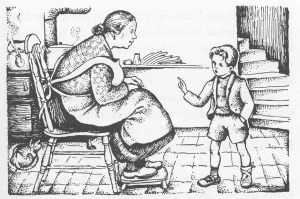
IN THE kitchen of the Orthopedic Hospital in Dublin the cook stirred the stew in the huge pot. She was an ample person, Mrs. Byrne, though she often wondered why. "Sorra a bit I ever eat," she would say with a hearty laugh. "It must be the smell that fattens me!"
After she had stirred the pot she sank down into a chair and folded her hands in her apron. When she shut her eyes she could imagine herself back in the kitchen of her old home in County Cork, and there was no big range beside her but a sweet, low turf fire with a kettle swinging over it. She could even smell the sea wind and hear the scratch, scratch of the hens as they tripped through the doorway and wandered under the table in search of crumbs.
"Please, ma'am," piped a voice by her elbow. With a shock Mrs. Byrne opened her eyes. A little fellow with tousled blond hair looked up at her; he had a bandaged foot, so he must be one of those poor little creatures from the children's ward.
"An' what might you be doing here?" Mrs. Byrne asked, giving the intruder a friendly glance, for she never got angry in a hurry. The boy peeped at her from under black lashes.
"Please, ma' am, they sent me to ask ye could ye make us something else for dessert today? It's sick and tired we all are of milk puddings an' prunes an' milk puddings an' prunes...."
Mrs. Byrne raised her eyebrows.
"Indeed," she said, "they sent ye? Who are 'they,' might I ask?"
"Oh, Tommy Fagan an' Chris Donaghy an' wee Andy - all of them," explained the boy.
; "An' what was it ye had in mind, then, instead of milk puddings?" asked Mrs. Byrne. The boy appeared to think intently with the aid of a wrinkle over his stubby nose.
"Me mother, she made us pies an' cakes," he suggested at last, hopefully. Mrs. Byrne's heart warmed to the music of his Cork accent, and she rummaged in one of her spacious cupboards until she found a slab of fruitcake.
"Will this satisfy your appetite?" she asked. But the boy shook his head.
"One piece isn't enough," he protested loyally. "There's fourteen of us." Mrs. Byrne sat down and laughed.
"Well," she sighed, "I never saw the likes of you before, not in all the years I've been here. So one piece isn't enough, is it?"
"It is not," said the boy firmly. "Sure, there'd be nothing left of it if we divided that. It's a whole cake we'll be needing every day an' no more puddings an' prunes!"
"Anything else?" asked Mrs. Byrne. A smile tiptoed over the boy's rosy face.
"Ye couldn't make it ice cream once in a while, could ye now?" he coaxed.
"Deary me!" cried Mrs. Byrne, raising her hands at this audacious request. "What will ye be asking me for next! The hospital isn't made of money, ye know." The boy nodded.
"Maybe we'd better offer up the ice cream, so," he conceded. Then he looked wistfully about the kitchen. "Ye wouldn't let me stay here awhile, would ye?"
"Indeed I would," said Mrs. Byrne. "But won't they miss ye up in the ward?" The boy climbed onto a chair. "Arra, let them miss me for a while," he said calmly: "Haven't they got me 'most all the time? Sure, it's lonesome I am for a kitchen."
"Och, God bless an' protect ye, me lamb!" cried Mrs. Byrne, her motherly heart running over. "Is it so long since ye left home?"
The boy counted it out on his fingers.
"I was here Christmas, an' Saint Patrick's day, an' Easter - 'deed there wasn't a bit of fun I didn't miss!"
And your parents, don't they visit ye?" The boy sent Mrs. Byrne a pitying glance.
"An' they over in Glengarriff," he said. "Sure, it's too far entirely for them to come!"
"What might your name be, then?" asked Mrs. Byrne curiously.
"Francie O'Sullivan." Mrs. Byrne looked at him with fresh interest. So this was the laddie the nurses were always talking about when they came down for a sup of tea. She had heard tales of how bright he was and how he had all the other children in the ward doing as he pleased.
"And he is the pluckiest boy we ever had," one of the nurses had told her. "Doctor Casey was obliged to operate twice on his foot, and the poor little fellow suffered quite a bit, but he never let out a whimper. The doctor thinks the world of him."
"So you're Francie," said Mrs. Byrne slowly, nodding her head. "It's a pleasure to meet ye, indeed it is. I've heard ye are no coward." Francie looked surprised.
"Why would I be a coward?" he asked. Mrs. Byrne sniffed.
"Ye'd be surprised how many people lose their courage in a hospital," she said. "I've seen men as brave as bulls an' they shaking like jellyfish as soon as they set eyes on a doctor's coat. It's a funny world, so it is." Mrs. Byrne got up and lifted the kettle off the range. She poured out two cups of tea and pushed one toward Francie, who went to sit at the table to drink it.
"I mind one boy," the cook continued, "an' he howled so loud the men could hear it over at the Bank of Ireland, an' they had to stuff the paper money in their ears to keep out the noise. That's the truth."
"Well," cried Francie, "an' him an Irish boy!"
"It's a fact," said Mrs. Byrne.
"It's not from County Cork he was, was he?" Francie asked anxiously.
"Is it likely he'd be? No, he was a Dublin boy." Francie gave a sigh of relief.
"Maybe he couldn't help it so," he said generously. "Dublin boys aren't the same, are they?"
"Indeed they're not, the creatures," agreed Mrs. Byrne, sipping her tea. Francie leaned forward confidentially and whispered:
"There's a boy up in our ward an' him a Protestant!"
"No!" said Mrs. Byrne.
"It's the truth, but he keeps it secret. He doesn't want the other fellows to know. I taught him the 'Hail Mary' an' he says it as well as any."
"Is that so?" and Mrs. Byrne looked properly impressed.
"There's all sorts of boys up in our ward," continued Francie. "One great big fellow called Tom is forever bossing the little ones. Sure, wasn't he the mean one for hitting wee Andy an' knocking him down, an' Andy with his whole leg in a splint!"
"An' what did the nurse do?" asked Mrs. Byrne.
"Oh, she wasn't there, but I grabbed Tommy meself an' fetched him a clout on his head. When the nurse came back she locked us both up."
"She shouldn't have locked yerself up so."
"Well, I wasn't telling on Tommy," said Francie. "How was she to know?"
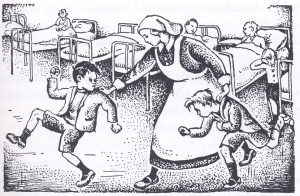 "Are the nurses kind to ye?"
" 'Deed they are, then, the way ye'd think I was a babby; But I do be lonesome all the same," Francie confessed.
"Have ye no friends amongst the boys?" asked Mrs. Byrne, who had Francie well tucked into her heart by now.
"The boys are all right," Francie conceded, "only there's not a one of 'em like Liam."
"And who might Liam be?" asked Mrs. Byrne, getting up to give another stir to the stew.
"Liam is me twin brother," said Francie. "He is the grandest boy in County Cork an' no mistake. He and I used to be always together till I came here. Och, it's himself I do be missing," and Francie let out a sigh that came from the soles of his feet. "Look!" and he pulled a crumpled piece of paper out of his pocket. "Here's the letter he wrote me himself!" Mrs. Byrne had to hunt for her spectacles, and then she went to the window and unfolded the piece of paper Francie had handed her.
The boy watched her with pride as she read:
"DEER FRANSIE WE ARE WELL PLEASE COME BAK SOON I AM SAD WEN U ARE AWAY MIKEL AND BRIGID SEND KISSES I AM RESPEKFULLY LIAM. PADDY CAM ON A WISIT AN BROUT ME A WISTLE ONLY BRAN SWALLOWED IT HE IS SAD TOO LIAM."
Mrs. Byrne had to go over it twice before she could make it all out.
"Glory be to God!" she cried. "It's a wonderful letter, so it is. And what might Liam's age be now?"
"The same as me own; we're six years old."
"And who are Michael and Brigid?"
"They're me elder brother and sister."
"An' Bran, is he another brother?" Francie went into peals of laughter.
"He is not!" he squealed. "He is our dog!" At that moment the door of the kitchen squeaked open and a white-capped nurse looked in.
"Francie!" she cried, "what are you doing here? We've been hunting for you everywhere!"
Francie glanced up reproachfully. "Well, what harm? Can't a fellow have a bit of fun?" he asked. The nurse went over to him and knelt down to feel his foot.
"Walking down those stairs!" she grumbled. "The doctor will be good and angry with you. Can't you be patient a little while? Soon you'll be able to go home and play like other boys." Francie sighed.
"It's been a little while for so long," he murmured.
"Well, you'd better come up now," the nurse said in a friendlier voice. "There's a visitor for you."
"A visitor!" Francie jumped up and hardly gave himself time to embrace his new friend, the cook, and to tell her not to forget the cakes and pies. "I'll be coming back if ye'll let me," he whispered. "It's most like home here."
"Bless your heart, boy, ye're welcome any time," said Mrs. Byrne, looking after him with fond eyes.
"Who is the visitor?" asked Francie, riding upstairs on the nurse's back.
"You'll see," and the nurse smiled mysteriously as she put him down and opened the door of the children's ward.
It was a long ward with a shining floor, high windows, a row of white beds, and a couple of screens. In the middle of it, surrounded by eager children, sat a sandy-haired little man with apple-red cheeks. He had put his pointed hat and knapsack beside him on the floor and was telling a story to a spellbound audience, the children in the beds stretching their necks to follow him better.
"And so," he was was saying as Francie entered, "and so he gave a good punch to her nose an' it came off, an' he pulled her gray hair an' it came out, an' he grabbed her hunchback an' it fell down, and then-what do ye think--she wasn't a witch at all at all but a beautiful princess the like of which ye won't find anywhere today, with hair like honey an' eyes like butterflies' wings. So the prince, he said: 'Will ye marry me?' an' she says: 'Maybe I will,' an' so they went to a priest to be wed an' lived happily ever after."
"Paddy!" cried Francie as he limped across the room.
"Paddy! Paddy!" and the children had to make way for his tempestuous figure as he flung himself at the little man with a shriek of joy.
"So, young Cuchulain," said Paddy, holding him at arm's length to have a look at him. "Ye're doing wonderfully well, I see. Played any football yet?" But Francie could only stare with eyes as big as potatoes.
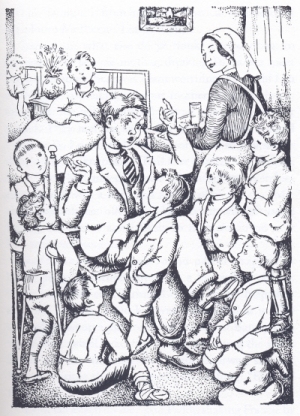 "Oh, Paddy, is it from home ye come?" he whispered at last. "From Mother an' Liam an' all?"
"Indeed, an' what else do ye think? I went down to Glengarriff to see me mother, thinking I'd have a quiet day, but, ochone, there was Liam worriting me would I go an' bring ye a present; an' your mother, bless her heart, must have me tell ye this an' that an' not to forget your prayers. They had me so loaded with messages I could hardly walk. Look!" and Paddy bent down to pull something out of his knapsack. "This here is what Brigid made for ye," and he handed Francie a beautiful handkerchief embroidered with a harp and a sprig of shamrock. "Michael sends ye his old knife. He says it will be useful because the nurses aren't likely to have one. And now look at Liam's present."
Paddy handed Francie a round parcel wrapped in brown paper. It turned out to be a" big yellow cheese. "From your own cow," grinned Paddy. "Liam helped to make it." Francie closed his eyes and sniffed at it. The smell conjured up a picture of the cottage at Bantry Bay, where the cowbell went ting-ling-ling among the gorse bushes and his mother stood in the doorway, shading her eyes against the evening sun and calling: "Francie! Liam!"
"Don't fall asleep on me," said Paddy, shaking Francie by the arm. "There's a deal more I must tell ye but first ye may treat the boys," and he hauled forth a bag of toffees. "Your mother made them for ye," he said. The children cheered and clapped as Francie proudly handed round the bag, not forgetting the poor crippled boys in the beds. When all mouths were filled Paddy pulled Francie beside him.
"Now ye must be answering me some questions," he said, "or it's your people will be disappointed when they see me again. They wanted to know so much I had to write it down." Paddy searched through his pockets. "Faith, if I haven't lost it now! Oh, dear, what'll they say if I don't bring them the right answers! ...Ah, here it is!" and Paddy opened out a paper. "First your father's question: Have ye done your alphabet every day as ye should?"
"I have, then," cried Francie. " 'Deed, an' I wouldn't let Liam get the better of me!"
"All right, then comes question two - that's Liam's: Do ye get ice cream every day?" There was a howl of rage from the children, and instead of letting Francie answer they all began to speak at once, crying out that it was nothing but milk puddings and prunes they ever got. Paddy smiled and quietly put down "No" beside question number two.
"Now, here's something the nurse will be able to answer better," he said. "How is Francie's foot and will he be able to come home soon, nurse?" The nurse rubbed her long nose.
"It depends," she said. "He is a terror for walking. I wonder how we ever kept him in bed at all. He even walks in his sleep."
"In his sleep ?" asked Paddy.
"Sure enough, only the other day I found him wandering downstairs in his pajamas in the middle of the night, an' I had to shake him hard to wake him. But he is doing as well as can be expected and he will be able to go in a few weeks if there is no relapse." Paddy grinned happily and pulled Francie's ear.
"Do ye hear that, Cuchulain?" he asked. "You take care there is no relapse! And now for the last questions. Brigid wants to know about the other children in the ward, but I can tell her that meself. Sure, an' I can see by all your noses that ye're a fine set of youngsters! And Michael, he wanted to know if ye had the electric light in the ward. Nurse, could ye turn it on a minute? I was to see it with me own eyes. There! Isn't that wonderful! Now I can tell him about it. Och, Francie me darling, ye don't know how we're all missing ye. Sure Glengarriff isn't the same place without ye. They're all complaining it's too quiet now with ne'er a bit of mischief about. Liam is as good as bread an' butter since ye're gone, an' Bran is growing fat. Even me mother's cow, Clementine, pines for ye, indeed she does; sorra a bit of cream did we get out of her ever since."
"A cow?" asked wee Andy, incredulously.
"Why not?" said Paddy. "A cow has feelings as well as anyone. Och, an' the way they're all looking out for a word from ye, Francie. Your father goes to the post every day an' when there's a letter the whole village will be coming to hear the news of ye an' your mother'll be reading it to my mother an' the children will be showing it at school."
"An' Liam, what does Liam say?" asked Francie eagerly.
"Liam? Sure, he was that jealous when he heard everyone talking about how the doctor had called ye a plucky boy. He went to your father an' said: 'Father,' said he, handing him a knife, 'ye may cut me foot into smithereens an' ye'll see I won't cry!' " All the children laughed but Francie asked:
"An' doesn't he miss me at all?"
"Miss ye, me boy? Och, ye should hear him, an' he asking his mother every day when ye'll be back! There isn't anyone that don't miss ye. When I'm walking the road ever so often a body will come running out of a cottage, crying: 'Paddy, is it yourself an' have ye news of Francie?' Even the birds an' the beasts do be calling at me from the bushes. 'Give our greetings to Francie and tell him to come back.' Listen to the song I made," and Paddy sang:
"Francie man, Francie man, where has he gone to?
Francie man, Francie man, where can he be?
Where is the little gossoon that we played with?
The hills are all weeping and so is the sea."The children are lonesome and asking for Francie,
All creatures on mountains and meadows are sad,
Around Bantry Bay goes the cry: 'Where is Francie?
Our bold, bad, and boastful, our mischievous lad?"The birds fly around with the news and the gossip:
'He is up in Dublin where houses are tall
And when comes back, 'tis the boys must be watchful
Or he'll beat them at football and hurling and all.'"Francie man, Francie man, where has he gone to,
Where has he gone to, Francie my man?
Liam sits sighing and watching for hours
And the wee dog beside him is heart-broken Bran."
The children stood still with admiration when Paddy had done. "Did ye make it all up yourself?" asked Tommy Fagan. Paddy nodded. "It's a gift," sighed Tommy from the bottom of his heart.
"I'll tell ye what," said Paddy, ruffling Francie's hair, "the whole of Bantry Bay'll be feasting and dancing the day ye come back."
Francie's eyes shone. "Will there be a band?" he asked. "A band? Three bands and a grand piano! An' we'll get the queen herself over from England to receive ye." Francie frowned.
"I don't want her at all at all," he said severely.
"Faith, an' you're right," Paddy amended hastily. "It was a foolish thought, that was. We'll have no English queens, only plain Irish folk."
"An' what'll we do?" asked Francie, delighted with the idea of a party.
"Well, we'll fetch ye from the station in Dan Murphy's haycart, all done up with flowers. Even the horses will be wearing wreaths, so they will, if they don't eat them, the creatures. An' we'll put the bands out on the platform an' when the train steams in ye'll be seeing us all standing there an' yer mother will be wearing her best hat, an' yer father'll carry ye out of the station an' we'll all cheer an' ye'll go home like a prince entirely." The children clapped their hands at the pretty picture, but Francie's eyes longed for the day he would be home. Paddy saw it and was sorry he had let his tongue run away with him. He pulled Francie onto his knee and kissed him.
"Sure, I know it's hard to wait," he whispered, "but we must be thankful your foot is doing so well. Won't all the boys be wondering at your swiftness and nimbleness when ye're back? Oh, the races we'll run-" Paddy bit his tongue. "Ochone, I do be talking of the day ye'll be back with us an' I mustn't, a mhilis, or ye'll be breaking your heart over it. Be patient now an' I'll say a Novena to the Blessed Virgin to let ye off soon."
"Will ye do that?" asked Francie, with moist eyes raised to Paddy's face. Paddy hugged him again.
"Indeed I will then; haven't I said a wee prayer for ye every night?" he whispered. Then he took out his handkerchief and blew his nose fiercely. "Sure, ye'll have yer old friend Paddy weeping on ye if ye don't cheer up soon. That's right now, smile, there!" and Paddy put Francie down with a last kiss and departed hastily, afraid of making a fool of himself in front of the children. Francie clung to him till the last and watched him out of sight from the window. Then he sat in a corner with his presents and would speak to no one. But when supper time came the nurse walked into the ward with a festive air, bearing a platter with a great big tower of pink ice cream and a card attached which read: "To Francie and his friends, from Paddy."
Excerpted from Francie on the Run by Hilda Van Stockum
Copyright 1939/1996, Used with permission of Bethlehem Books