My son began this school year with Saxon's Math 76. It was his third year of using Saxon, and while the first year had helped a lot with his accuracy and consistency, he was starting to burn out on it. Math 76 wasn't working so well for him (perhaps just his learning style) so I began looking around for something else. Then I heard that Teaching Textbooks had just come out with Math 7. After some investigation, we got the CDs (the book wasn't yet available, but TT offered free PDF downloads to customers) and my son started on it.
From the Product Description on the Teaching Textbooks website:
The Math 7 Teaching Textbook™ . . . features automated grading, step-by-step audiovisual solutions, and lectures that contain lively animation and sound effects. Math 7 covers all of basic arithmetic, including fractions, decimals, and percents. The program also teaches a fair amount of geometry (e.g. how to find the area of a circle). Other topics include statistics and probability, simple graphing concepts, equations, and inequalities. There are even several chapters dedicated to math in the real world.
The CDs are available for Windows or Mac, but not Linux. Each chapter presents a topic, broken into several lessons and with a unit test at the end. Each lesson begins with a lecture, which is presented in audio with accompanying text displays. The student may be invited to fill in the answer to a sample problem after being shown an example. After the lecture, there are usually five practice problems on the new topic and twenty mixed practice problems covering both old and new topics. The problems are often amusing and the presentation is clear and easy for the student to follow. I've also been pleased to see "real life" topics such as taxes and stock listings included in the lessons.
The program automatically checks the answers and offers a second chance for arithmetic (not multiple choice or true / false) problems. It then computes a percentage correct for the lesson as a whole, not including the 5 practice problems. Solutions are included for all the problems, so if the student misses it, he can see how it should be done. The automatic grading aspect is a big help, with one caveat, below.
Teaching Textbooks recommends using the following procedure:
- view CD lecture
- review lecture info in workbook
- work out problems in book
- enter answers into computer for checking / grading
However, for the most part, we have just used the CDs and my son has worked the problems on scratch paper. He has liked this program much better than the equivalent Saxon 76.
Occasionally, when reviewing with my son, I have found that he can use their method to do something, such as finding the lowest common denominator, but does not understand why the method works. So he became confused, for example, when he went on to multiplying fractions. (In one case, you cancel the excess matching factors, while in the other, you cancel both matching factors. Understanding why you cancel avoids this kind of confusion.) It isn't clear to me whether this is a student issue or a program issue.
One other item I should mention is that the workbook lacks an index, making it tedious to find a particular concept quickly.


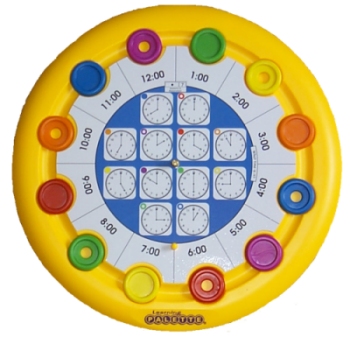 This clever learning tool for young children features an almost 12 inch diameter "palette" which holds a double-sided learning card and 12 different colored discs. A clear plastic lid is included. I have been very impressed with how these palettes hold up under a lot of use (and occasional abuse from babies and toddlers). Each card has pictorial equations or problems on one side. The child matches the correct color/shape disc with the answer he chooses. When finished placing all twelve discs, he can turn the card over and correct the answers himself.