Math

Math Talk

mathematical ideas in poems for two voices
Book cover: 'Math Talk: mathematical ideas in poems for two voices'
Author(s): 
Theoni Pappas
Subject(s): 
ISBN: 
933 174 748
Resource Type: 
Copyright: 
1999
Review: 

I have long been a fan of the poems for two voices books by Paul Fleischman. This book puts a twist on the idea by covering math topics in poems. It's a really unique and engaging way to memorize a math concept, reciting it as a poem. A poem for two voices is a poem recited by two people where sometimes the same words are said in tandem, sometimes alternately, and sometimes, the speakers speak at the same time saying different things.

Here is a sample of part of a poem from the book: (The first column is the first speaker and the second column, the second - shown smaller than actual size)
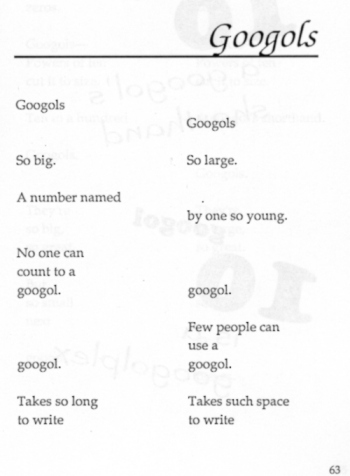
Some of the math concepts in the poems are fairly simple ideas that would pertain to a grammar school student, however most of the ideas are for middle schoolers or high schoolers. There were a few math concepts I had never heard of, such as fractals, (the geometry of nature), Fibonacci numbers (adding the last two numbers in a series to give the next number), and Mobius strips (circular strip with a twist in it).

While you don't learn everything you need to know about the math concepts in the poems, you get an introduction to the idea and the basic or interesting facts. For tessellations, the reader learns that not all figures tessellate; for triangles, the reader learns that the angles in the figure must equal 180 degrees. Some of the accompanying illustrations are also instructive. I could not have visualized the Mobius strip without the drawing of it.

This is a fun way to talk about these concepts. Trying to say the poems as a team takes a lot of concentration and brings a lot of laughs along the way. The book would make a great addition to a living math program or be a nice break from a formal textbook program.

Recommended for grades 4-12

Publisher: 
Wide World Publishing/Tetra
Binding: 
Softcover
Number of pages: 
71 pages
Review Date: 
6-21-05
Reviewed by: 
TitleSort: 
Math Talk

Math-U-See

Book cover: 'Math-U-See'
Author(s): 
Steve Demme
Subject(s): 
Grade / Age level: 
Resource Type: 
Copyright: 
1998
Review: 

Math-U-See is a fairly new Math program, designed especially for homeschoolers, which runs from Kindergarten all the way through high school. The author is a former high school Math teacher who has attempted to balance a solid conceptual understanding of math with enough practice to let it "sink in." The program consists of a student text (workbook format), a teacher's manual, and optional practice sheets, special Math-U-See blocks and a teacher training DVD. I am very impressed with this program. The author does a fine job of allowing the students to become well aquainted with using numbers. I found math concepts very easy to explain to my daughter with the use of the very clever manipulatives (which might be thought of as a cross between "Base-ten Blocks" and Cuisinaire Rods). I was particularly impressed with how clearly place value is taught and how thoughtfully the child is prepared for future lessons (e.g. early on in addition, the child starts doing simple "solve for the unknown" problems in preparation for subtraction). Other skills learned include telling time, measurement and a heavy emphasis on skip counting (in preparation for future multiplication and factoring). My only complaint is that some of the material is contained only in the teacher's manual (I can imagine that this might have been done intentionally to force the parent to follow along in the teacher's manual rather than letting the child work entirely on their own. The author demonstrates how each concept works on the DVD so that the parent may more confidently teach the concept to the child.

Over the years we haven't always used Math-U-See as our primary Math text, but we have always found the DVDs and blocks useful no matter what we were using.

Publisher: 
Math-U-See Foundation
Review Date: 
7-7-05
Reviewed by: 
TitleSort: 
Math-U-See

Mental Math: Fifth Grade

Book cover: 'Mental Math: Fifth Grade'
Author(s): 
Kathy French
Subject(s): 
Copyright: 
1998
Review: 

Problems at this level include a review of 4th grade math and practice in the topics usually introduced at the 5th grade level. In the 10 questions for each day, concepts of numbers, computation, application, mixed practice, decimals, fractions and percents are covered. Sample questions chosen at random include the following: What number when multiplied by six and divided by three becomes 12? Write seven and four tenths as a mixed number with a decimal. How much time has elapsed from 4:31 a.m. to 7:01 a.m.? 72 people were on the train. 1/8 of them got off at the first stop. How many people were left on the train? What is the volume of a box that is 2 cm by 2 cm by 2 cm?

Publisher: 
Math Concepts, Inc.
Binding: 
Comb-bound
Number of pages: 
141 pages
Review Date: 
1999
Reviewed by: 
TitleSort: 
Mental Math: Fifth Grade

Mental Math: First Grade

Book cover: 'Mental Math: First Grade'
Author(s): 
Kathy French
Subject(s): 
Copyright: 
1998
Review: 

Problems at this level center around practice in the topics usually introduced at the 1st grade level. In the 5 questions for each day, concepts of numbers, computation, application, and mixed problems are covered. Sample questions chosen at random include the following: Write the number 203. What comes next: 50, 100, 150, ___ ? What month comes after March? A square has ___ sides. Jenny is six months old. Nicki is ten months old. Which one is almost one year old?

Publisher: 
Math Concepts, Inc.
Binding: 
Comb-bound
Number of pages: 
75 pages
Review Date: 
1999
Reviewed by: 
TitleSort: 
Mental Math: First Grade

Mental Math: Fourth Grade

Book cover: 'Mental Math: Fourth Grade'
Author(s): 
Kathy French
Subject(s): 
Copyright: 
1998
Review: 

Problems at this level include a review of 3rd grade math and practice in the topics usually introduced at the 4th grade level. In the 10 questions for each day, concepts of numbers, computation, application, and mixed practice are covered. Sample questions chosen at random include the following: Increase the tens place by one in the number 23,460. What is the area of a square that is 4 feet on a side? What number when multiplied by two becomes 22? AZ, AY, AX, ____. What comes next? If I put five red marbles and one green marble in a bag, what are my chances of picking a red marble? Write it as a ratio.

Publisher: 
Math Concepts, Inc.
Binding: 
Comb-bound
Number of pages: 
141 pages
Review Date: 
1999
Reviewed by: 
TitleSort: 
Mental Math: Fourth Grade

Mental Math: Second Grade

Book cover: 'Mental Math: Second Grade'
Author(s): 
Kathy French
Subject(s): 
Copyright: 
1998
Review: 

This Math supplement provides 10 questions (which should take approximately 7 to 10 minutes) each day which are read aloud by the parent/teacher and computed mentally by the student who writes only the answer on paper. The questions should be helpful in introducing students to the language and vocabulary used on standardized tests, gaining confidence and practice in mental computation and allows the parent/teacher to quickly (and regularly) evaluate the student's progress (this might be especially useful for students who do much of their Math work independently). We also found that these problems make a good opportunity for working on following directions.

This second grade book begins with 15 review lessons of five problems each. The students then begin sets of the normal 10 problems which cover material such as writing numbers in standard or expanded form, determining the next number in a pattern, values of greater than or less than, and determining whether a number is even or odd. Later problems in this volume involve simple computation (addition and subtraction), money and time problems, days of the week, months of the year, simple fractions and place value. The answer is included in parentheses after each problem. Also included in the book are an extensive glossary and ideas for implementing a incentive/reward system (probably more appropriate for the classroom than a homeschool situation).

We've used this book for several months and I've found it to be a helpful supplement for my second grade daughter. Because of it's simplicity, it would also make a good choice for those who homeschool "part-time" (i.e.supplement their child's education at home).

Sample problems (selected from throughout the book) include: Write the number 214 in expanded form. What comes next 33, 36, 39, _ ? What digit is in the ones place in the number 34? Write the number that has five hundreds, six tens and three ones. Decrease the tens place by one in the number 58. Is the number eight even or odd? Is the number 47 about 50 or about 40? Which is more: 301 or 311? Draw a circle. Shade one half of it. Which is less: two tens or three tens? Which is more: three dimes or one quarter?

Publisher: 
Math Concepts, Inc.
Binding: 
Comb-bound
Number of pages: 
75 pages
Review Date: 
11-28-2000
Reviewed by: 
TitleSort: 
Mental Math: Second Grade

Mental Math: Third Grade

Book cover: 'Mental Math: Third Grade'
Author(s): 
Kathy French
Subject(s): 
Copyright: 
1998
Review: 

Problems at this level include a review of 2nd grade math and practice in the topics usually introduced at the 3rd grade level. In the 10 questions for each day, concepts of numbers, computation, application, and mixed practice are covered. Sample questions chosen at random include the following: Draw six circles and shade one-third of the set. Estimate the answer: 490 + 180 is about how much? It is one hour earlier in Chicago than here. Look at the clock and write down the time that it is in Chicago now. What comes next: A1, B2, C3, ___ ? 13,900 - 1,000 = ?

Publisher: 
Math Concepts, Inc.
Binding: 
Comb-bound
Number of pages: 
135 pages
Review Date: 
1999
Reviewed by: 
TitleSort: 
Mental Math: Third Grade

Miquon Math

Author(s): 
Lore Rasmussen
Subject(s): 
Grade / Age level: 
Resource Type: 
Review: 

Miquon Math is a series of 6 math workbooks designed to be used in 1st through 3rd grade. They are named by color and not by grade level, so that an older child can use them without feeling they are "remedial". The workbooks are designed to be used with Cuisenaire Rods. I have had the books for a couple of years but have only started using them this year as a supplement for my 3rd and 4th graders. I hesitated using them before because they have an unusual format -- the pages don't necessarily have to be done in order, and are grouped by topic rather than in sequential chapters. Multiplication is introduced along with addition in first grade, and advanced concepts such as squared numbers and pre-algebra are introduced through use of concrete manipulatives. However, my 3rd grader now says she "loves this kind of math" and both the children have shown a better grasp of what numbers mean since they have started using the books. We've discovered that when the manipulatives come out and are used to illustrate concepts, the "littlies" want to join in. My 5yo was watching carefully as my 8yo tried to figure out the square of 4, and suddenly announced "It's 16!" He was so proud of himself!
I have ordered the Orange Book (the first one in the series) to start with my almost 6 year old. After completing the Miquon Series, a child can go straight into Saxon Math 54 or 65.

Publisher: 
Key Curriculum Press
Review Date: 
1999
Reviewed by: 
TitleSort: 
Miquon Math

Multiplication Songs

Book cover: 'Multiplication Songs'
Subject(s): 
Copyright: 
1998
Review: 

Audio Memory offers math audio tapes and CDs for practicing "Math Facts" in Addition, Subtraction and Multiplication. (Sold separately from each other). These are Math drills set to music (of the synthesized variety). Although these make for an easy memorization aid, I found the songs almost unbearably sappy. (My children did like them though.)

Publisher: 
Audio Memory
Review Date: 
5-13-2000
Reviewed by: 
TitleSort: 
Multiplication Songs

My First Number Book

Book cover: 'My First Number Book'
Author(s): 
Marie Heinst
Subject(s): 
Grade / Age level: 
Copyright: 
1999
Review: 

This delightful picture book introduces many math concepts to preschoolers. We have enjoyed working through concepts such as counting, matching, sorting, sets, and sequencing. The illustrated pages make it fun for my son to discover more, less, and equal, addition and subtraction, geometric solids, and more. For example, matching begins with familiar matching pairs such as handprints, shoes, and earrings. Ideas of more or less begin to take shape as the child ponders such questions as, "Are there enough collars for the puppies?"

Sometimes your child may surprise you with an unexpected answer; for example, on a page showing five puppies and three doghouses, my son confidently assured me that "each puppy can have its own house." When I asked him how, he said, "The puppies that are brothers share a house." To him, sharing was not incompatible with the idea of being its "own" house.

The book also includes a few games. My son's favorite is a simple game involving counting backward or forward according to the roll of the die and directions on specific spaces.

Numbers are incorporated into the book in other clever ways; for example, each page number is illustrated by a string of the appropriate number of items. See if your child notices. Near the end is a section of BIG numbers, which all my children have enjoyed.

This book does an unusually good job of combining attractive photographs with questions designed to lead the child to discover math concepts.

Publisher: 
DK Publishing
Binding: 
Sewn Hardcover
Number of pages: 
48 pages
Review Date: 
5-5-2009
Reviewed by: 
TitleSort: 
My First Number Book