Science Elementary

The Way Things Work Kit

Book cover: 'The Way Things Work Kit'
Subject(s): 
Grade / Age level: 
Copyright: 
2000
Review: 

This kit provides dozens of special cardboard pieces, wooden dowels string, wheels, etc. for making simple machines (inclined planes, scales, etc.) that can be used for understanding basic concepts of mechanics - how things work. Based upon the bestselling "The Way Things Work" by David Macaulay, the kit continues the theme of Wooly Mammoths as props and characters for use in these experiments. (Included in the kit are two cardboard Wooly Mammoths to which you affix a certain number of identical coins to provide a common weight for some of the experiments.) A thin, but colorful book (32 pages - glossy cover) takes you through the scientific explanations of the various principles involved in the experiments. 5 1/2 " x 8 1/2" glossy full color cards provide detailed step-by-step instructions (with the typical DK photos) for each experiment.

Although some of the experiments took a little more finesse than might have been expected (but understandable due to the limitations of the materials) and some of the instruction cards were a little hard to follow, overall we found this to be an exceptional value - a lot of bang for your buck at the $30 retail price. We found that a dozen or so ziploc bags were very helpful in keeping the various pieces straight and, with a little patience, all the pieces can be stored in the box.

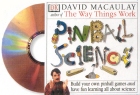
The biggest hit in our family so far was the Pinball Science CD ROM which also came with the kit. Pinball Science Cover The game includes three pinball arenas each having a specific theme (village, island and moon). The science part involves answering questions in order to earn the right to place certain fixtures on each pinball game. Without the fixtures, scores are lower and players are unable to advance to the next level. With each question, the player has the option to "Research Answer". This feature takes the player to the appropriate page in an interesting, humorous and interactive log book which explains the functioning of various devices such as windmills, faucets, hot-air balloons, gears, and rockets. Some of the graphics are a little silly (Wooly Mammoths in bikinis on the island and such), but I didn't find anything really objectionable.
Publisher: 
Dorling Kindersley
Review Date: 
4-4-01
Reviewed by: 
TitleSort: 
Way Things Work Kit

Trains

Author(s): 
Gail Gibbons
Grade / Age level: 
Copyright: 
1987
Review: 

I really like it when authors of children's books remember that details of how things work are fascinating to children. Gail Gibbons is definitely one of those authors. Her book is filled with very simple illustrations and text about trains, but the various parts of the trains are labeled and the text explains things like how the trains link together and the differences between gondola cars, hopper cars, boxcars and tank cars.The back page contains a chart of signs and signals relating to trains. Appropriate for preschool or kindergarten age children.

Publisher: 
Holiday House
Binding: 
Softcover
Number of pages: 
30 pages
Review Date: 
1999
Reviewed by: 
TitleSort: 
Trains

What Lives in a Shell?

Book cover: 'What Lives in a Shell?'
Author(s): 
Kathleen Weidner Zoehfeld
Subject(s): 
Grade / Age level: 
Copyright: 
1994
Review: 

This beautifully illustrated book, designed for preschool and kindergarten, explains different kinds of shells and the creatures that inhabit them. The shells are compared to the shelter occupied by people and by other animals. We learn that some shells do grow larger along with certain animals while other animals must shed their out-grown shell in favor of a new one. Many shells are beautifully depicted and identified and the story-format of the text is very easy and interesting for young children to follow.

Publisher: 
Harper Collins
Binding: 
Softcover
Number of pages: 
32 pages
Review Date: 
11-17-99
Reviewed by: 
TitleSort: 
What Lives in a Shell?

What Makes Day and Night?

Book cover: 'What Makes Day and Night?'
Author(s): 
Franklyn M. Branley
Subject(s): 
Grade / Age level: 
Copyright: 
1986
Review: 

The clearly written text is combined with simple, colorful pictures to make the concepts of day and night and the rotation of the earth in relation to the sun very understandable for both young children and their parents. : ) Included is a very simple hands-on "experiment" requiring only your child and a desk lamp. Some information about the moon is also covered. Like other books in this series, this book is a great solution for satisfying some of those "why" questions that young children constantly ask.

Publisher: 
Harper Collins
Binding: 
Softcover
Number of pages: 
32 pages
Additional notes: 

Copyrights 1962/1986

Review Date: 
1999
Reviewed by: 
TitleSort: 
What Makes Day and Night?

What the Moon is Like

Book cover: 'What the Moon is Like'
Author(s): 
Franklyn M. Branley
Subject(s): 
Grade / Age level: 
Copyright: 
1986
Review: 

This book covers the appearance of the moon from the earth (in regards to its surface rather than its changes over the month), the explanations people have given for the appearance of the moon (man in the moon, etc.) and why it really looks that way. It covers many interesting details about the surface of the moon (including a simple map of the moon's surface marked with the locations of moon landings), its atmosphere, the length of day and night on the moon (and the extreme temperature difference between the two), the difference in gravity on the moon, etc. The book is fully illustrated and quite engaging although I think some of the ideas on how the moon was formed are still open for discussion. A final page offers a few simple moon-related projects and a few related websites for further information.

Publisher: 
HarperTrophy
Binding: 
Softcover
Number of pages: 
32 pages
Review Date: 
1-29-01
Reviewed by: 
TitleSort: 
What the Moon is Like

Who Eats What? Food Chains and Food Webs

Book cover: 'Who Eats What? Food Chains and Food Webs'
Author(s): 
Patricia Lauber
Subject(s): 
Grade / Age level: 
Copyright: 
1995
Review: 

This book explores the notion of various plants and animals that are linked together based on "who eats what." Children will learn about some simple food chains such as - leaf, caterpillar, wren and hawk. They also see how one plant or animal can belong to several food chains and that members or these related food chains (food webs) have a certain amount of dependence on each other. The text goes on to explain, through an example of a problem with over-hunted otters around the turn of the century, that when part of a food chain is disturbed, the other members will also be affected. There are some mild "environmental" messages in this text which our family used as an opportunity to discuss good stewardship of what God has given us.

Publisher: 
Harper Collins
Binding: 
Softcover
Number of pages: 
32 pages
Review Date: 
1999
Reviewed by: 
TitleSort: 
Who Eats What? Food Chains and Food Webs

Why Do Leaves Change Color?

Book cover: 'Why Do Leaves Change Color?'
Author(s): 
Betsy Maestro
Grade / Age level: 
Copyright: 
1994
Review: 

Our family has really enjoyed this book which explains why leave fall off the trees before winter, where the different colors come from, how weather affects the brilliancy of the colors and lots more. It's written in a very simple manner, so that it's quite understandable even for preschoolers or kindergarteners, and yet it contains substantial information so that even moms (like me) realize that they don't know everything : ) You'll also find labeled pictures of the leaves from different kinds of trees, a cross section of a leaf, an explanation of how trees make food, and how to make leaf rubbings and preserve leaves by ironing them between sheets of waxed paper.

Publisher: 
Harper Collins
Binding: 
Softcover
Number of pages: 
32 pages
Review Date: 
1999
Reviewed by: 
TitleSort: 
Why Do Leaves Change Color?

Why I Sneeze, Shiver, Hiccup and Yawn

Book cover: 'Why I Sneeze, Shiver, Hiccup and Yawn'
Author(s): 
Melvin Berger
Subject(s): 
Grade / Age level: 
Copyright: 
2000
Review: 

A simple book with cartoon-like illustrations that explains reflexes and the related workings of the nerovus system - focusing, of course, on those four topics mentioned in the title. The story also invites children to try out a few simple experiments to observe reflexes for themselves. A "Find Out More" section provides "Things to Think About", additional "Test Your Reflexes" ideas and "Fun Facts".

Publisher: 
HarperTrophy
Binding: 
Softcover
Number of pages: 
32 pages
Review Date: 
3-20-01
Reviewed by: 
TitleSort: 
Why I Sneeze, Shiver, Hiccup and Yawn

CHC Lesson Plan Guide: Middle School Years

Book cover: 'CHC Lesson Plan Guide: Middle School Years'
Grade / Age level: 
Copyright: 
2005
Review: 

I have just finished planning the school year for my 5th and 8th graders using the new CHC Lesson Plan Guide for the Middle School Years, and I have never had such a productive and enjoyable time of it! Normally, I like to plan, but there never seemed to be enough time or information in one place to do it effectively or efficiently. I prefer a customized curriculum for each of my students, emphasizing their particular interests while shoring up their weaker subjects. With six students alongside little ones, planning the school year's curriculum is a very time-consuming process. CHC has made all the difference for me this year.

The Lesson Plan Guide is just that---a complete guide to designing your student's studies for each of the middle school (grades 5-8) years. There is structure within flexibility, and many options to appeal to a diversity of students with different gifts and talents. This is not a "school-in-a-box" that you can open and immediately put to work. You will need to spend a few hours for each grade level, looking over the courses that are detailed for you, and considering your student. But, this investment of a few hours will provide you, as the teacher, with a firm overview of the path you will take to meet the goals at the other end of the school year. Having that "big picture" helps tremendously when motivation lags. Using the CHC Lesson Planner (reviewed elsewhere) will simplify this customization further as they were designed to be used together.

Each of the four years is laid out with a plan for core subjects, non-core and elective subjects, enrichment materials, and parent resources. Sample schedules for each grade level are provided as an example of a balanced workload for a typical student. Unique to CHC are the Independent Study Charts that show the student which material he should be able to work on without direct teaching. Six detailed hands-on student courses are provided for up-to-date, beautiful Catholic textbooks in the areas of history, virtues, and Church history. As if that weren't enough value for the money, the Guide also offers wonderful teacher resources that provide the "what-you-need-to-know-to-teach" writing, science, and world history at these grade levels. Several authors contributed these resources, and the different approaches to these subjects are refreshing in their variety.

CHC has managed to produce a wonderful plan for middle-grade students that features the best characteristics that we have come to expect from them:

  • do-able projects that the children both anticipate and cheerfully complete;
  • a unique hands-on approach to most subjects that truly engage the student on several levels;
  • an underlying structure that the teaching parent becomes familiar with as the year goes on;
  • a progression in critical thinking, the ability to work independently for longer periods, and solid academics at a comfortable pace as the years pass.

All in all, this book is one of the best investments available for a Catholic homeschooling family who prefers to individualize their student's curriculum, within limits, while providing a thoroughly Catholic education utilizing multiple methods of learning

This book contains:

Planning Guides:

  • Fifth Grade: (18 pages)
  • Sixth Grade: (18 pages)
  • Seventh Grade: (18 pages)
  • Eighth Grade: (20 pages)

Hands-On Student Courses:

  • 5th Grade From Sea to Shining Sea Hands-On Study Guide (9 pages)
  • 6th Grade All Ye Lands Hands-On Study Guide (9 pages)
  • 7th Grade "The Virtue Tree" Student Course (44 pages)
  • 7th Grade "Timeline of the Republic" Guide (19 pages)
  • 8th Grade: 2000 Years of Christian History Study Guide (12 pages)
  • 8th Grade: "Timeline of the Ages" (19 pages)

Teacher Resources:

  • "Jump Start Your Writing" (26 pages)
  • "Science in a Nutshell" (24 pages)
  • "World History Timeline" (46 pages)
Publisher: 
Catholic Heritage Curricula
Series: 
CHC Lesson Plan
Binding: 
Spiralbound
Perspective: 
Catholic
Number of pages: 
308 pages
Review Date: 
8-23-05
Reviewed by: 
TitleSort: 
CHC Lesson Plan Guide: Middle School Years

The Big Dipper

Book cover: 'The Big Dipper'
Author(s): 
Franklyn M. Branley
Subject(s): 
Grade / Age level: 
Copyright: 
1991
Review: 

A very simple science book for children with cartoon-like pictures (nice cartoon, not cheezy-cartoon) that introduces some basic concepts about the stars. The very simple story line discusses looking at the night sky, that you see different stars in the summer and winter, where the big dipper got it's name, the names of the stars that make up the big dipper, how people can find direction from the North Star and the traditional constellation Ursa Major that the Big Dipper belongs to. The language is very simple, but not at all dumbed down - especially appropriate for preschool.

Publisher: 
Harper Collins
Series: 
Let's Read and Find Out Science
Binding: 
Softcover
Number of pages: 
32 pages
Additional notes: 

Copyrights 1962/1991

Review Date: 
1-29-01
Reviewed by: 
TitleSort: 
Big Dipper