Science

The Dawkins Delusion?

Atheist Fundamentalism and the Denial of the Divine
Author(s): 
Alister McGrath
Joanna Collicutt McGrath
Grade / Age level: 
Copyright: 
2007
Review: 

Cogent, concise, and coherent, that is The Dawkins Delusion.

Written as a response to The God Delusion, Alister McGrath takes Richard Dawkins head on. A former atheist, Alister, along with his wife Joanna, convincingly demonstrate the errors of Richard Dawkins's atheism. Equal to the task, Alister received a doctorate in molecular biophysics and presently is a professor of historical theology at Oxford University (where Dawkins also teaches).

An admirer of Dawkins's earlier work, The Selfish Gene, McGrath clearly points out that Dawkins has diverged into new territory with his diatribe against God, resulting in erroneous conclusions.

McGrath considers himself an "evidence-based" thinker (like Dawkins), yet ultimately his conclusions are vastly different than Dawkins.

Ironically, although Dawkins considers himself an evidence-based thinker, The God Delusion is anything but. As McGrath states, . . ."Dawkins simply offers the atheist equivalent of slick hellfire preaching, substituting turbocharged rhetoric and highly selective manipulation of facts for careful, evidence-based thinking."

McGrath goes on to state, "The book [The God Delusion] is often little more than an aggregation of convenient factoids suitably overstated to achieve maximum impact and loosely arranged to suggest that they constitute an argument."

Because of this, McGrath says, "Every one of Dawkins's misrepresentations and overstatements can be challenged and corrected." Rather than correct him point for point, McGrath instead chooses to pick "representative points" to discuss.

Answering Dawkins's flawed argumentation, McGrath demonstrates that God is not a delusion created by a deluded people, science has not disproved God, that science need not be locked in a battle with religion unto death and that they can actually be compatible with one another, God is not based on superstitious beliefs, not all religions are the same, and that Christianity is not evil.

McGrath reminds Dawkins that in our modern times there have already existed societies which have sought to stamp out religion, resulting in great, evil atrocities.

Not a heavy handed treatise, but a highly accessible answer to Dawkins's ranting and raving, The Dawkins Delusion? makes for an enlightening, educating, and entertaining read.

Publisher: 
IVP Books , An Imprint of InterVarsity Press
Binding: 
Sewn Hardcover
Perspective: 
Judeo-Christian
Number of pages: 
118 pages
Additional notes: 

This would be an ideal resource for the student heading off to a secular college, who may encounter those who will attack his Christian beliefs based on atheistic notions.

Review Date: 
8-26-2008
Reviewed by: 
TitleSort: 
Dawkins Delusion?

The Heart

Book cover: 'The Heart'
Subject(s): 
Grade / Age level: 
Copyright: 
1996
Review: 

This is a fascinating and colorful look at the heart and the amazing job it performs. Computer-enhanced photos are used to illustrate the heart and the blood vessels while magnified images give us a close-up look at the blood. Also included are simpler illustrations showing the chambers of the heart, it's valves and arteries and the general make-up of arteries and veins and their valves. The text is simple enough to be understood by fairly young children (particularly as a read-aloud) but is written in such a way as to capture the awe and mystery of how our body works. It covers quite a bit of material in a fairly in-depth fashion - the basic workings and function of the heart, the various components of the blood, the various types and functions of the blood vessels, the basic path of the blood through the body, how the lungs work within the cardiovascular system, the role of white blood cells and some of the problems that people develop in their blood's circulatory system. An impressive, engaging and informative book.

Publisher: 
Mulberry Books
Binding: 
Softcover
Number of pages: 
29 pages
Review Date: 
3-19-01
Reviewed by: 
TitleSort: 
Heart

The Insect World of J. Henri Fabre

Book cover: 'The Insect World of J. Henri Fabre'
Grade / Age level: 
Copyright: 
1977
Review: 

Jean-Henri Fabre (1823-1915) was a French naturalist who penned many writings about his beloved insects. These essay/stories describe, in great detail, his encounters with some interesting insects - how he worked with them and what he discovered about them. For instance The material is informative and even humorous at times, but rather dense (definitely not dry!). Here is a sample (from "The Pine Processionary")...

"You voracious little creatures, if I let you have your way, I should soon be robbed of the murmur of my once so leafy pines! Today I will seek compensation for all the trouble I have taken. Let us make a compact. You have a story to tell. Tell it me; and for a year, for two years or longer, until I know more or less all about it, I shall leave you undisturbed, even at the cost of lamentable suffering to the pines."

Although it might be suitable for high school students and could possibly be read aloud to younger students, it constitutes a portion of the Freshman Lab studies at Thomas Aquinas College. J. Henri Fabre is listed as one of the authors recommended in Catholic Authors: 4-Sight Edition.

A compilation of some of these stories, titled Fabre's Book of Insects is available from Emmanuel Books.

Publisher: 
Beacon Press
Binding: 
Softcover
Number of pages: 
333 pages
Additional notes: 

Copyrights 1949/1977

Review Date: 
4-4-01
Reviewed by: 
TitleSort: 
Insect World of J. Henri Fabre

The Librarian Who Measured the Earth

Book cover: 'The Librarian Who Measured the Earth'
Author(s): 
Kathryn Lasky
Setting: 
Grade / Age level: 
Copyright: 
1994
Review: 

This is a fascinating story, told for children and fully illustrated (beautiful full color pictures with interesting and at times humorous details) of the Greek Scientists, Mathematician and Astronomer - Eratosthenes. (Don't worry - the author does help you to pronounce the name). Eratosthenes was born in the 3rd century B.C. in the country we now call Libya to Greek parents. There he was educated in the classical Greel tradition and developed a keen interest in the world around him. As a young man he was sent to Athens to study where he became known as a scholar and historian. At 30 he was appointed tutor to the son of the King Ptolemy II of Egypt and so he settled in Alexandria. He became involved in the great Library at Alexandria where he eventually became head librarian. In this setting he worked on his most famous problem - attempting to calculate the circumference of the earth. The book takes us through the process he went through in solving the problem and illustrates the events and concepts involved in a way that can be grasped by young children (early gradeschool and up - although my preschoolers enjoyed the book without fully grasping all the details). The story is particularly interesting because his calculations were within 200 miles of our present day figures.

We enjoyed this book very much - the content is great and the illustrations are very nice. It would make a fine supplement for Greek History and encompasses a bit of Math and Science as well. The reading level is more challenging than your average picture book (perhaps 4th grade level) but it could be read aloud to younger children.

Publisher: 
Little Brown Publishing
Binding: 
Sewn Hardcover
Number of pages: 
48 pages
Review Date: 
9-13-2000
Reviewed by: 
TitleSort: 
Librarian Who Measured the Earth

The Mystery of the Periodic Table

Book cover: 'The Mystery of the Periodic Table'
Author(s): 
Benjamin Wiker
Copyright: 
2003
Review: 

This new title from Bethlehem Books follows the tradition of Jeanne Bendick with her books on Archimedes and Galen by making scientific concepts accessible to ordinary people.

Dr. Wiker is a prolific author of articles on matters relating to science and the faith. He has taught at Thomas Aquinas College and Franciscan University of Steubenville.

Wiker takes us all the way back to the Neolithic era to begin his story of mankind's fascination with metals that started the development of the science of Chemistry. The various scientific characters that play a role in this story - from ancient Greek atomists to brilliant modern scholars - are interesting in and of themselves. We learn of the diligent John Dalton (1766-1844) who kept a daily journal called "Observations on the Weather" for 57 years; the daring and foolhardy Humphry Davy (1778-1829), who discovered laughing gas and a whole slew of elements, and Dimitrii Mendeleev (d. 1907) who discovered the order of the elements by 'playing cards.' A great deal of scientific content that led to the development of the Periodic Table is presented in these middle chapters. The content is made particularly accessible through Wiker's humorous, engaging style and the connections he makes between each scientist's interest in a particular subject and what that meant to scientific progress. He also has fun pointing out the errors scientists made that ironically caused some of the very greatest leaps in scientific knowledge.

The last three chapters can be a little harder to follow and students will benefit from working through them slowly and carefully studying the numerous diagrams. The publisher recommends that, although the book is generally accessible to ages 10 and up, these later chapters might be more understandable to slightly older children. I found that drawing up additional diagrams of my own helped me to follow the text better (particularly diagrams of the structures of the electron "shells"). Diligence in studying these last few chapters really pays off, though, as the final discoveries about the Periodic Table and the well-ordered nature of the relationships between the elements are absolutely fascinating.

Now, you might be asking yourself "Why would someone who teaches at Catholic colleges and writes for Catholic publications be so interested in the Periodic Table?" The answer is simple: The Periodic Table shows the relationships between the most basic elements that comprise everything on earth. It is phenomenal and mind-boggling how mathematically-ordered these elements are. This kind of order seen in nature is a powerful argument against random and chaotic theories of the origins of the world. I should also note that, although Dr. Wiker's interest in this topic is likely related to his faith, he never directly brings up the topic in his book. I'm really glad that he didn't. There's a time for laying it all on the table and a time for a little more subtlety. This sort of book allows readers to discover some of the "Wow!" of Science and later, gradually make the connection between the order of the elements and the awesomeness of the Creator who designed it all.

Highly and enthusiastically recommended! Probably the most fun I've ever had reading a science book. :)

Click here for Study Questions

Publisher: 
Bethlehem Books
Binding: 
Softcover
Number of pages: 
166 pages
Review Date: 
7-24-03
Reviewed by: 
TitleSort: 
Mystery of the Periodic Table

The Salamander Room

Author(s): 
Anne Mazer
Subject(s): 
Illustrator(s): 
Steve Johnson
Lou Fancher
Grade / Age level: 
Resource Type: 
Copyright: 
1991
Review: 

The Salamander Room is a beautifully illustrated picture book that is sure to captivate the nature-loving child. Brian finds a salamander and asks his mother to keep him as a pet. Rather than saying "no" his mother asks leading questions as to where the salamander will sleep, what he will eat, where he will play and if he'll be lonely.

Eager to keep his new pet, but also desiring to give him a happy home, Brian reassures his mother that he will bring moss into his room, wet leaves, boulders and insects to make the salamander happy.

Brian's mother continues to question, and Brian continues to imagine bringing the out of doors--in. He says he will bring trees into his room and birds... and by the end, Brian has lifted the roof off his room in order to let in the sun and rain. In fact, so much of the salamander's home has found its way into Brian's room that the only thing recognizable about Brian's room is Brian's bed where he hopes to sleep under the stars beside his new pet salamander.

Publisher: 
Dragonfly Books
Binding: 
Softcover
Number of pages: 
12 pages
Review Date: 
8-16-2007
Reviewed by: 
TitleSort: 
Salamander Room

The Seashell on the Mountaintop

Author(s): 
Alan Cutler
Setting: 
Grade / Age level: 
Copyright: 
2003
Review: 

The Seashell on the Mountaintop is a very welcome biography of St. Neils Stenson, also known as Nicholas Steno and about 16 other variations. The good news is that, after years of neglect, this convert, this holy man, and this founder of the science of geology is being pulled from the edge of oblivion to be remembered for his true greatness. The title of the book refers to the presence of fossil shells in the mountain soils of Italy and , among other places, and the long effort to interpret such a curiosity. As a Dane, Neils had not grown up in the presence of fossils, but he went to Italy as an adult and joined the academy that had been Galileo's fellowship a generation earlier. Here he took an interest in everything around, including the hills of Tuscany and their shells.

The geology part is interesting because Steno's ideas were so far ahead of others' that those who were interested in figuring out the fossil puzzle read them for a hundred years before they were able to take the next step in building the science. During his own lifetime, Neils was famous for he was a seminal thinker on several topics, but by the time the geologists were able to build on his work, his extraordinary personality was almost forgotten although, even today, the principles expressing our basic understanding of sedimentation are still called Steno's laws.

Cutler's gives a striking account of the competing ideas about fossils in Stenson's days – late 17th century. Did shell forms naturally grow in the soil? And if so, did they grow with breakages and wormholes and all, just as if they'd been on the shore? Were they dropped by Noah's Flood? If so, how had they come so far inland; many thought that Noah's finding a live tree branch after the flood meant it could not have brought salt water all the way inland everywhere. Cutler presents all this material thoughtfully and in a manner respectful of the mental challenges of another age, so easy to underestimate.

Not only the shells interested Neils, but also the faith of Italy, and though welcomed by the Florentine academy as a Lutheran, he became a Catholic in time, then a priest, and finally a very holy bishop of a vast tract of Lutheran Europe, for whose salvation he relinquished his scientific investigations and then sacrificed his health.

This is a good introduction to the 17th century, to geology, and to a saint with a wonderful, Renaissance mind.

Publisher: 
Plume Publishing
Perspective: 
Catholic
Number of pages: 
240 pages
Review Date: 
12-26-06
Reviewed by: 
TitleSort: 
Seashell on the Mountaintop

The Story of Science

Newton at the Center
Author(s): 
Joy Hakim
Copyright: 
2005
Review: 

Hakim's The Story of Science is an attractive but frustrating piece. Her comprehensive portrayal of the history of physics is extensively researched and beautifully illustrated, but marred by a steady stream of errors of science and history and an irritating political and philosophical drumbeat about things like population control and the proper separation (only now known to man) between religion and science.

The history of science is ambitious topic, requiring both an insight into science and a knowledge of history. It was perhaps wise to exclude almost completely the life sciences – biology, medicine, anthropology, and paleontology -- as well as the earth sciences of geology and meteorology. No controversy about Darwin here! Nevertheless, having made that decision, it might have been well to rename the book, indicating that it would be primarily "the story of physics", with substantial segments on chemistry and astronomy (which could hardly be left out of the history of physics) and no more than a passing mention of other topics.

It would be still clearer to say that Hakim is here presenting the stories of the physicists, in chronological order, with brief and mostly modern explanations of the insights they were working through. This is enough subject matter to be very challenging, very interesting, and certainly more useful than long explanations of old and erroneous ideas. We see the faces of the physicists, their equipment, and the geography of their homes and travels. Sidebars on the scientific or mathematical principles they were investigating are mostly well done but make it difficult to sort out what was actually known at a particular time, and are so numerous as to distract from the flow of her present-tense narrative.

Hakim's errors of science range from minor failures of clarity and information to real confusions indicating that she does not understand her material. The book cannot be used as a stand-alone science course; it must be checked.

  • In a minor misstatement, she reports (p. 51) that Tycho Brahe "guesses that the stars are at least 700 times further than Saturn. He is wrong about that; the nearest star is more than 20,000 times farther…" Well, if his guess was "at least," he was right of course. What is important here is to note what a stretch was required of the 17th century imagination. The difficulty of accepting a sun-centered cosmos was not just traditionalism, but the radical expansion of our imagination regarding knowable space.
  • More problematic is her boxed discussion of Tycho's supernova. First, (p 50 blue print in the green box) she says that "[I]n a split second, a massive star runs out of fuel… gravity collapses the core." Well, the collapse is sudden, and it happens after the star runs out of fuel, but the running out of fuel is not particularly abrupt, and it is the cooling after that depletion that brings about sudden collapse. And actually, Tycho's supernova worked a little differently, because it was not a core-collapse supernova. So it gets worse…
  • (In the same box, black print,) Hakim says that "a supernova explosion destroys the original star. A nova explosion happens on the surface of a white dwarf…" On page 51, (still in the green box), she offers an image of "what's left of Tycho's 1572 supernova… There's no trace of a stellar core which suggests that the original star was a white dwarf in a binary system rather than a red giant. If a core does survive, it can become a neutron star or a black hole." So does a supernova destroy a star, or can it leave a core? And was this a nova – as suggested by the mention of its being a white dwarf -- or a supernova? An attentive student must run through several sources to find the answers. An ordinary reader may shrug – astronomy is too difficult for me!
  • On page 85, there is a discussion of Galilean relativity. This is an unusual term, likely to confuse her readers as it certainly confused Hakim herself. She states that Galileo merely reported the visual difference between the appearance of a vertical path when a ball dropped from a mast and viewed by the moving ship's passengers -- and the curved appearance of the same ball's path as viewed from shore against a stationary background such as quiet clouds – my addition; there should be clouds in the picture – or something clearly stationary. Hakim says that "Albert Einstein, in the twentieth century, will help with the explaining." We don't need Einstein for this one; Newton works. A cloud will do it, and an artist who knows what he is illustrating. Einstein's topic was far more subtle.
  • Hakim reports (p. 289) that "Hydrogen molecules (H2 with only two protons and electrons) are small and light. Most other molecules are heavier." Well, if molecules are composed of two or more atoms, all other molecules are heavier; this is her definition in two places. But, without commenting on the discrepancy, she alternates this with a definition which allows for single atoms -- such as those of the noble gases and the metals of coinage -- to be considered molecules. This is very confusing, and one wonders what she herself intended to convey.
  • In discussing Avogadro's insight into gases, Hakim reports that: "His idea only makes sense if the particles in a gas are far apart, with space between them (which is the case – even for liquids and solids.)" No, no! This is only about gases. Adding the liquids and solids means Hakim didn't get the picture. Will her readers? (also p. 289)
  • Hakim says, "An ellipse is not just any old oval; it has a precise curve." It would be best to say nothing about ovals, which are wider at one end, like an egg, but which do have a "precise" mathematical definition. (While the two foci of an ellipse are points, an oval has a circle at one focus.) Comparing the mathematical and astronomical term "ellipse" with the colloquial (not mathematical) term oval is too bad. (p. 358) Besides, she discussed the drawing of ellipses on pages 129-131. Since this is a history of sorts, it would have made sense to mention in this drawing lesson that the conic section was from Apollonius of Perga in 200 B.C. and the pin drawing was James Clerk Maxwell's idea in 1845.
  • Hakim reports that metals "mostly have high melting and boiling points (except for mercury, which is the only metal that is liquid at room temperature) ." Yes, well, mercury has a very low melting point, but gallium melts in your hand, so that's a pretty low melting point too. (p. 296)

As I said, a range of errors of many types.

Her sense of history as a setting for the story of science is worse.

The first two paragraphs in the first chapter takes us right to the heart of the matter – the first one is about population growth leading to deforestation, starting in the Middle Ages. The next is a rather poorly considered piece on St. Joan of Arc, not a personality who needed to be included – rather carelessly -- in a history of science, merely to provide some color for the years before 1453, Hakim's starting date for this volume. As is often the case throughout this work, this loaded "setting" story is simply off-topic.

Continuing the topic of deforestation, we find, on pages 2-3, a full spread with images and text explaining how deforestation began in the Middle Ages, and continues with the destruction of the rainforest. "Big question: Will the forests continue to be threatened by population growth?"

This gratuitous tree politics with its eugenic bias raises all sorts of political and philosophical questions, not to mention that the very progress she lauds really depended on the plow because you can't do science until farming gets easy enough to leave time for other things. Anyway, a book in which the Big question is overpopulation is opposed to the Catholic attitude towards the miracle of human life. Big red flag right there on page 2, and it goes on.

Of course most of the history errors are the usual ones having to do with the stupid old middle ages, the foot-dragging Church, and the wonderful Greek and modern thinkers.

For example, Copernicus (p. 31) is about to make discoveries that "will challenge everyone's ideas about the heavens and the Earth," says Hakim, winding up to his sun-centered universe. But when we get there, we find (p. 38) that Aristarchus has been there. So now are we to suppose that Copernicus was the first guy to read Aristarchus since 200 B.C.? Nor is she correct in asserting that "the Aristotle/Ptolemy model has worked well enough for centuries." It was precisely because it didn't work well enough that Copernicus was asked to correct it. Of course it is only too well known that some people were irritated by the work of Copernicus, but by no means "everyone", for the Church which requested Copernicus' research set about using his work and had the new calendar in 40 years.

In philosophy, Hakim shows the colors of her consultants when she states (p. 19) that "The act of observing the [subatomic] particles changes their behavior." This is part of the thinking of many, but by no means all 20th century physicists, not of Einstein for example. Philosophically, it is called positivism; it is going out of favor, and it has arguably hobbled physics for half a century. In any case, it is not an established scientific fact, and it is opposed to Catholic philosophy, for it leads directly to the question whether anything can be known at all, as she puts it: "Is there really any certainty in science?"

Then, at the end of her book, Hakim raises the question why the western world has been the leader in scientific thought. Her answer, admittedly personal, is that we have the Greek heritage of freedom plus the Renaissance insight of tying mathematics to physics. Perhaps she does not even know that Father Stanley Jaki (20th century physicist and theologian with a specialization in the history of science) has argued for a very different answer – a conviction of order that only came with Christianity. This is not the place to argue with her, but only to say that she hasn't read the basic alternative arguments, (either Jaki or the more accessible Thomas Woods) on this topic and her answer is merely an uninformed and irritating opinion, oblivious of the Catholic contribution, and not seriously related to the actual history of science.

One last complaint would be hilarious if it were not meant seriously. On page 97, Hakim is talking about the end of our sun and wondering where we'll be when it goes: – "maybe in another solar system or another galaxy or another universe."

Hmmm. Another solar system is not such an easy matter.

Another galaxy? Clueless. As ignorant of the meaning of distance as Brahe was about the distance to the stars.

Another universe? Such words seemed to have a meaning when we thought other galaxies were other universes; now they are just noise. It's heaven or nothing, folks.

Publisher: 
Smithsonian Books
Binding: 
Sewn Hardcover
Number of pages: 
256 pages
Review Date: 
1-10-2008
Reviewed by: 
TitleSort: 
Story of Science

The Universe: Think Big!

Book cover: 'The Universe: Think Big!'
Author(s): 
Jeanne Bendick
Subject(s): 
Grade / Age level: 
Copyright: 
1991
Review: 

Jeanne Bendick, author of Archimedes and the Door of Science, explains some basic concepts regarding the universe in a surprisingly simple way (approximately 2nd grade reading level - short pages with large type). First she invites children to try to imagine how big the universe is (in terms of it being much, much bigger than other, more familiar things). The bulk of the book focuses on large distances and how they're measured and how people used to believe that the earth was at the center of the universe and remained motionless. The final page explains the big bang theory. For a controversial topic it is explained rather nice in terms of "How did the Universe begin? Nobody knows for sure, but here is what most scientists of today think." Although the big bang theory was first thought of by a Catholic priest (LeMaitre) who was trying to point toward something which God created, we all know that the big bang theory is often used to try to explain God away. Young children don't have much trouble with this when presented as it is in this book. After the book says "Suddenly, this object exploded with a big bang." you can ask your children, "If this is the way the Universe really did begin, then who made the explosion happen?" Chances are, they'll know the answer. :)

Publisher: 
Millbrook Press
Binding: 
Softcover
Number of pages: 
32 pages
Reviewed by: 
TitleSort: 
Universe: Think Big!

The Way Things Work Kit

Book cover: 'The Way Things Work Kit'
Subject(s): 
Grade / Age level: 
Copyright: 
2000
Review: 

This kit provides dozens of special cardboard pieces, wooden dowels string, wheels, etc. for making simple machines (inclined planes, scales, etc.) that can be used for understanding basic concepts of mechanics - how things work. Based upon the bestselling "The Way Things Work" by David Macaulay, the kit continues the theme of Wooly Mammoths as props and characters for use in these experiments. (Included in the kit are two cardboard Wooly Mammoths to which you affix a certain number of identical coins to provide a common weight for some of the experiments.) A thin, but colorful book (32 pages - glossy cover) takes you through the scientific explanations of the various principles involved in the experiments. 5 1/2 " x 8 1/2" glossy full color cards provide detailed step-by-step instructions (with the typical DK photos) for each experiment.

Although some of the experiments took a little more finesse than might have been expected (but understandable due to the limitations of the materials) and some of the instruction cards were a little hard to follow, overall we found this to be an exceptional value - a lot of bang for your buck at the $30 retail price. We found that a dozen or so ziploc bags were very helpful in keeping the various pieces straight and, with a little patience, all the pieces can be stored in the box.

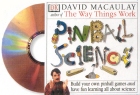
The biggest hit in our family so far was the Pinball Science CD ROM which also came with the kit. Pinball Science Cover The game includes three pinball arenas each having a specific theme (village, island and moon). The science part involves answering questions in order to earn the right to place certain fixtures on each pinball game. Without the fixtures, scores are lower and players are unable to advance to the next level. With each question, the player has the option to "Research Answer". This feature takes the player to the appropriate page in an interesting, humorous and interactive log book which explains the functioning of various devices such as windmills, faucets, hot-air balloons, gears, and rockets. Some of the graphics are a little silly (Wooly Mammoths in bikinis on the island and such), but I didn't find anything really objectionable.

Publisher: 
Dorling Kindersley
Review Date: 
4-4-01
Reviewed by: 
TitleSort: 
Way Things Work Kit